Near Miss Reporting: Examples, Report Fields and Automatic Detection
What counts as a near miss, why reporting programs miss most of them, what a good report contains, and how AI cameras log near misses automatically.
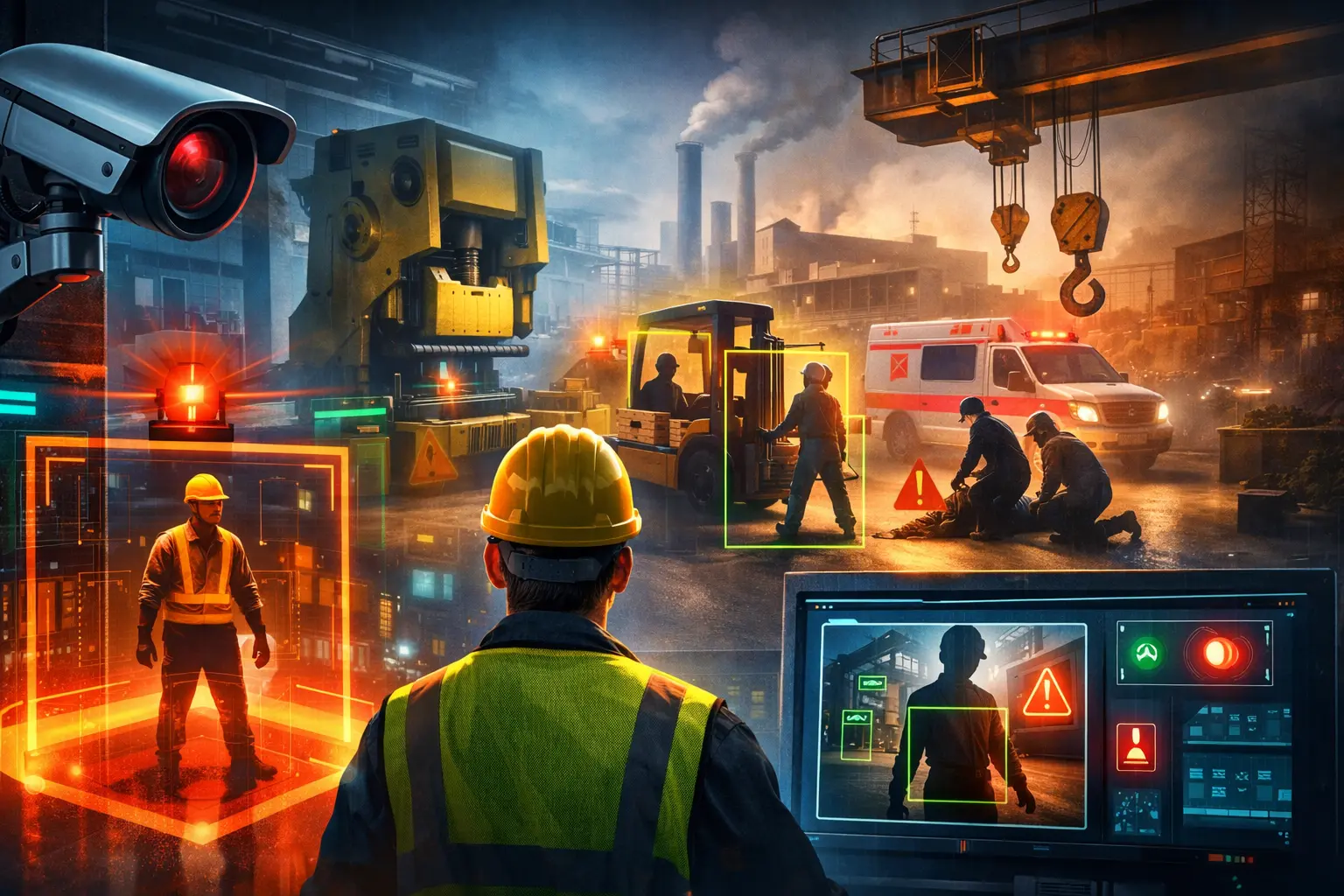
A near miss is an unplanned event that could have injured someone or damaged equipment but did not. A forklift that stops a step short of a pedestrian, a crane load that swings past a worker, a hand pulled back from a press die at the last moment: each is a warning that arrived for free. Near miss reporting is the process of capturing those warnings, investigating them and fixing the cause before the next one becomes an injury. This guide covers what counts as a near miss, why reporting programs miss most of them, what a good report contains, and how ISEE Vision's AI cameras log near misses automatically.
What counts as a near miss?
A near miss is an event where a small change in timing, position or a failed barrier would have caused an injury or damage, but nothing was harmed. The event actually happened; only the outcome was lucky.
Turkish regulation defines it precisely: a near-miss event ("ramak kala olay") is an event at the workplace that had the potential to harm an employee, the workplace or work equipment but did not (Occupational Health and Safety Risk Assessment Regulation, Art. 4(1)(d), Official Gazette 29.12.2012, No. 28512).
Steelmakers use a sharper category. worldsteel defines a potential serious injury or fatality (PSIF) as a near miss that could have resulted in a serious injury or fatality if not for specific barriers or countermeasures, or if one factor around the event had been changed (worldsteel, Safety and health in the steel industry: Data report 2025). Separating PSIF events from minor near misses keeps the high-severity signals from being buried in volume. For the main hazards in steel plants, see our overview of occupational safety in the steel industry.
Why are near misses the most valuable safety data?
Near misses are leading indicators: they show where the next serious injury is likely to come from, before it happens. Injury and fatality rates are lagging indicators; they only describe harm that has already occurred.
The idea goes back to Herbert W. Heinrich, who in 1931 proposed a ratio of roughly 1 major injury to 29 minor injuries to 300 no-injury accidents. Frank E. Bird later extended it, from an analysis of about 1.7 million accident reports from almost 300 companies, to 1 serious injury : 10 minor injuries : 30 property-damage accidents : 600 near misses (Accident triangle, Wikipedia). The exact ratios are disputed and Heinrich's original data has been lost, so modern programs focus less on the arithmetic and more on high-severity potential.
The current industry data supports that focus. worldsteel members reported 67 fatalities in 2024, a fatality frequency rate of 0.016 per million hours worked and a lost time injury frequency rate of 0.70. The same report notes that typically around 20% of incidents have the potential to become serious injuries or fatalities, and that steelmakers should focus on better identifying, managing and reporting near misses to reduce serious harm (worldsteel Data report 2025).
Near miss examples across industries
Near misses follow the hazards. These are the scenarios industrial sites see most often:
- Forklift and pedestrian: a vehicle and a person meeting at a blind corner or a shared aisle. See our guide to forklift safety solutions.
- Overhead crane: a worker walking under or into the swing path of a moving load.
- Presses and dangerous machines: a hand entering the die area during a cycle. The causes are covered in why machine accidents happen.
- Racking and storage: personnel climbing racks or standing next to an unstable stack.
- Missing PPE: entering a hard-hat or high-visibility zone without the required equipment.
- Loading docks and doors: a truck or forklift moving while someone is on the dock or in the doorway.
- Steel and metals: personnel entering hot-metal transfer routes or crane zones during handover. Sector-specific risks are in steel mill safety with AI vision.
Why do near miss reporting programs miss most events?
Most near misses go unreported because the report depends entirely on a person choosing to file it. Nothing was damaged, so the event is easy to forget. Forms are filed at the end of a long shift, or not at all. Workers worry that a report about walking into a crane path will be read as an admission of fault.
Reporting also decays when nothing visibly changes after a report. Programs that launch with a burst of submissions often fade within months if workers never see a corrective action come back.
worldsteel names the symptom directly: if a company's incident triangle is narrower than expected, it could mean that not all incidents are reported (worldsteel Data report 2025).
What should a near miss report include?
A useful near miss report captures enough to prevent a repeat, and nothing that slows the reporter down. The minimum fields:
| Field | Why it matters |
|---|---|
| Date, time, shift | Reveals shift-handover and fatigue patterns |
| Location / zone | Lets trends be mapped on the site layout |
| What happened, what could have happened | Separates minor events from PSIF-potential ones |
| Equipment involved | Forklift, crane, press, conveyor, tool |
| Immediate and root causes | Visibility, marking, missing PPE, procedure, time pressure |
| Corrective action, owner, due date | Closes the loop the workforce is watching |
| Reporter (optional) | Anonymous reporting raises volume |
ISO 45001 requires organizations to manage incidents and nonconformities, including corrective action (clause 10.2), and near miss records feed that process directly. In Turkey, Law No. 6331 requires employers to investigate and report events that had the potential to harm employees, the workplace or equipment (Art. 14(1)(b), Law No. 6331). In Great Britain, RIDDOR requires certain dangerous occurrences, incidents with a high potential to cause death or serious injury listed in Schedule 2, to be reported to HSE even when nobody is hurt (HSE: Dangerous occurrences). Most everyday near misses fall outside that list, so they are captured through the organization's own reporting process.
How do AI cameras capture near misses automatically?
AI safety cameras detect defined hazardous situations the moment they happen and log them, without waiting for anyone to fill in a form. ISEE-CAM, built by ISEE Vision, runs detection on the device itself, keeps sensitive data on site, and turns detections into alerts and daily, weekly and monthly reports.
ISEE-CAM detection modes that map to common near-miss scenarios:
| Near-miss scenario | ISEE-CAM mode |
|---|---|
| Forklift and pedestrian in the same zone | Forklift and personnel presence check |
| Person in a crane operating area | Personnel presence in crane operation area |
| Person in a hazardous machine zone | Hazardous machinery area detection |
| Hand in a press or die area | Hand presence check in risky area |
| Missing helmet or vest | Helmet and vest check |
| Personnel climbing racks | Rack climbing detection |
Each detection can trigger a siren, flasher or PLC output and is recorded with its zone and time. These outputs work together with the machine's existing safety system; they do not replace certified light curtains or safety relays. The wiring and signal chain are explained on the ISEE-CAM PLC integration page, and the case for on-device processing is in edge AI vs cloud for safety systems.
How to combine automatic detection with a just culture
Automatic detection only improves safety if the records are used to fix conditions, not to punish individuals. If every detection becomes a disciplinary case, workers will route around the monitored zones and the data will dry up.
A workable flow:
- Detect: ISEE-CAM logs the event with zone, time and detection mode.
- Review: the EHS team classifies it and flags PSIF-potential events.
- Trend: events are grouped by zone, shift and scenario every week or month.
- Correct: fixes target the zone or process (marking, barriers, mirrors, layout, training) rather than the person.
Camera-based monitoring also involves personal data. Our KVKK, GDPR and ISO/IEC 42001 guide covers the compliance side.
Getting started
Start with the two or three zones where serious near misses are most likely: shared forklift aisles, crane bays, press lines. Measure what is happening there for a few weeks before setting targets; the first numbers are usually higher than manual reports suggested, because events that were always happening are now visible.
To map the highest-risk zones at your site, contact the ISEE Vision team.