Forklift Safety Solutions to Ensure Occupational Health and Safety
This blog post discusses the main causes of forklift accidents in industrial environments and examines the impact of driver negligence and rule violations on occupational health and safety. It explains how ISEE-CAM’s advanced computer-vision-based forklift safety modes (Modes 4–17) prevent accidents through human, vehicle, and zone detection solutions and improve safety in working environments.
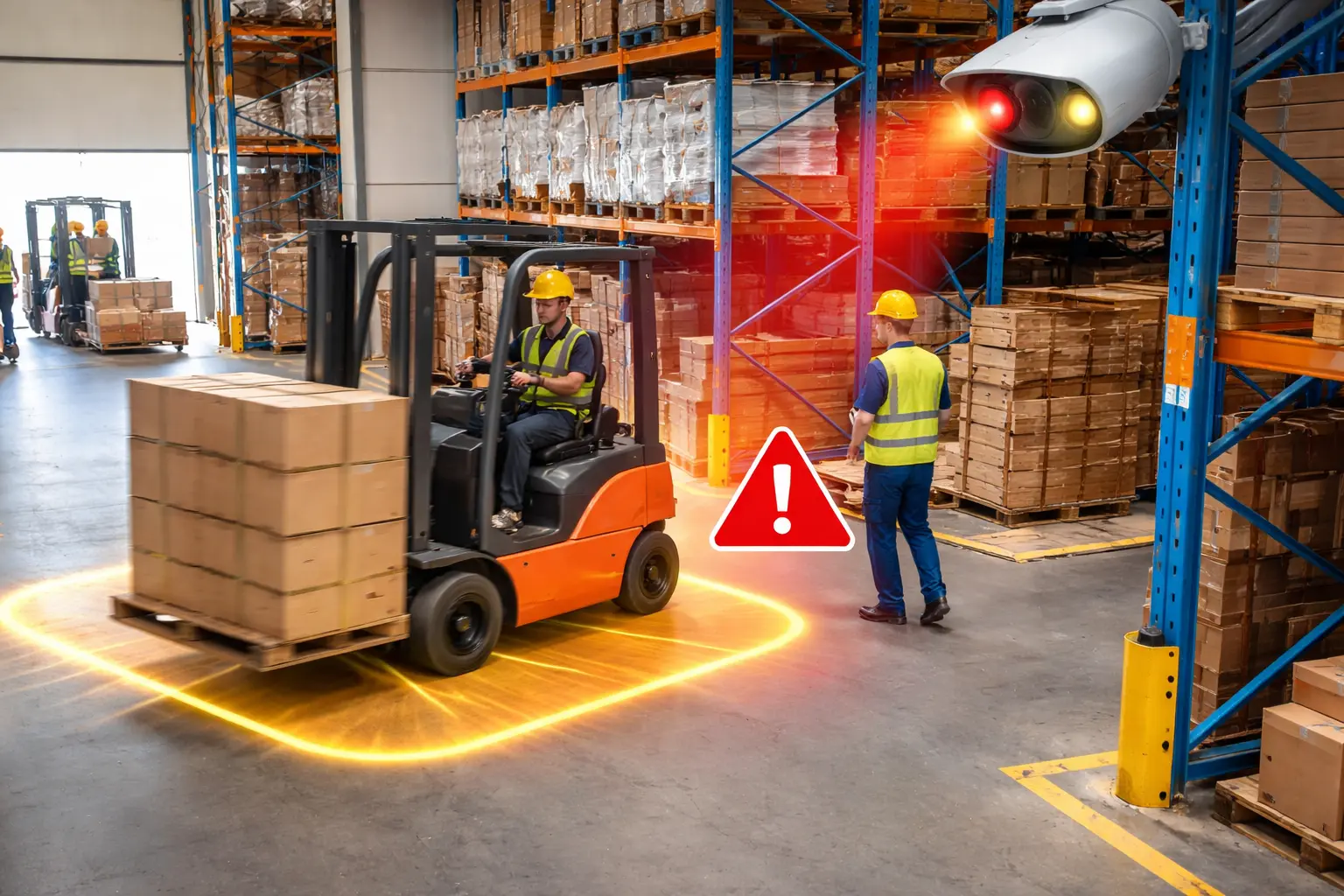
One of the areas where most workplace accidents involving people occur in factories is forklift operating zones. Accidents may happen due to drivers, pedestrians, or external factors. In the most common scenario, accidents are caused by driver negligence. Possible accident scenarios and the most frequent driver mistakes can be listed as follows:
-
Excessive speed
-
Failing to check surroundings
-
Mistakes while placing the load on the forks
In addition to negligence, rule violations are also among the most important causes of accidents.
If we examine these topics one by one;
-
Excessive speed requires drivers to reduce their reaction time proportionally in order to avoid collisions. Actions that cannot be taken at the right time may lead to fatal accidents.
-
Environmental awareness is something every driver must maintain. When forklift drivers fail to check their surroundings due to reasons such as distraction, forklifts carrying hundreds of kilograms may overturn, hit pedestrians, or damage products. The most common situation in which environmental awareness cannot be maintained is when forklifts carrying loads move forward, causing blind spots.
-
Mistakes made while placing the load on the forks may cause the center of gravity of the load to shift, leading to falls during transportation. This situation may also result in fatal accidents.
To prevent these scenarios, ISEE-CAM offers solutions. There are accident-prevention forklift solutions available in Modes 4, 5, 10, 11, 13, 14, 15, 16, and 17. Briefly describing the modes:
-
Mode 4 provides forklift detection to prevent forklifts from causing accidents in areas where forklift presence must be controlled.
-
Mode 5 provides human and forklift detection to prevent accidents in scenarios where people are present in forklift operating areas.
-
Mode 10 defines areas where forklifts are prohibited or allowed only for limited durations and monitors whether permitted vehicles exit after the defined time.
-
Mode 11 defines areas where forklifts and employees are prohibited or allowed only for limited durations and monitors whether permitted vehicles and employees exit after the defined time.
-
Mode 13 involves tracking forklifts under the projection area of overhead cranes, where forklift operation poses a risk, in order to prevent accidents.
-
Mode 14 involves tracking both forklifts and people under the projection area of overhead cranes to prevent accidents.
-
Mode 15 detects forklifts around automatic doors in loading areas and keeps the doors open as long as human presence is detected.
-
Mode 16 detects humans around automatic doors in loading areas and keeps the doors open as long as forklift presence is detected.
-
Mode 17 detects humans or forklifts around automatic doors in loading areas and keeps the doors open as long as human or forklift presence is detected.
For more detailed explanations of the modes, we invite you to visit our page.