Preventive Measures for Overhead / Bridge Cranes
A practical overview of the risks around overhead and bridge cranes, the limits of traditional safeguards, and how AI-powered camera systems can prevent incidents before they happen.
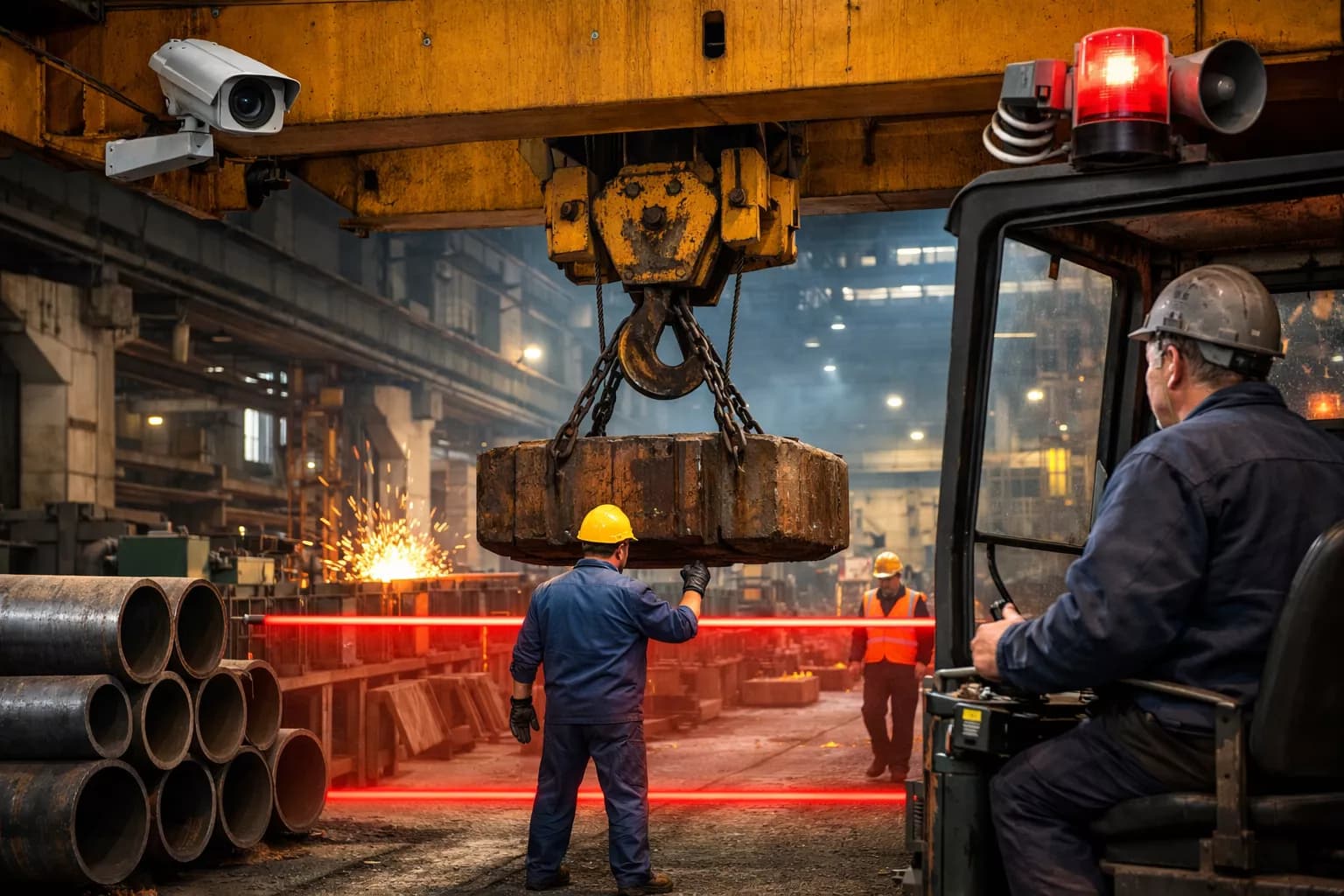
Overhead and bridge cranes are critical equipment used to move heavy loads across industrial sites, from steel mills and automotive plants to cement factories and logistics warehouses. Yet they also carry the risk of severe incidents when a single mistake occurs. A large portion of crane accidents are not caused by mechanical failure, but by the shared space between the load, the operator, and nearby workers.
The primary risk factor for overhead cranes is the moving load itself. Loads weighing tons can swing, shift direction unexpectedly, or create risks of impact, drop, or collision. A worker standing below or near the load often has no chance to react in time. In addition, crane operators frequently control the load remotely with limited visibility. Noise, dust, steam, and complex production flows further reduce human awareness.
Traditional precautions for overhead cranes typically include limit switches, simple area sensors or photocells, and audible/visual alarms. These measures help with mechanical safety, but they leave critical gaps for human safety. Sensors usually cover only a narrow line or point, cannot detect a person under the load, cannot confirm whether someone remains in a risk zone, and create false confidence due to blind spots.
More importantly, these systems often provide passive warnings only. An alarm sounds or a light flashes, but if the operator does not notice or reacts too late, the accident still occurs. Another common issue is that sensors are intentionally or unintentionally disabled, leaving the system present on paper but ineffective in reality.
Common field scenarios include: a worker under the load not being noticed, a swinging load striking a worker, hand–arm–head crush injuries during rigging, personnel entering the danger zone outside the operator’s field of view, and workers unable to escape after a load drop.
The common thread in these incidents is visibility: the hazard was not detected in time. The risk existed, but neither the operator nor the system recognized it early enough.
AI-powered camera systems integrated into overhead cranes fundamentally change this approach. They monitor the entire risk area, not just a single point. The load, its surroundings, and its direction of movement are continuously observed. Camera-based systems detect a person under the load or in a dangerous zone in real time, automatically block crane motion until the area is clear, intervene directly in crane control rather than only issuing warnings, and eliminate blind spots by covering areas outside the operator’s visibility. Safety is no longer left to human attention or reflexes.
Overhead cranes move continuously, impact wide areas, and operate from above. This means fixed sensors cannot practically cover the entire area, the risk zone changes dynamically with load position, and human–load distance changes instantly.
AI cameras analyze this variability in real time. When a person approaches the load, the system warns; when a person enters beneath it, the system generates an immediate stop signal. The system can also detect camera obstruction, shutdown, or manipulation and shift into a safe mode.
With this approach: fatal incidents are prevented, psychological load on operators decreases, safety no longer slows production, unplanned downtime and accident-related costs drop significantly, and most importantly, safety becomes proactive rather than reactive.
True crane safety starts not only with moving the load, but with seeing the person beneath it. Sensors protect a point; cameras understand the entire area. AI-powered crane safety systems do not report accidents after they happen, they stop them before they occur. Today, the real question for facilities is not “Should the crane run?” but “Who must not be there when it runs?” Because cranes carry loads, but responsibility carries human life.