Why do accidents occur in dangerous industrial machines?
A clear and data-driven analysis of why accidents still occur around dangerous industrial machines, despite conventional safety measures. This article explains the hidden limitations of sensor-based protection systems and demonstrates how AI-powered camera technologies deliver a fundamentally safer, more reliable, and production-friendly approach. By focusing on continuous area monitoring, manipulation detection, and limb-level risk analysis, it shows how modern facilities can prevent accidents before they happen—without sacrificing efficiency.
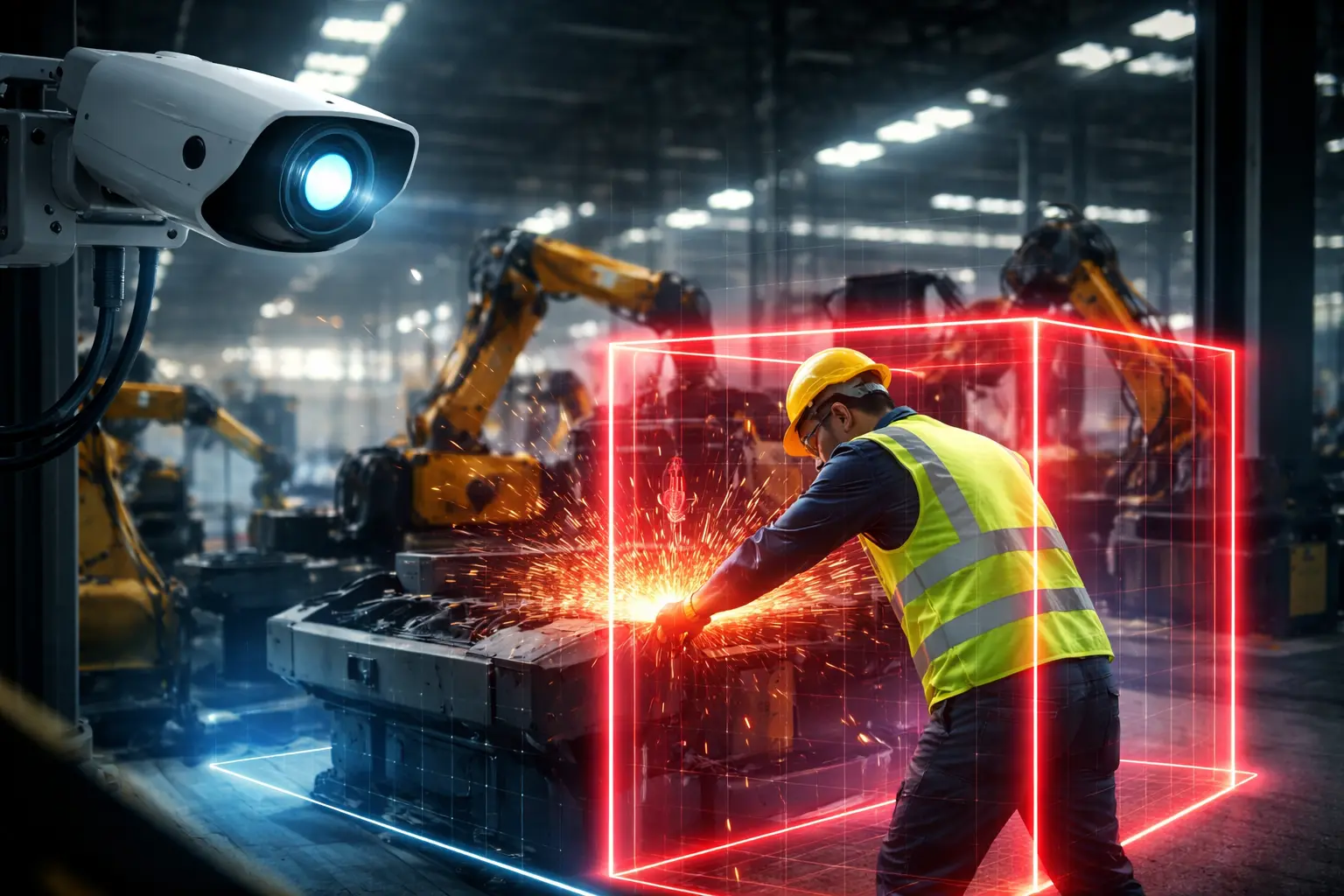
First, it is necessary to clearly define the concept of dangerous industrial machines. Large press machines used in the iron and steel industry, high-capacity grinders in mining and cement plants, and cutting, bending, crushing, and bundling machines in metal processing lines are the main equipment in this category. In addition, conveyor systems, roller mills, robotic production cells, hydraulic presses, and automatic packaging lines also pose serious risks to the human body or limbs in case of uncontrolled contact. All machines that share the same working area with humans, move automatically or semi-automatically, and generate high force, speed, or energy are considered dangerous industrial machines in terms of occupational safety.
The main reason these machines are dangerous is that they must operate in close proximity to workers. During production processes, while such machines are active, employees working nearby or observing the system out of curiosity may unknowingly enter risk zones. The danger does not arise only from unconscious behavior; it is also caused by inattention created by production speed, noise, and complex workflows. For this reason, many facilities use protective systems such as sensors, laser scanners, or light curtains around these machines. However, such solutions cannot always provide complete safety due to blind spots. After a person enters the sensor area, the system may be restarted, and the worker inside can be left alone with the dangerous movements of the machine. This situation causes systems that appear safe on paper to create serious safety vulnerabilities in real environments.
Although sensors, laser scanners, and light curtains are important precautions for occupational safety, they are not sufficient on their own to ensure an adequate level of safety. According to International Labour Organization (ILO) data, approximately 2.3 million people worldwide lose their lives every year due to occupational accidents, and hundreds of millions of workers are injured. A significant portion of these accidents occur in facilities where humans share the same space with heavy and dangerous machinery. Existing sensor-based systems can easily be manipulated by methods such as disabling the laser, covering the sensor, or temporarily deactivating it. This causes the safety system to become practically ineffective despite its presence. At this point, AI-powered camera systems come into play. These vision-based systems not only eliminate blind-spot problems, but also automatically prevent the machine from becoming active as long as a person is present in the working area. Thus, they offer a safety approach that physically stops the risk rather than merely issuing warnings, preventing both accidents and conscious or unconscious manipulations.
So, why do AI-powered cameras operate much more efficiently compared to sensors?
Traditional sensor systems only control a specific passage line or a defined boundary. When a transition is detected in the sensor area, they can stop the system; however, they cannot detect whether the person is still inside the dangerous zone after leaving the sensor line. Moreover, the inherent blind spots of sensors can render the system completely ineffective for a person entering through these areas. This leads to a situation where, despite having sensors in the field, real safety cannot be achieved.
From an occupational health and safety perspective, AI-powered cameras offer a much more holistic and secure approach at this point. A camera system that continuously monitors the area analyzes not only the moment of entry, but also the duration of stay in the area and the moment of exit without any gaps. As long as a person remains in the dangerous zone, the continuous output signal it generates prevents the machine from operating. The system cannot be reactivated until the person has completely left the area. In addition, these systems can detect manipulation attempts such as the camera being turned off, the field of view being blocked, or deliberate interference, and generate fault conditions while clearly warning operators. Thus, they not only prevent accidents but also prevent the intentional disabling of the safety system.
Another critical factor that distinguishes AI camera systems from sensor-based systems in occupational safety is their ability to perform limb-based detection. In every dangerous machine, risk does not begin merely with a person being near the machine; in most cases, risk arises when a specific part of the human body enters the dangerous zone. For example, a worker standing near a small press machine may not pose a problem by itself. However, the same worker extending a hand under the press area can lead to a serious and irreversible occupational accident within seconds. Indeed, a large portion of severe injuries occur as a result of only a single limb of the human body coming into contact with a dangerous zone.
Traditional sensor systems cannot make this distinction. When a person approaches the machine, they stop the system entirely, which causes unnecessary downtime and production losses even when no real risk exists. Especially in mass production facilities, such unnecessary stoppages can lead to annual efficiency losses of 5–10%. AI-powered camera systems, on the other hand, continuously analyze the environment and make much smarter decisions. When a worker approaches the machine, the system first issues a warning; however, when a hand is extended into the press area, it detects only the relevant limb and stops the machine instantly. Thus, intervention occurs exactly at the moment of real risk, while unnecessary slowdowns in production under the pretext of safety are avoided. This approach transforms occupational safety and production efficiency from competing elements into complementary ones.
In conclusion, accidents in dangerous industrial machines usually arise not from the machine itself, but from the inability to adequately control human behavior, the environment, and technology at the same time. Traditional sensor solutions provide protection up to a certain point, but they remain insufficient in the face of the complexity of modern production sites. AI-powered camera systems, by viewing the site as a whole, offer a new-generation safety approach that detects risk at the moment it occurs and intervenes directly. This approach removes occupational safety from being an obstacle to production and makes it a sustainable part of production. Today, the question is no longer “Are these systems necessary?” but rather “Why are these accidents still happening when they are preventable?” Real safety is achieved not only by taking precautions, but by using the right technology in the right place.
Today, occupational safety in production facilities is not only a legal obligation, but also a matter of efficiency, continuity, and corporate responsibility. AI-powered camera systems offer an approach that does not report accidents after they happen, but prevents them before they occur. In this way, both employees are protected and unplanned downtime, production losses, and hard-to-compensate occupational accidents are prevented. Modern facilities no longer leave safety to human reflexes or manipulable sensors; they are managed with intelligent systems that see, decide, and intervene instantly. The real investment is not paying the cost after an accident, but deploying today the technology that ensures accidents never happen.