Occupational Accidents and Industrial Safety in Turkey (2025 Data)
A review of why occupational accidents remain high in Turkey based on 2025 data and how AI-powered camera systems deliver preventive safety in industrial environments.
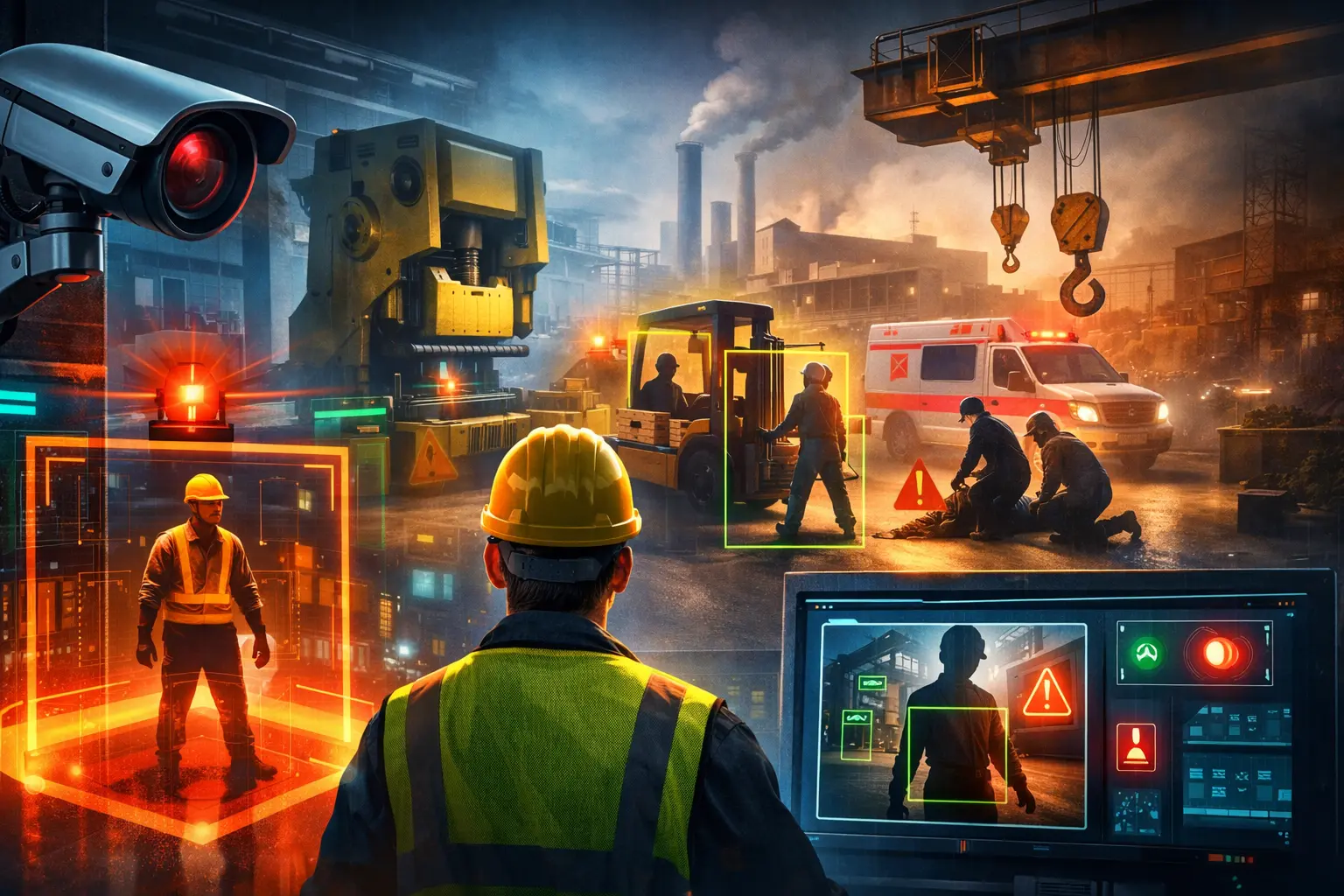
A Preventive Safety Approach with AI-Powered Camera Systems
Occupational accidents in Turkey are not merely an OHS topic for industrial producers; they directly affect human life, production continuity, and legal responsibility. The latest 2025 data indicate that workplace accidents remain at high levels and that the need for preventive solutions in industrial safety continues to grow. According to independent reports, more than 2,100 workers lost their lives while working in Turkey in 2025. This equals an average of 5–6 workplace accident deaths per day.
This picture shows that accidents are not random; they largely stem from predictable and preventable risks.
Why Are Occupational Accidents Still High in Turkey?
The main reason is that people and hazardous industrial machines share the same areas in production sites, and risks are not detected early enough. Heavy industry facilities, production lines, and logistics areas are environments where high-energy machines operate and error tolerance is extremely low.
Human–Machine Interaction in Industrial Sites
A significant portion of accidents in areas with press lines, conveyor systems, overhead cranes, freight elevators, and forklifts occur because a person approaches a danger zone or remains there unnoticed. In Turkey, most fatal or severe workplace accidents are caused by crushing, entrapment, and machine contact.
Blind Spots and Lack of Perception
Traditional safety measures focus on fixed points. But production sites are not static; people move, machines operate in different modes, and risk zones constantly change. This creates blind spots and delays the detection of human presence. Many accidents happen precisely in these blind spots.
How Do Hazardous Machines Cause Occupational Accidents?
Hazardous machines are not the sole risk; the real risk is failing to manage human presence around them. Presses, conveyors, and cranes create dynamic safety zones while operating. When these zones are not clearly detected on site, accidents become inevitable.
Risks from Presses, Conveyors, and Cranes
Most accidents linked to these machines do not result from a single sudden mistake; they stem from risky conditions that persist unnoticed. A person enters the danger zone, remains there, and the machine restarts while the person is still in a hazardous position.
The Limitations of Fixed Sensor Systems
Light curtains and laser sensors provide protection at specific points, but they cannot cover every scenario in changing site conditions. Areas outside sensor coverage become the most frequent accident zones.
How Do AI-Powered Camera Systems Prevent Accidents?
AI-powered camera systems shift industrial safety from point-based protection to area-based and contextual safety. These systems do not only react to a line breach; they monitor the entire interaction between people and hazardous zones.
Area-Based Detection and Real-Time Risk Analysis
ISEE Vision’s camera-based image processing solutions analyze human presence, position, and relationships with risk zones in real time. When a person approaches or remains in a hazardous area, the system detects it immediately.
Stopping the Machine Until Risk Is Fully Removed
When risk is detected, the system does more than issue a warning; it integrates with automation systems to stop machine motion and does not allow restart until the risk is completely removed. This prevents “last-second” scenarios before they happen.
Proven Preventive Impact in the Field
ISEE Vision solutions are actively used in many production facilities across the steel, automotive, packaging, and heavy industry sectors in Turkey. These AI-powered camera systems have detected potential accident scenarios in real time and prevented them before they became incidents. Unauthorized entry into hazardous zones, human presence under machines, and risky proximity have been detected and acted upon instantly on site.
Behavior-Based Risks and Safety Culture
Analyses show that more than 80% of workplace accidents are linked to unsafe behavior and insufficient control mechanisms. These behaviors often occur repeatedly well before the accident itself.
Behavior Analysis with AI
Field data from reference facilities using ISEE Vision systems show that early detection of repeated risky behaviors plays a critical role in preventing accidents. This approach transforms safety from a reactive response into a predictive and managed system.
A New Standard for Industrial Safety in Turkey
Financial and moral compensation lawsuits following accidents create serious costs for businesses. But these processes begin after the accident. The goal of modern safety is not to report accidents, but to prevent them from ever happening.
ISEE Vision applies its AI-powered camera solutions not only in theory but in real production environments under demanding industrial conditions. Field experience in reference sites clearly shows that most accidents can be prevented through accurate detection and timely intervention.
Every year in Turkey, thousands of workers lose their lives or suffer permanent injury due to workplace accidents that are largely predictable. Most of these accidents are not caused by machine failure but by the inability to accurately detect human presence and risk zones. Today, ISEE Vision solutions operate actively in reference facilities across sectors in Turkey and help stop potential accidents at the very first step. Because real safety is achieved not in reports, but on site, at the right time, with the right intervention.