Line image
INPUT · RAW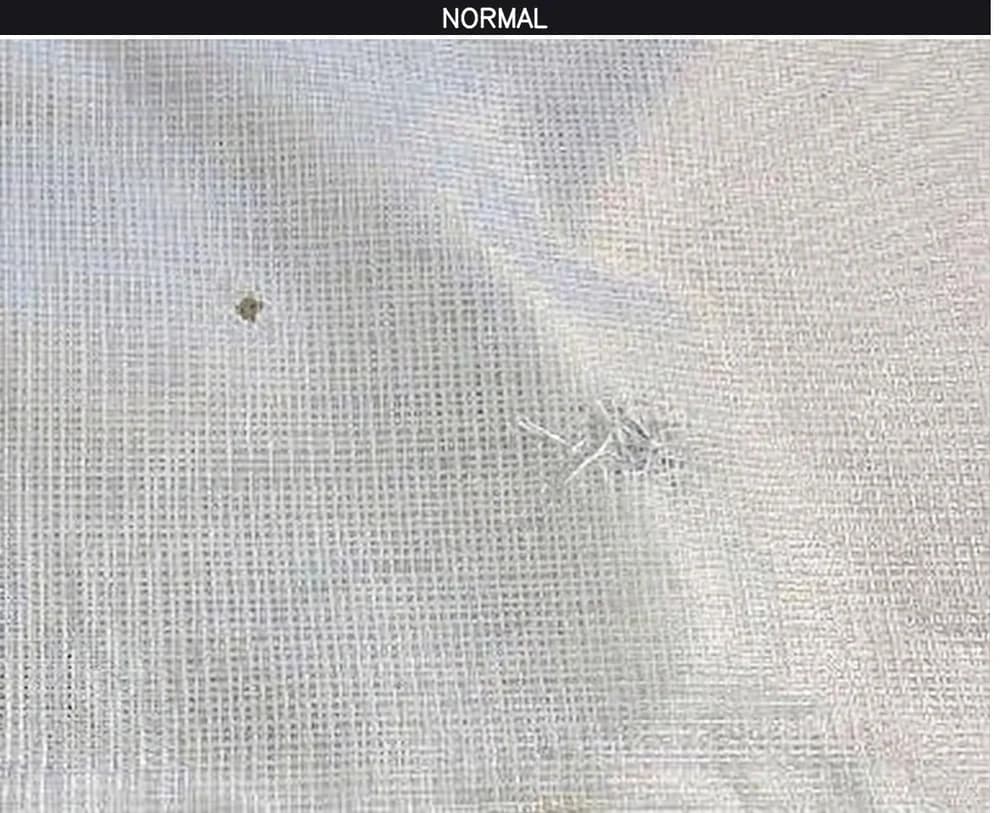
Unprocessed camera image of the fabric passing through the line.
A light-isolated edge station installed on the weaving, knitting, printing, or coating line compares the fabric meter by meter with a learned perfect reference in real time. It catches holes, floats, stains, and pattern drift, records the position of each defect by the meter, and raises an immediate alert.
 LIVE · LINE 01INSPECTION ACTIVEFABRIC SURFACE · CONTINUOUS LINE
Technical Specifications
| Installation | Light-isolated enclosed station above the line |
|---|---|
| Inspection method | Real-time comparison against a perfect reference fabric |
| Processing | Edge / on-device — no cloud dependency |
| Inspection continuity | Every meter, continuous — no sampling |
| Detected defects | Holes, floats, broken yarn, warp / weft faults, stains, oil marks |
| Print and color | Pattern drift, print distortion, color tone deviation |
| Line speed | Up to 450 m/min |
| Positioning | Anomaly position logged by the meter via encoder |
| Anomaly threshold | Customer-adjustable sensitivity and acceptance limit |
| Defect classification | Type-based labels (hole / float / stain / print drift, etc.) |
| Action outputs | Line stop · siren / light · PLC / relay · operator notification |
| Logging & reports | Images stamped with meterage and time · per-roll quality report |
| Visual evidence | Original image + anomaly heatmap + confidence score |
| Integration | Added to an existing weaving / printing line as an independent station |
Reference · Comparison
A reference fabric meeting your acceptance criteria is introduced to the system first. That reference holds the weave density, pattern structure, and color tone. The fabric on the line is compared against this profile without interruption; deviations are marked on an anomaly map, converted into a confidence score, and matched with encoder data so the exact meter of the roll is recorded.
Unprocessed camera image of the fabric passing through the line.
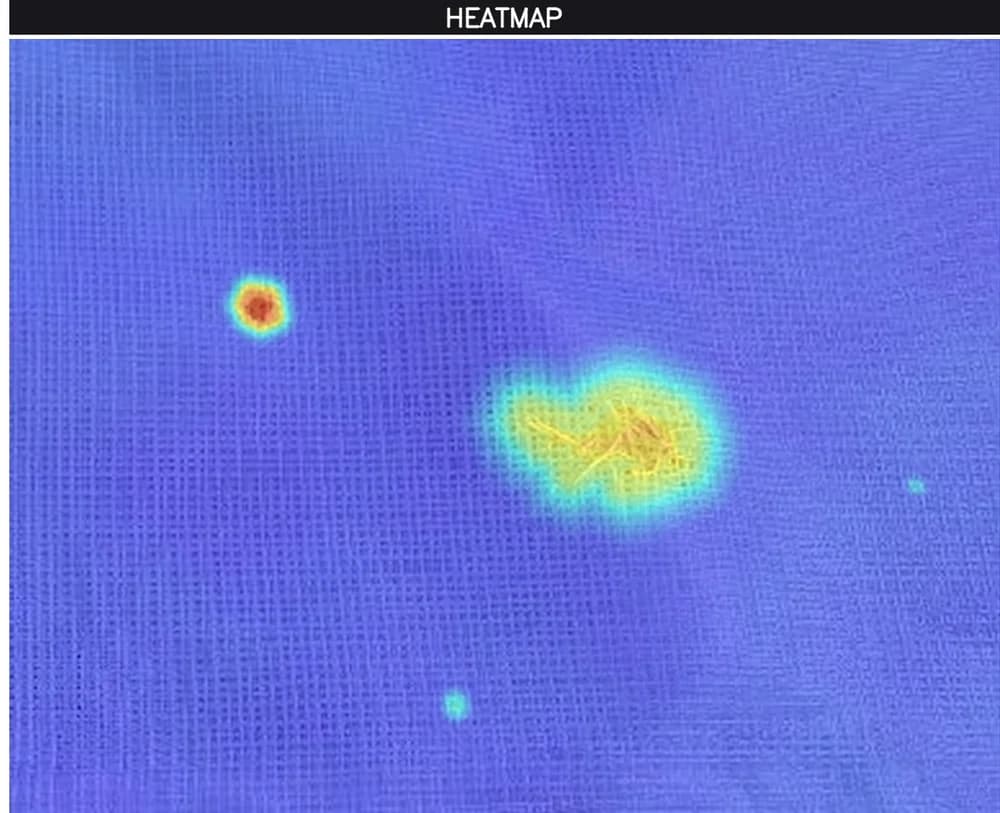
The deviating region is marked, its score checked against the acceptance threshold, and matched with the meterage.
Core Capabilities
A perfect fabric is learned and every deviation per meter is measured against it.
The encoder records the exact meter of the roll where the defect occurred.
On-device analysis preserves low latency and data privacy.
Continuous inspection at line speeds up to 450 m/min, with no slowdown.
Pattern drift, repeat errors, and color tone deviation are tracked.
Sensitivity and acceptance limits are configured per fabric type.
Defects are labeled as holes, floats, stains, broken yarn, and print drift.
The source image, heatmap, and confidence score are stored together.
A defect map is produced for every roll and fed into the cutting plan.
How It Works
The perfect fabric's texture, pattern, and color profile is saved with the product code.
The fabric is imaged continuously under controlled lighting inside the enclosure.
Deviations are mapped and converted into a confidence score.
When the threshold is exceeded, the system alerts, records the position in meters, and reports it.
From the Field · Detections
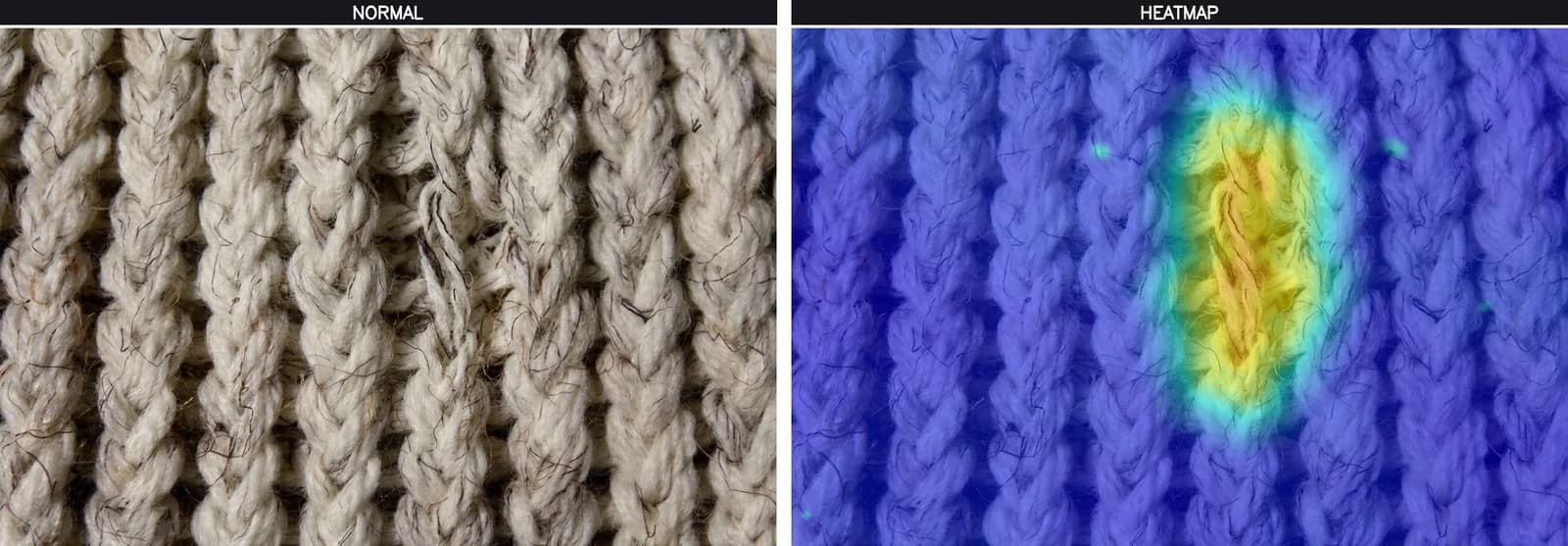
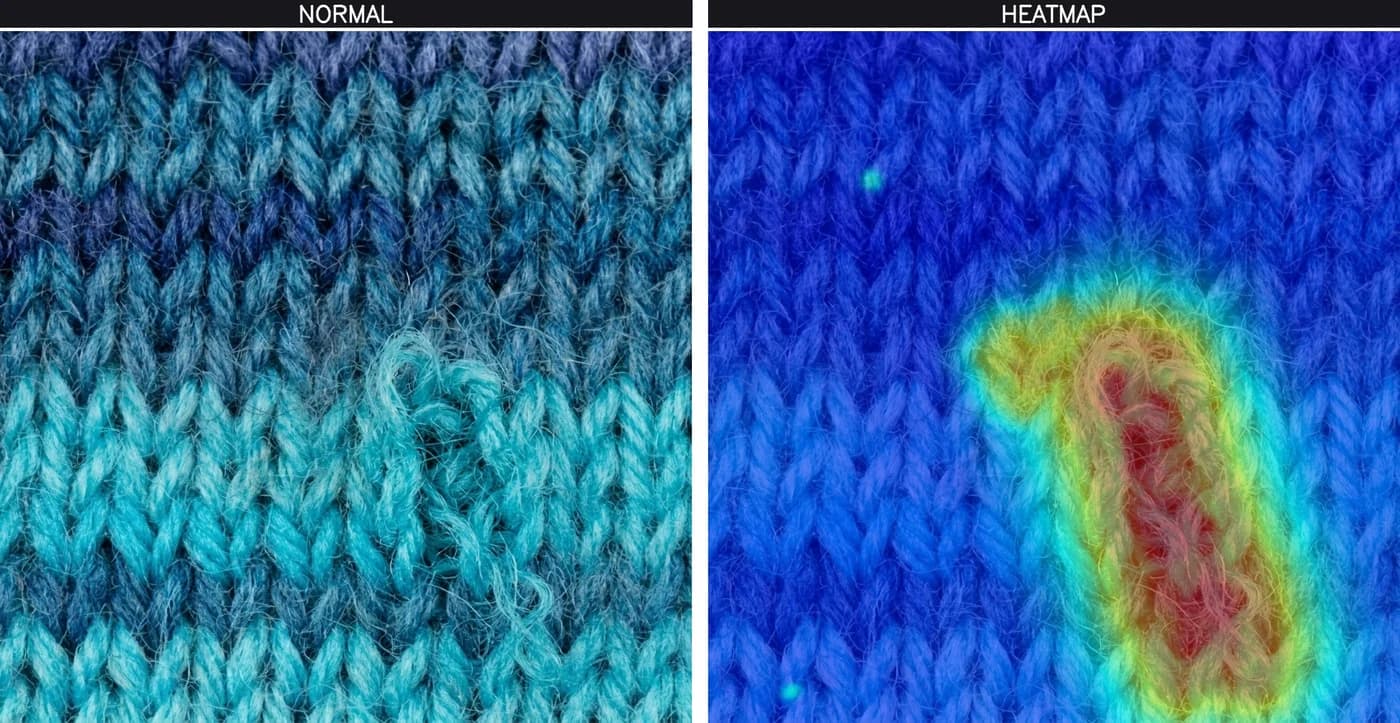
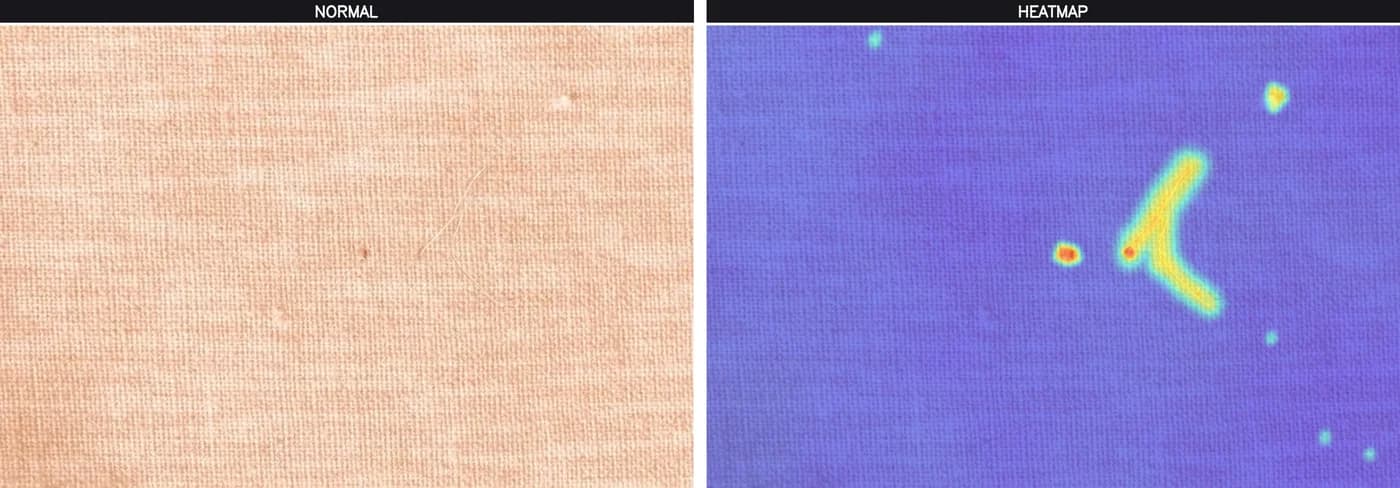
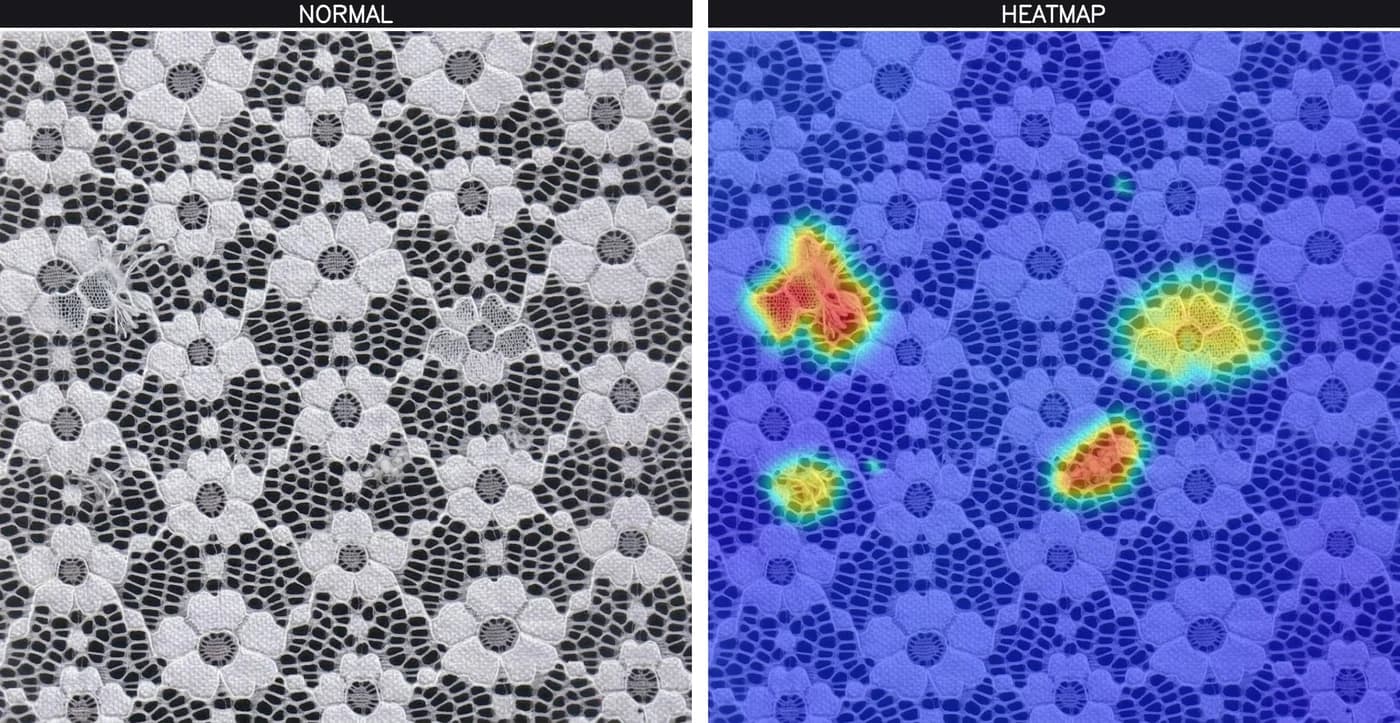
The examples below show anomaly heatmaps produced by the system.
ORIGINAL + HEATMAP
Weave float — loss of continuity in the warp direction.
ORIGINAL + HEATMAP
Oil stain — local contamination on the surface.
ORIGINAL + HEATMAP
Pattern drift — position deviation in the print repeat.
Detected Anomalies
Structure, surface, and pattern are all inspected in the same pass, against the same reference.
Holes, floats, broken yarn, and warp–weft faults; deviations that break the fabric structure.
Stains, oil marks, tone degradation, and surface defects caused by foreign matter.
Pattern drift, repeat errors, color tone differences, and print distortions.
Action Outputs
Alert only, alert plus stop, or full automation—the system is configured for your production scenario.
Automatically stops the line on critical defects through relay / PLC integration.
Immediately warns the operator with a siren or alarm.
Signals with a lamp or tower light.
Shows the alert, defect image, and meterage on screen.
Provides outputs compatible with existing automation.
Time- and meterage-stamps detections and includes them in reports.
Line Integration
The enclosure is positioned directly above the line.
Meterage data is taken from the line and matched with the anomaly position.
Stable images are captured independently of ambient light.
PLC and relay outputs connect to existing infrastructure.
Any product that travels along a conveyor or extrusion line, or is checked in a fixed cell, can be inspected. Defects, presence–absence, dimension, angle, shape, fill level, and surface — in short, every deviation beyond the defined standard is detected.
Configured for your line
Tell us about your fabric, line speed, and acceptance criteria. We'll propose the right installation, thresholds, and action scenario.