CCTV vs AI camera: factory footage records, it doesn't prevent
CCTV vs AI camera in a factory: one records what happened, the other acts while it happens. See how they differ, where each belongs, and how to combine them.
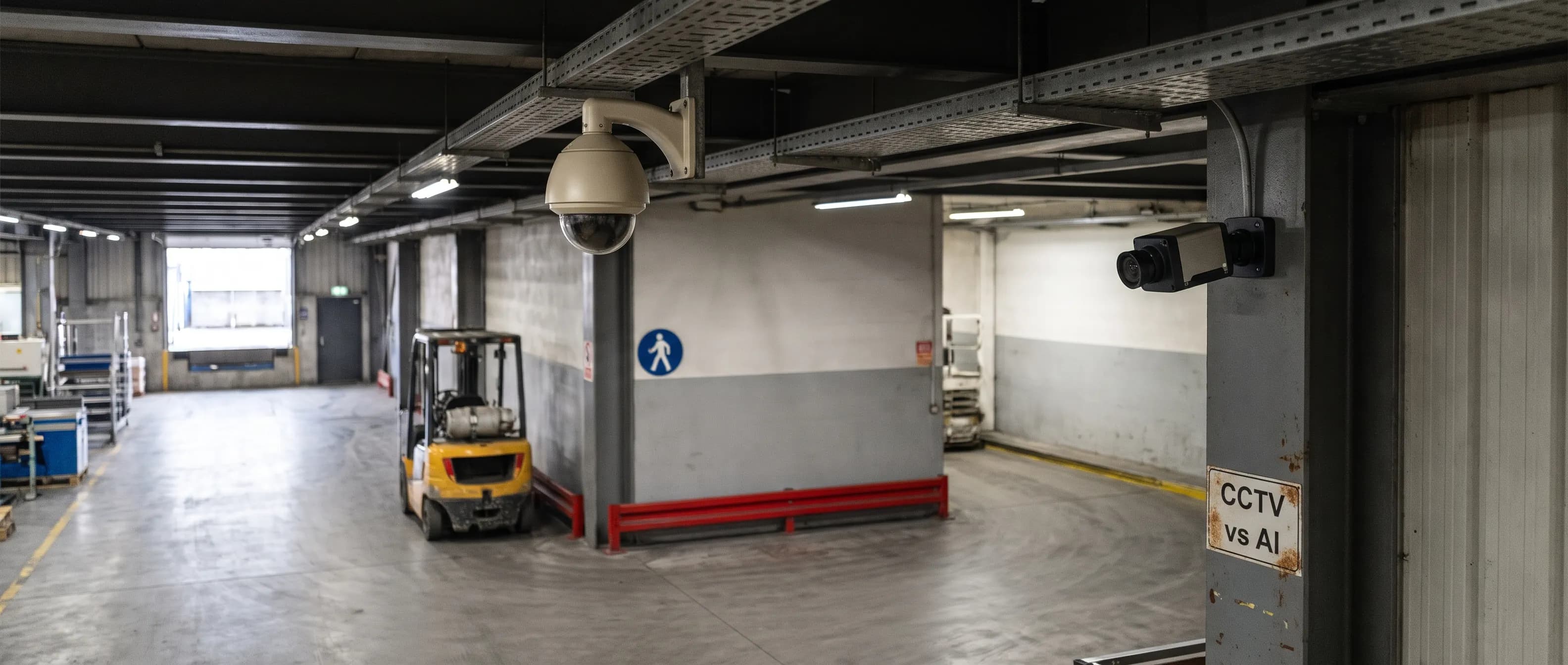
CCTV vs AI camera is not really a question of image quality. It is a question of what the camera does. CCTV records what happened. An AI camera detects what is happening and acts on it while there is still time.
The morning after an incident, the EHS manager pulls the footage. It is sharp: the forklift comes around a blind corner, the pedestrian steps into the aisle looking at a phone. Everything is on record. The incident still happened.
Most plants already have cameras. The gap is not coverage; it is function. This guide explains what each system is for, why one does not replace the other, and where AI cameras should go first.
How big is the problem?
According to the U.S. Bureau of Labor Statistics, 5,070 workers died from work-related injuries in 2024, one every 104 minutes. Transportation incidents were the most frequent fatal event, with 1,937 deaths (BLS Census of Fatal Occupational Injuries, 2024). The same release counts 369 deaths in 2024 from pedestrians struck by motorized vehicles, up 19% from 2023.
A plant with cameras still has incidents. Footage shows how an incident happened; it does not prevent it. And the cost to the business goes beyond the human one: lost production, investigations, claims, and a lasting hit to the team.
What does factory CCTV do, and what can't it do?
CCTV records video and puts it on a screen. It deters theft, watches gates and entrances, and lets you reconstruct an event afterward. For security and evidence it is essential. For worker safety it has three limits.
- Nobody is watching: one guard cannot keep eyes on 30 feeds, and most plants have no one at the monitors at all. Even dedicated operators focus on one screen; a study of live CCTV operators found they spent more than 90% of their time on a single spot monitor (Stainer, Scott-Brown and Tatler, 2013).
- No response: CCTV cannot stop a machine, sound a horn, or switch a warning light.
- No data: it cannot tell you how many people entered without a hard hat or how many near misses happened at a given corner. Finding out means hours of playback.
In short, CCTV answers "what happened?" Safety teams need an answer to "what is happening right now, and how do I stop it?"
How does an AI camera work?
An AI camera recognizes people, forklifts, hands, hard hats, and vests in every frame. When a rule is broken inside a zone drawn for that site, it triggers an output directly: a horn, a beacon, a PLC signal, or a machine-stop request. It does not wait for someone to look at a screen.
ISEE-CAM does this on the camera itself, without sending video to the cloud. Alert-to-output latency is under 100 ms. It has three outputs and one input over dry contact, and events can also reach the PLC and SCADA layer over OPC-UA, Modbus TCP, and REST API. Wiring details are on the ISEE-CAM PLC integration page.
One limit up front: an AI camera works alongside the machine's safety system, not in place of it. Certified light curtains, safety relays, and interlocks stay. The camera is an extra layer that watches the area they cannot see.
CCTV vs AI camera: side-by-side comparison
The two can look alike on the wall. They do different jobs.
| Criterion | Factory CCTV | AI camera (ISEE-CAM) |
|---|---|---|
| Main job | Recording and evidence | Real-time detection and action on the floor |
| Monitoring | Depends on human eyes | Continuous, automatic |
| Response time | Minutes, or never | Under 100 ms from alert to output |
| Machine and alarm connection | None | PLC, horn, beacon via dry-contact outputs |
| Reporting | Manual playback | Event logs plus daily, weekly, and monthly reports |
| Cloud dependency | Depends on the setup | None; processing on the device |
| Environmental rating | Varies by model | IP69K, −20 to +70 °C |
The row that matters most is response time. Footage is reviewed after the incident. An output switches the light on before it.
CCTV vs AI camera in the hierarchy of controls
NIOSH ranks hazard controls from most to least effective: elimination, substitution, engineering controls, administrative controls, and PPE (NIOSH Hierarchy of Controls). In Europe, the OSH Framework Directive sets similar principles of prevention, including combating risks at source, adapting to technical progress, and giving collective protection priority over individual protection (EU-OSHA, Framework Directive 89/391/EEC).
A recording camera does not sit on that ladder at all. It produces evidence after the fact. A system that detects a person in a hazard zone and pushes a warning or stop request to the floor acts where the risk arises and protects everyone in the zone, not only the person wearing a tag. That does not make it a legal requirement. It does help you explain, in a risk assessment, which investment serves which principle.
Isn't analytics software on existing cameras enough?
A common pitch goes: "We connect to your existing CCTV, no new hardware needed." That approach has real value. It turns existing footage into PPE compliance rates, zone violation counts, and trend reports. For compliance tracking and audits, it is a strong tool.
Ask three questions, though. First, where does the alert go? On most software platforms, it lands on a dashboard, an email, or a phone, so it still waits for a person. Second, where is the video processed? If it goes to a server or the cloud, network latency is added, and when the link drops the alert stops too. Third, is the existing camera in the right place? A security camera usually points at a door or an aisle, not at the front of a press or the load zone under a crane.
So the real question is not "new camera or software?" It is "how fast does the warning reach the person at risk?" We break that down second by second in AI safety camera alerts: a notification or an action?
When is CCTV alone enough?
Not every area needs an AI camera. Parking lots, perimeter security, office entrances, and shipping-door records are CCTV's home ground. There, the goal is usually deterrence and evidence.
An AI camera earns its place where risks develop in seconds and can injure someone directly: moving vehicles, moving loads, and moving machinery. If any one of those shares space with people, that spot needs more than a recording.
You don't need to rip out your CCTV
The best setup runs both. CCTV keeps recording the wide area and doing its security job. AI cameras go where risk concentrates: blind corners, press fronts, crane load zones, freight elevator doors, and forklift-pedestrian crossings.
A practical starting point:
- Pull the last 12 months of incident and near miss records.
- Mark the three to five spots where events cluster on a floor plan.
- For each spot, write down who is at risk, from what, and at which moment.
- Put the first AI cameras there and decide which output triggers what.
Your existing footage helps here too. Video of past events shows where to draw zone boundaries and how much warning distance you need.
Industrial camera vs standard security camera
A plant floor is not an office corridor. Water, dust, vibration, oil mist, and temperature swings take consumer-grade cameras out quickly. An industrial camera is built for those conditions.
ISEE-CAM is rated IP69K, runs from −20 to +70 °C, and is tested for vibration to ISO 16750-3. It captures 1920 × 1080 video at 25/30 frames per second. That is what lets it work in a food plant washdown area or near a hot zone in a steel mill.
Which facilities is it for?
- Warehouses and distribution centers where forklifts and pedestrians share aisles; see our blind spot monitoring system guide.
- Presses, shears, and robot cells with amputation risk. The camera does not replace the light curtain; it watches the surrounding area the curtain does not cover.
- Steel mills and heavy industry with overhead cranes. People entering the load zone are detected, an alarm sounds, and a stop signal goes to the crane; more in suspended load safety.
- Any production area where PPE use has to be checked. Hard hat and vest checks produce both instant warnings and shift-level reports.
FAQ
What is an AI camera?
A camera that recognizes people, vehicles, and protective equipment and triggers its own alarm or output when a rule is broken. A standard security camera only records; an AI camera acts in the moment.
Does an AI camera replace an existing CCTV system?
No. CCTV keeps recording the wide area. AI cameras are added where risk concentrates, such as blind corners, press fronts, and crane load zones.
Does an AI camera work without internet?
ISEE-CAM does. Processing happens on the camera, so detection and floor warnings continue if the connection drops.
What about privacy and GDPR?
Video that never leaves the site lowers the risk, but obligations such as informing workers and setting retention periods still apply. The European Data Protection Board's Guidelines 3/2019 on processing personal data through video devices are the reference for EU sites.
Conclusion: recording is not enough, add a layer
Factory CCTV tells you what happened. An AI camera switches the light, sounds the horn, and signals the PLC while it is happening. Recording is necessary, but it is not enough; you need a layer that reaches the floor at the moment of risk.
If you want to identify your highest-risk spots and see which detection mode and output fit each one, contact us.
Contact: info@isee-vision.com · +90 216 455 95 44
Sources
- Census of Fatal Occupational Injuries Summary, 2024 — U.S. Bureau of Labor Statistics
- Stainer, Scott-Brown and Tatler (2013), Looking for trouble: a description of oculomotor search strategies during live CCTV operation — Frontiers in Human Neuroscience
- Hierarchy of Controls — NIOSH
- The OSH Framework Directive (89/391/EEC) — EU-OSHA
- Guidelines 3/2019 on processing of personal data through video devices — European Data Protection Board