Blind spot monitoring system: a guide for forklift sites
How an industrial blind spot monitoring system works: where forklift blind spots form, OSHA and EU rules, and how mirrors, sensors, tags and AI cameras compare.
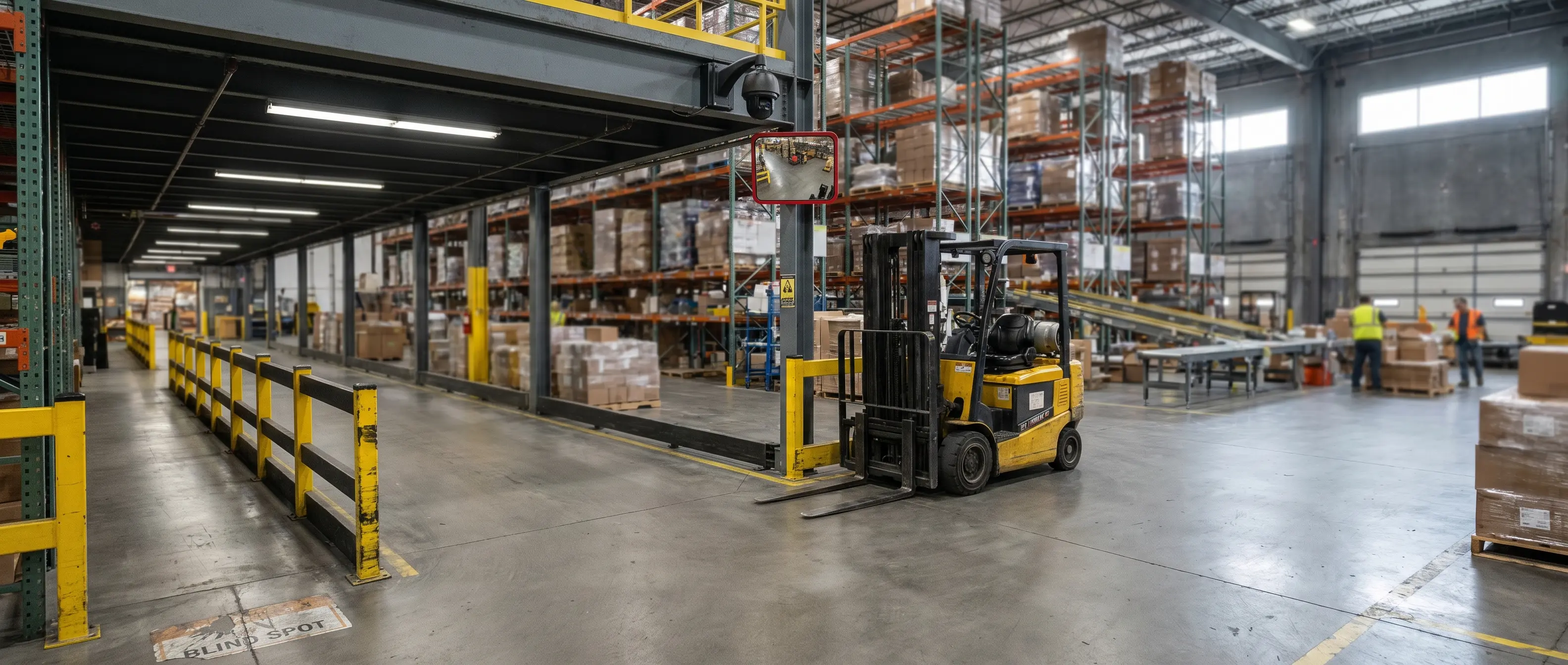
A blind spot monitoring system in a car watches the lane beside you and lights an icon in the mirror. A blind spot monitoring system in a plant has a harder job. The hidden zone is a rack end, a dock door or the space behind a counterbalance truck, and both sides of the risk are moving: the forklift and the person on foot.
This guide covers where blind spots form on an industrial site, what OSHA and EU rules expect, how the common technologies compare, and what to ask before you buy one.
What is an industrial blind spot monitoring system?
An industrial blind spot monitoring system detects people or vehicles in a zone a driver cannot see directly, then warns the driver, the pedestrian or both, and in some cases sends a signal to the vehicle. It can watch a fixed blind corner or the area around a moving truck.
The idea comes from road vehicles. Transport Canada describes car systems that use cameras, ultrasonic sensors or radar and warn through lights in the mirror or door, sounds, or steering wheel vibration (Transport Canada). It is also frank about the limits: the system may miss motorcycles or very fast vehicles, and it does not replace the driver's attention and judgment.
Does blind spot monitoring reduce crashes?
On the road, yes. The Insurance Institute for Highway Safety found 14% fewer lane-change crashes in vehicles with blind spot detection. Injury lane-change crashes were 23% lower, though that second result was not statistically significant (IIHS, 2017).
The lesson for plants: a timely warning about something you cannot see cuts collisions. Indoors, the hard part is reaching the right person without crying wolf.
Where blind spots form on an industrial site
Blind spots cluster where racking, columns, walls, doors or the load itself break the line of sight. Start your walk-through here:
- Rack-end intersections: where a picking aisle meets a main aisle, tall racking hides the truck and the pedestrian until the last meter.
- Doorways and building corners: trucks moving between halls turn through doors or around corners. High-speed doors hide traffic until they open.
- Dock approaches: trailers parked tight against the building form a wall, and a truck leaving the dock cannot see the staging area.
- Reversing: on large trucks with bulky loads, the area behind the counterweight is hard to check.
- Loads that block the view: a tall load on the forks hides everything in front.
- Truck-to-truck crossings: not every blind spot incident involves a pedestrian; another forklift in a hidden lane is just as dangerous.
The stakes are well documented. The US Bureau of Labor Statistics counted 614 workers killed in forklift-related incidents between 2011 and 2017 (BLS). Our forklift accident statistics post breaks the numbers down further. Reversing deserves special attention: the UK Health and Safety Executive says nearly a quarter of all deaths involving workplace transport happen during reversing (HSE).
What OSHA and EU rules expect
In the United States, OSHA's powered industrial truck standard is direct about obstructed views. 29 CFR 1910.178(n)(4) requires the driver to slow down and sound the horn at cross aisles and other locations where vision is obstructed, and to travel with the load trailing if it blocks the forward view. Paragraph (n)(6) requires the driver to look in the direction of travel and keep a clear view of the path (OSHA 1910.178).
In the EU, the Work Equipment Directive 2009/104/EC sets the baseline. Annex I, point 3.1.6(d) says that where the driver's direct field of vision is inadequate to ensure safety, adequate auxiliary devices must be installed to improve visibility (Annex I). Annex II requires traffic rules for equipment moving around a work area (2.2) and organizational measures to keep workers on foot out of the area of operation of self-propelled equipment (2.3) (Annex II).
Neither text names a technology. A blind spot monitoring system is one way to provide an "auxiliary device" and back up your traffic rules, alongside mirrors, speed limits and separation. For the full layered approach, see our guide to traffic management in industrial areas.
Why mirrors, spotters and floor lines hit a ceiling
Traditional controls work, partly. They all share one weakness: they depend on people doing the right thing every time.
Convex mirrors are cheap and need no power. But the driver has to look. The image is small and distorted, mirrors get dirty, and they give the pedestrian no warning at all.
Spotters protect one crossing, on one shift, while they stay focused. Most sites have more blind zones than spare people, and the spotter stands in the same hazard.
Floor markings work when everyone follows them. Visitors and contractors may not know them, and under production pressure even trained drivers cut corners. A line informs. It does not stop anyone.
HSE puts it plainly for reversing: no single measure is likely to be enough.
Blind spot monitoring technologies compared
Every system follows the same pattern: a sensor notices something in the hidden zone, logic decides whether it is a risk, and an output warns someone. The differences are what they detect, whether they can tell a person from a pallet, and who gets the warning.
- Blue or red spot lights: project a mark on the floor ahead of or behind the truck. Useful for pedestrians, but always on, detect nothing and tell the driver nothing.
- PIR warning lights: flash when something moves nearby. They react to any motion, so drivers learn to ignore them.
- Ultrasonic and radar sensors: beep near any obstacle and work in the dark. They cannot tell a person from a rack, pallet or wall, which drives false alarms.
- UWB and RFID tags: each worker wears a tag; readers on trucks or anchors measure distance. They work through walls, but anyone without a working tag is invisible: visitors, contractors, a worker with a flat battery. Our UWB vs AI camera comparison goes deeper.
- LiDAR: maps geometry precisely but does not classify. A pallet, a person and fallen scrap can look the same.
- AI cameras: a camera aimed into the blind zone analyzes video on the device, classifies people and forklifts separately, and switches a light, siren or control signal only when the defined rule is met.
| Criterion | Convex mirror | Spot light | Ultrasonic / radar | UWB tags | AI camera |
|---|---|---|---|---|---|
| Detects anything? | No | No | Yes | Yes | Yes |
| Person vs. object? | Driver-dependent | – | No | Tagged only | Yes |
| Covers untagged visitors? | If seen | If seen | Yes | No | Yes |
| Warns the pedestrian? | No | Yes | Rarely | Tag vibration | Light or siren |
| Can slow the truck? | No | No | Some products | Some products | With on-truck hardware |
| Main limit | Must be checked | No detection | False alarms | Untagged people | Needs line of sight and light |
Cameras have limits too: they cannot detect what they cannot see, so mounting position, lens cleaning and backlight matter.
Six questions before you choose
- Is the hazard fixed or moving? A fixed corner suits a fixed system; the zone behind a truck suits an on-truck system.
- Are there untagged people on site? Heavy visitor or contractor traffic leaves gaps in tag-based coverage.
- Who needs the warning? The driver, the pedestrian, or both?
- Is a warning enough? At busy crossings you may want a slow-down signal as well as a light.
- Will the hardware survive? Check the ingress rating and temperature range against cold stores, washdown areas or foundries.
- Does it connect? A system that cannot talk to traffic lights, PLCs and door controls is just an alarm box.
How the ISEE-CAM blind spot warning works
ISEE-CAM is an industrial AI camera that runs detection on the device. Video stays on site, there is no cloud dependency, and alert-to-output latency is under 100 ms.
The ISEE-CAM blind spot warning (Mode 22) works in three steps:
- It watches the side the driver cannot see. At a corner, the camera looks down the hidden aisle; on a truck, it faces backward. It detects people and forklifts up to 20 m away.
- It decides whether the way is clear. You draw blind spot zones in the web interface. On a truck, graded green, yellow and red zones mark rising risk. Swinging doors, pallets and shadows do not change the light.
- It switches the light and can slow the truck. A dry-contact output turns the traffic light to warning or sounds an alert in the cab. With additional on-truck hardware, compatible forklifts can be slowed or stopped.
The camera has three dry-contact outputs and one input, and talks to PLCs and SCADA over OPC-UA, Modbus TCP and REST API; see PLC integration for wiring. The housing is IP69K and rated from −20 to +70 °C. Events feed daily, weekly and monthly reports, so you can see which corners generate the most risk.
Where forklifts and people should never share a zone at all, forklift and personnel presence detection (Mode 5) covers that rule. The same blind spot principle also works around machines: at Teksan, a camera inside a robot cage sees a person standing in the blind spot behind the fence.
To be clear about the role: these outputs work with the truck's and the site's own safety devices. They do not replace them. ISEE-CAM adds a warning and intervention layer on top of mirrors, speed limits, horn use, the traffic plan and training. Our forklift safety solutions guide shows how the layers fit together.
FAQ
What is a blind spot monitoring system in a warehouse?
It is a system that detects people or vehicles in zones a forklift driver cannot see and warns the driver, the pedestrian or both. Options range from mirrors and spot lights to radar, UWB tags and AI cameras.
Is it the same as a blind spot monitor for cars?
No. Car systems are radar-based driver aids for road lanes. Industrial systems are built for forklift and pedestrian traffic in plants and yards, and the best ones tell people apart from racking and pallets.
Does OSHA require blind spot monitoring?
OSHA does not name a technology. 1910.178(n)(4) requires drivers to slow down and sound the horn where vision is obstructed. Monitoring is one way to support that rule; it does not remove the duty.
Can a blind spot monitoring system stop a forklift?
On compatible trucks, with additional on-truck hardware, it can slow or stop the vehicle. Without that hardware, the warning comes through traffic lights and audible alerts. The truck's own safety systems stay in place either way.
Closing the gap at your blind corners
On the road, showing drivers what they cannot see reduces crashes. On an industrial site, a blind spot monitoring system also has to do three things: warning both sides of the risk, telling people apart from materials, and sending a signal to the truck when a light is not enough. The right choice depends on whether your blind spots are fixed or moving, and on whether everyone on site carries a tag.
Book a free site visit: we will map your blind corners with your safety lead and propose which layer fits where. Contact us.
Sources
- Lane departure warning, blind spot detection help drivers avoid trouble — IIHS (2017)
- Blind spot warning — Transport Canada
- Fatal occupational injuries involving forklifts — BLS
- Safe driving: reversing — HSE
- 29 CFR 1910.178 Powered industrial trucks — OSHA
- Directive 2009/104/EC, Annex I and Annex II — legislation.gov.uk