Mode 22 · Blind spot warning
Forklift blind spot warning system
Mode 22 is a blind spot warning system for forklift traffic. A camera watches the area a driver cannot see, such as a blind corner, a rack-end intersection or the zone behind the truck, and detects people and forklifts there. When something is in the blind spot, traffic lights switch to warning and, with on-truck hardware, compatible forklifts can be slowed or stopped.
- People and forklifts up to 20 m
- Traffic light switches to warning
- Fixed or on-truck rear camera
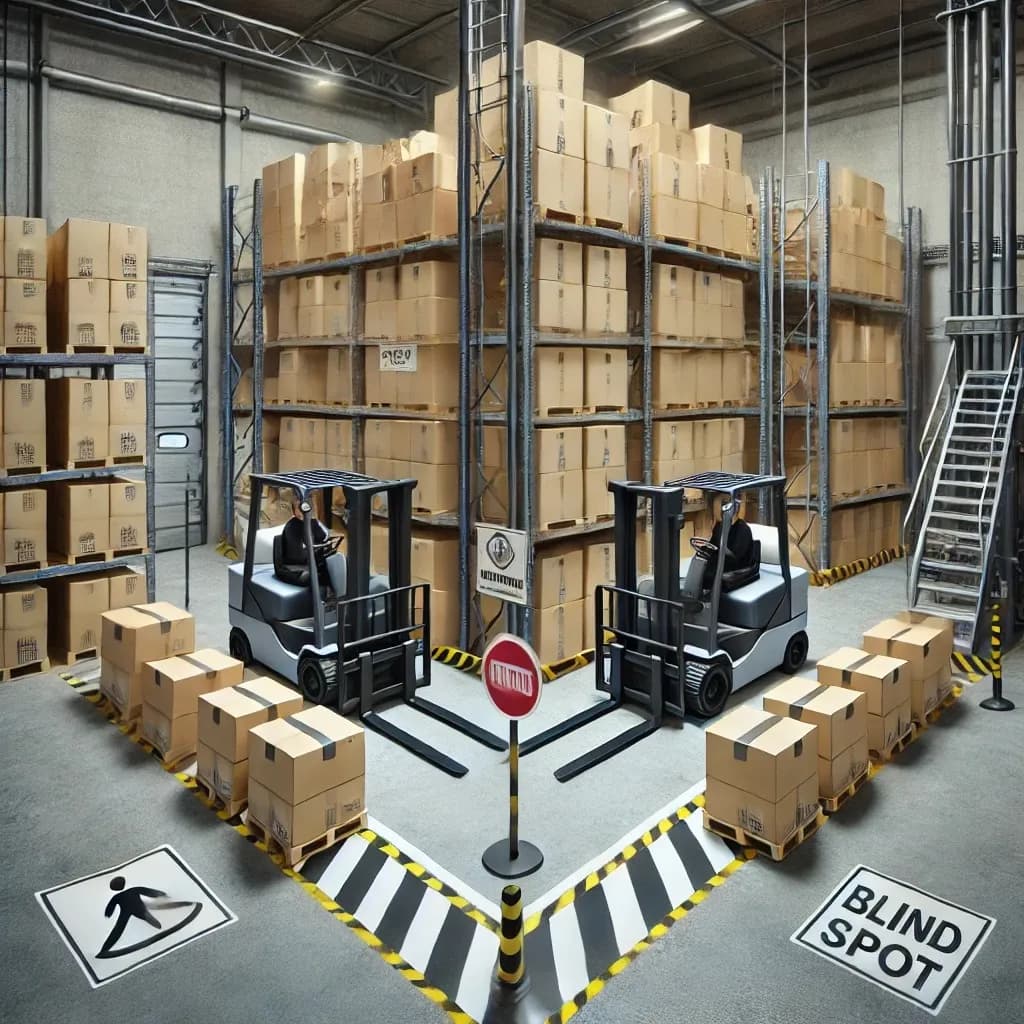
How the blind spot detection camera warns drivers
Many forklift accidents happen at places where nobody can see the other party in time: two trucks meeting at a rack end, a pedestrian stepping out from behind a wall, a worker walking behind a reversing forklift. Convex mirrors help only if the driver looks at the right moment, and a mirror cannot tell anyone that the way is not clear. Mode 22 watches the hidden side for the driver and turns what it sees into a clear signal: go, or wait.
01 · Zone
Blind corner, intersection or rear of truck
02 · Trigger
Person or forklift detected in the blind spot
03 · Outputs
- Traffic light switches to warning
- Audible alert for the driver
- Slow-down or stop via on-truck kit
Step 1
Watch the side the driver cannot see
At a corner, ISEE-CAM is mounted so it looks down the hidden aisle. On a truck, it faces backward. Its on-device model detects people and forklifts up to 20 m away, so it sees both the pedestrian about to step out and the other truck about to turn in.
Step 2
Decide whether the way is clear
In the web interface you draw the blind spot zones. On a truck, several zones can mark rising risk, for example green, yellow and red bands behind the forklift. The logic is customized per site: which zone matters for which approach direction, and when the light goes back to normal.
Step 3
Switch the light, slow the truck
When the blind spot is occupied, a dry-contact output switches the traffic light facing the forklift to warning, or sounds an alert in the cab. With additional on-truck hardware, compatible forklifts can be slowed or stopped. Alert-to-output latency is under 100 ms, and events go into periodic reports.
Field footage
Rear blind spot zones on a 10-ton forklift
Green, yellow and red zones behind a heavy forklift
This clip is the view from an ISEE-CAM mounted at the rear of a 10-ton forklift. Three zones are drawn behind the truck, green, yellow and red, getting closer to the forklift step by step. When a person walks into the area behind the forklift, the camera marks them and the zone they stand in sets the level of the warning, giving the driver a view a mirror cannot.
Where forklift blind spots are most dangerous
Rack-end intersections
Where a picking aisle meets a main aisle, high racking hides both the truck and the pedestrian until the last meter. A camera looking down the hidden aisle switches the light at the intersection before the forklift pulls out.
Wall corners and doorways
Forklifts passing between halls often turn through a doorway or around a building corner. Mode 22 watches the far side and shows the driver a warning light when someone is coming the other way.
Heavy forklifts and reversing
On large forklifts carrying bulky loads, the area behind the counterweight is hard to check. A rear-facing camera with graded zones warns the driver while reversing and can slow the truck when a person is in the closest zone.
Forklift-to-forklift crossings
Not every blind spot accident involves a pedestrian. At crossings used by several trucks, Mode 22 detects an approaching forklift in the hidden lane and turns the light to warning for the other driver.
Blind spot warning system specifications
- Detection targets
- People and forklifts in the blind spot zone
- Detection range
- Up to 20 m from the camera
- Mounting
- Fixed at a corner or intersection, or on the forklift facing rearward
- Warning output
- Traffic light switches to warning; audible alert optional
- Truck intervention
- Slow-down or stop on compatible forklifts with on-truck hardware
- Interfaces
- 1 input, 3 dry-contact outputs; OPC-UA, Modbus TCP, REST API
- Housing
- IP69K, −20 to +70 °C, DC 12–24 V, ISO 16750-3 vibration rated
Before installing blind spot detection at a corner or on a truck
- For a fixed corner, a mounting point that looks down the hidden approach, plus a traffic light placed where the driver sees it before the turn.
- For on-truck use, a rear mounting position with a clear view behind the counterweight; slow-down or stop needs additional hardware matched to the forklift model.
- This is an industrial system for forklift and pedestrian traffic inside plants and warehouses, not a blind spot accessory for cars or road trucks.
- It adds a warning and intervention layer to mirrors, speed limits, horn use and the site traffic plan; it does not replace them or the forklift's own safety devices.
Blind spot camera vs. mirrors, lights and sensors
Most blind corners already have something on the wall; here is what each option can and cannot do.
| Method | Covers | Gap |
|---|---|---|
| Convex mirrors | Lets the driver look around the corner | Works only if the driver checks it; distorted, dirty, no warning |
| Blind spot warning lights with PIR sensors | Flashes when something moves nearby | Reacts to any motion, so drivers learn to ignore it |
| Reversing radar or ultrasonic sensors | Beeps near any obstacle behind the truck | Cannot tell a person from a rack, pallet or wall |
| ISEE-CAM Mode 22 | Tells people and forklifts apart, drives the light, can slow the truck | Needs line of sight into the blind spot and adequate light |
Questions & Answers
Frequently asked questions
What is a forklift blind spot warning system?
It is a system that watches the areas a forklift driver cannot see and warns when a person or another vehicle is there. With ISEE-CAM, a camera covers the blind corner or the zone behind the truck, detects people and forklifts with AI, and switches a traffic light or alert so the driver waits.
Can the camera be mounted on the forklift itself?
Yes. Besides fixed cameras at corners, ISEE-CAM can face backward on the truck. The IP69K housing is rated for vibration under ISO 16750-3 and runs on DC 12–24 V. Zones behind the forklift, for example green, yellow and red, set how strong the warning is.
Will the light switch every time something moves?
No. Unlike motion-based warning lights, Mode 22 reacts only to people and forklifts in the zone you defined. Swinging doors, pallets and moving shadows do not change the light, which keeps drivers trusting it.
Can it slow the forklift down at a blind corner?
Yes, on compatible forklifts. The camera's output goes to additional hardware on the truck, which reduces speed or stops it when the blind spot is occupied. Without that hardware, the warning is given through the traffic light and audible alerts.
Is this the same as a blind spot monitor for cars?
No. Car blind spot monitors are usually radar-based driver aids for road lanes. Mode 22 is an industrial system for forklift traffic in plants, warehouses and yards. It detects people specifically and can be connected to traffic lights, a PLC or the forklift itself.
Plan a tailored deployment
Send us a photo or video of the blind corner from the driver's seat, or of the area behind the truck, along with the forklift model. We will propose the camera position, zones and how the warning light or slow-down should work.