Suspended load safety: protecting the overhead crane load zone
Suspended load safety starts with keeping people out from under the hook. Compare OSHA and EU rules, warnings, barriers, signalers and crane-mounted cameras.
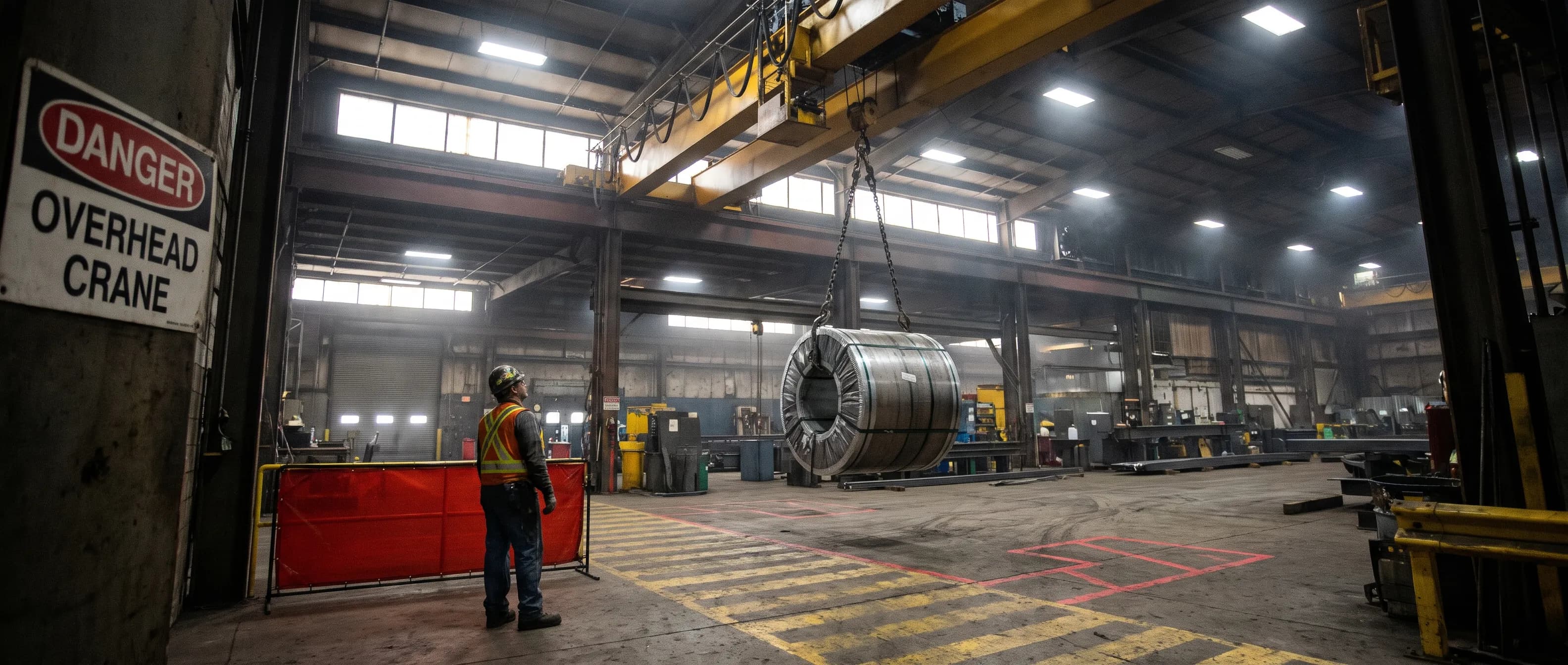
A pendant-controlled overhead crane carries a steel coil down a 60-meter bay. The operator walks alongside it, eyes on the load. At the far end of the runway, a maintenance technician with hearing protection is working on a motor directly below the crane path. Both are doing their jobs correctly. When the coil reaches that point, one of them will be in the wrong place. That is the core problem of suspended load safety: nobody breaks a rule, but the timing creates the hazard.
This article does not cover overhead crane safety in general. It focuses on one area: the space under and around a suspended load. We look at what OSHA and EU law require for that zone, where common controls fall short, and what changes when detection travels with the load. For the wider picture of crane hazards and controls, see our guide to preventive measures for overhead cranes.
Why is suspended load safety so critical?
There is no time to escape when something fails above you. A wire rope parts, a sling slips, or the load swings or rotates. All of this happens in seconds, and for the person underneath, the outcome is often fatal.
According to the U.S. Bureau of Labor Statistics (BLS), 297 workers died in crane-related incidents between 2011 and 2017, an average of 42 per year. Just over half of those deaths involved a worker being struck by an object or equipment. In 91 of those 154 cases, the worker was struck by a falling object or load (BLS). Manufacturing accounted for 24% of all crane-related deaths in the same period, so this is not only a construction-site problem.
Why the crane load zone never stays in one place
On a press line, the danger zone is fixed. You guard it and you are done. Under an overhead crane, the danger zone moves with the hook. "Under the load" is somewhere different every second, and the runway often spans the entire bay.
That means the floor under the runway is also a walkway, a maintenance area, a storage area, and a forklift route. In practice, exposure peaks at three moments:
- During travel: The operator watches the load, not the person 20 meters ahead.
- During rigging and landing: The rigger stands next to the load. It lifts unevenly, rotates, or swings.
- At the far end of the runway: With pendant or radio control, the operator may not see someone at the other end of the bay, especially through dust, steam, or stacked material.
What these moments share is a hazard that keeps relocating. You cannot protect it with a fixed fence or a single fixed sensor.
What OSHA and EU rules say about working under suspended loads
In the United States, OSHA's overhead and gantry crane standard, 29 CFR 1910.179, addresses the load zone directly (OSHA 1910.179):
- 1910.179(n)(3)(vi): The employer shall require that the operator avoid carrying loads over people.
- 1910.179(n)(3)(xi): The warning signal shall be sounded when starting the bridge and when the load or hook approaches near or over personnel.
- 1910.179(n)(3)(v): No hoisting, lowering, or traveling while any employee is on the load or hook.
- 1910.179(i): Except for floor-operated cranes, each crane with a power traveling mechanism needs a gong or other effective warning signal.
In the European Union, Directive 2009/104/EC on the use of work equipment sets the minimum requirements, and national rules build on it (Directive 2009/104/EC, Annex II):
- Annex II, 3.1.3: Measures must be taken to ensure that workers are not present under suspended loads. Loads may not be moved above unprotected workplaces usually occupied by workers.
- Annex II, 3.2.3: If the operator cannot observe the full path of the load, a competent person must be in communication with the operator to guide them.
- Annex II, 3.2.6: If the equipment cannot maintain its hold on the load when power fails, measures must be taken to avoid exposing workers to the resulting risks.
Both frameworks tell the employer what outcome to achieve, not which control to use. "Avoid carrying loads over people" and "measures must be taken" leave the method to you, and so does the burden of showing that the method works. That is why the load zone deserves its own line in the risk assessment, not a footnote under "crane".
Common load zone controls and where they fall short
Most facilities combine several controls. Each one has value and should stay. Each one also has a gap.
Horns and beacons
A horn and flashing light during travel are the most common control, and OSHA requires a warning device on most powered cranes. The weakness is habituation. A horn that sounds all shift becomes background noise. A worker wearing hearing protection next to a loud machine may not hear it. And the horn sounds whether anyone is there or not, so it carries no information about where people actually are.
Barriers, floor markings, and exclusion zones
Permanently closing off the area under the runway is the strongest control, but in most plants it is not possible. If the whole bay is under the crane, a permanent barrier stops production. Temporary tape and signs depend on behavior. Someone in a hurry ducks under the tape.
Signal persons
When the operator cannot see the load path, the EU directive requires a competent person to guide them, and signal persons are standard practice elsewhere too. A trained signal person is the most flexible "sensor" on the floor. The weakness is that they are human: attention drifts, fatigue builds over a shift, and assigning one to every lift is expensive.
Fixed area sensors
A photoelectric sensor or area scanner at a fixed point detects anyone crossing that point. Because the load zone moves, a fixed sensor cannot cover it. Most of these sensors also cannot tell a person from a pallet.
| Control | Covers the moving load zone? | Detects people? | Signal to crane control | Weak point |
|---|---|---|---|---|
| Horn and beacon | In general terms | No | No | Habituation, noise |
| Permanent barrier | No, it is fixed | No | No | Rarely practical |
| Floor marking and signs | Partly | No | No | Depends on behavior |
| Signal person | Yes | Yes (human eyes) | Via radio, through the operator | Fatigue, cost |
| Fixed area sensor | No, one point | Detects a crossing | Possible | Cannot tell people from objects |
| Crane-mounted AI camera | Yes | Yes, classifies people | Yes, via dry contact | Mounting angle, dust, lighting |
What changes when the camera rides on the crane
The difference is that the detection zone travels with the load. Mounted on the bridge, trolley, or crane leg, the camera always looks at the area under the hook. Wherever the crane is on the runway, the protected zone moves with it.
ISEE-CAM Mode 12 (crane zone personnel detection) works on this principle:
- Detect people under the load. The camera looks down and detects people up to 20 m away. Workers do not need tags or badges.
- Separate warning from danger. In the web interface, you draw an outer warning zone and an inner alarm zone. A person in the warning zone triggers a horn or light. A person in the alarm zone escalates to a crane intervention.
- Act on the crane. Dry-contact outputs are wired into the crane control so the drive slows or stops, and the crane stays blocked until the zone is clear. Alert-to-output latency is under 100 ms.
Processing runs on the device with Edge AI, so no video leaves the facility and no server is required. The housing is IP69K, rated from −20 °C to +70 °C, and vibration-rated to ISO 16750-3, which matters on a bridge girder in a dusty bay. Wiring options for PLCs and crane controls are covered on the ISEE-CAM PLC integration page.
To be clear: the camera does not replace the crane's limit switches, emergency stop, brakes, overload protection, or a required signal person. The stop signal is designed to work alongside the crane's own safety circuit. Its value is as an added layer that catches the moment human attention misses. We explain why a signal that reaches the crane matters more than an alert on a screen in AI safety camera alerts: notification or action?
For crane, ladle, and hot-load scenarios in steel plants, see steel mill safety with AI vision systems.
A short suspended load safety checklist
Before choosing any technology, answer these questions on the floor:
- What happens under the runway? Map walkways, maintenance points, storage, and forklift routes separately.
- Can the operator see the full load path? If not, is a signal person assigned, and is the communication method defined?
- Do loads travel over occupied workstations? If they do, is there a written work method?
- How are rigging and landing done? Where does the rigger stand while the load lifts?
- Is the warning signal actually heard? In hearing-protection areas, is there a visual warning too?
- Are near misses recorded? If entries into the load zone are not counted, nobody knows how big the problem is. Near miss reporting is a good place to start.
Frequently asked questions
Is it illegal to stand under a suspended load?
OSHA 1910.179(n)(3)(vi) requires employers to make operators avoid carrying loads over people. In the EU, Directive 2009/104/EC requires measures to keep workers out from under suspended loads. Both treat the load zone as a hazard the employer must control.
What should happen if the operator cannot see the load path?
Assign a trained signal person who stays in reliable communication with the operator. The EU directive requires this explicitly when the operator cannot observe the full path of the load.
Can a crane personnel detection system stop the crane?
Yes. ISEE-CAM Mode 12 sends a slow-down or stop signal to the crane control through dry-contact outputs when a person enters the alarm zone. That signal should be designed to work with the crane's own safety circuit.
Does a camera replace the signal person?
No. Where the rules call for a signal person, one is assigned. The camera adds a layer that catches what the signal person or operator might miss.
Conclusion
The overhead crane load zone is not fixed. It moves with the hook. Horns, barriers, and signal persons are still necessary, but each depends on someone looking at the right place at the right moment. Detection that travels with the load is a practical way to close that gap in suspended load safety.
Tell us your crane type, runway length, and the traffic underneath it. A photo or short video from the crane's point of view is enough for us to suggest a camera position, warning and alarm zones, and how the stop signal should be wired. Contact us to talk it through.
Contact: info@isee-vision.com · +90 216 455 95 44