Freight elevator safety: who and what is in the car?
Freight elevator safety: what OSHA, ASME A17.1 and EN 81-31 say about riders, plus five controls compared, from key switches and door locks to AI cameras.
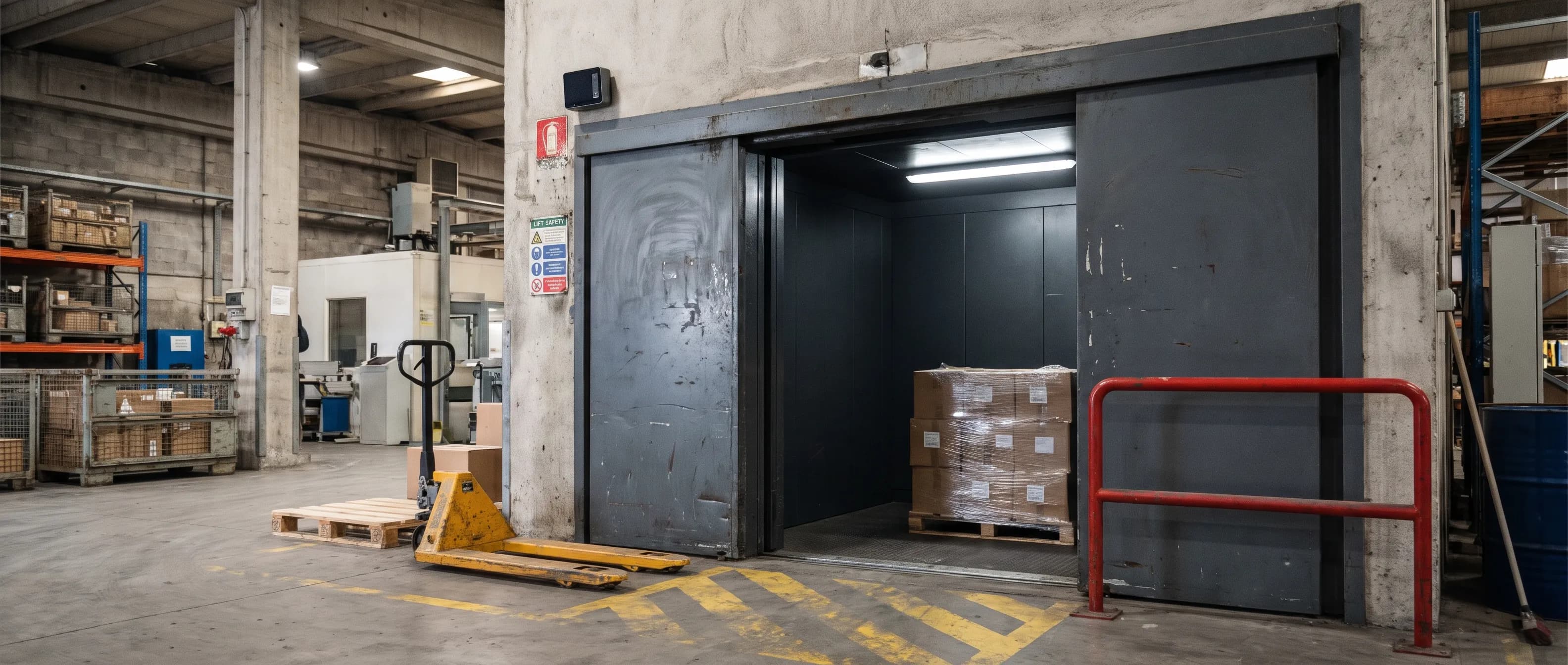
It is the end of the shift and the truck is waiting. A warehouse worker pushes a pallet into the goods lift and, instead of walking to the stairs, steps in with it. The rule is clear and the "No riders" sign is right above the door. But everyone says "just this once" at some point. That moment is where freight elevator safety usually breaks down.
This article covers how the rules classify freight elevators and goods-only lifts, where the risk comes from when a person or a forklift is in the car, and what five common controls do and do not solve. At the end, we explain what an AI camera adds and what it does not.
Why freight elevator safety starts with classification
Not every lift that carries goods follows the same rules, and the word "freight elevator" means different things on each side of the Atlantic. Knowing which type you have is the first step to setting the right rule.
In the United States, elevators are designed and maintained to ASME A17.1, which OSHA's construction standard references for permanent elevators used by employees (OSHA 1926.552(d)). U.S. freight elevators often allow some riders. Ohio's elevator code, for example, defines a freight elevator as one on which only the operator and employees, in the pursuit of their duties and with the employer's permission, are allowed to ride (Ohio Admin. Code 4101:5-1-02). Material hoists are stricter: on construction sites, nobody may ride them except for inspection and maintenance (OSHA 1926.552(b)(1)(ii)).
In the European Union, the Lifts Directive 2014/33/EU covers lifts that carry persons, persons and goods, or goods alone if a person can enter the carrier without difficulty and it has controls inside or within reach of a person inside (Directive 2014/33/EU, Article 1). Lifting appliances with a speed of 0.15 m/s or less are excluded.
The typical factory goods lift sits under a different standard. EN 81-31:2024 sets the safety rules for accessible goods-only lifts with a rated load above 300 kg that are not intended to carry persons, and it is harmonized under the Machinery Directive 2006/42/EC (EN 81-31:2024 summary). Passenger and goods passenger lifts followed EN 81-20 and EN 81-50 for years. Both were withdrawn in June 2026 and replaced by EN ISO 8100-1 and EN ISO 8100-2 (EN 81-20, EN 81-50).
In short: the data plate and the manufacturer's manual tell you whether your lift may carry people. If it is a goods-only lift, a person in the car is outside its design.
Why people end up riding goods-only lifts
A goods-only lift is not built to carry people, so it does not have to include every protection expected of a passenger lift. A person in the car is somewhere the designer did not plan for.
People still ride. The usual reasons:
- Time pressure: The stairs or passenger elevator are far away. The goods lift is right there.
- An unseen car: If the call button is on another floor, the person calling the lift cannot see who is inside.
- Staying with the load: Workers want to keep a tall pallet or a loose stack from tipping on the way up.
- Trust in signage: A "No riders" sign sets a rule. It does not enforce it.
In a U.S. facility where trained employees may ride, the problem shifts but does not disappear. Now the question is who is allowed in, with what load, and whether someone is still in the car when a forklift drives in.
When a forklift or pallet jack enters the car
The second major risk is the vehicle. When a forklift, powered pallet jack, or stacker drives into the car, two problems appear at once.
The first is weight. The truck's own weight adds to the load, and not every lift is designed for that kind of loading. The second is that the driver comes in with the truck, so the "person in a goods lift" problem returns in another form. Whatever your site rule is, if the lift must not move with a vehicle inside, that rule needs something on the floor that makes it real.
We cover the wider picture of shared truck and pedestrian zones in forklift safety solutions.
Five freight elevator safety controls and their limits
Most facilities combine the controls below. The first four are necessary and should stay in place.
| Control | What it provides | Limit |
|---|---|---|
| Signage and training | Awareness, required marking | Does not stop a violation |
| Key switch or badge control | Reduces unauthorized use | An authorized person can still ride |
| Door interlocks and safety contacts | Prevent movement with the doors open | Do not know who is inside once the doors close |
| Overload sensor | Prevents exceeding the rated load | Cannot tell a person from a pallet below the limit |
| AI camera | Detects a person or vehicle in the car, signals the controller | Needs a clear view of the car and correct integration |
None of the first four answers the question "is there a person in the car right now?" The door interlock knows the door state. The overload sensor knows the weight. Nothing looks inside the car. That is the gap an AI camera fills.
What an AI camera does inside the car
Mounted on the car ceiling or above the door, ISEE-CAM watches the inside of the car continuously. The detection mode depends on your site rule:
- People: Personnel presence (Mode 0) reacts when someone is inside the drawn zone.
- Vehicles: Forklift presence (Mode 4) detects a forklift in the car.
- Both together: Mode 5 reacts only when a forklift and a person are in the same zone at the same time, which suits U.S. sites where riders are allowed but not alongside a truck.
On detection, the camera sends a "no movement permitted" signal to the lift controller through a dry-contact output, and can trigger a siren or beacon at the same time. Processing runs on the device with Edge AI, with no cloud or internet connection required, and alert-to-output latency is under 100 ms. ISEE-CAM has one input and three outputs and also talks to PLCs over OPC-UA, Modbus TCP, and REST API. Wiring options are on the PLC integration page.
This is a working deployment, not a concept. At Egger, ISEE-CAM monitors a freight elevator used by both forklifts and people, and the elevator door is controlled when a forklift or a person is detected. The video is on our customer stories page.
To be clear: the camera does not replace door interlocks, safety contacts, overload protection, or the lift's safety circuit. The controller uses the camera signal as one more permission condition on top of the existing ones. We explain why a signal that reaches the controller matters more than an alert on a screen in AI safety camera alerts: notification or action?
What to check before installation
- Field of view: The whole car should be visible in one frame. A ceiling corner or a position above the door usually gives the widest view.
- Lighting: Car lighting should be steady. The IP69K housing and −20 °C to +70 °C range suit cold stores and dusty areas, but the camera still needs to see the car clearly.
- Integration: Any connection to the lift controller should be made with the lift manufacturer or its authorized service company, with the existing safety circuit left intact.
- The rule itself: Are people banned, vehicles banned, or only the two together? Decide this on site before choosing a mode.
- Testing: Before going live, test with different postures, clothing, and load situations, and record the results.
Frequently asked questions
Can people ride a freight elevator?
It depends on the lift. Some U.S. freight elevators allow the operator and authorized employees to ride. A goods-only lift built to EN 81-31 is not intended to carry persons. Check the data plate and the manufacturer's manual.
Can the camera detect a forklift or pallet jack in the car?
Yes. Forklift detection can be set as a separate rule next to person detection, and the camera produces a warning or a no-movement signal according to your site rule.
Can it be added to an existing elevator?
Yes, no new lift is needed. The camera mounts on the car ceiling or above the door, and the controller connection is made with the lift's authorized service company.
Does the camera replace the elevator's safety devices?
No. Door interlocks, safety contacts, and overload protection stay in place. The camera adds a layer that answers "is someone in the car?"
Conclusion
Freight elevator incidents rarely happen because nobody knew the rule. They happen because someone thought "just this once." Signs and key switches set the rule. Door interlocks and overload sensors protect the lift. A camera that looks inside the car answers the last question in freight elevator safety: is anyone in there right now?
Send us a photo of the car and your controller type, and we will suggest a mounting point and wiring approach. Contact us or see the ISEE-CAM product page.
Contact: info@isee-vision.com · +90 216 455 95 44