Traffic management in industrial areas: a layered-defense guide
How does traffic management in industrial areas work? Build a layered-defense plan with segregation, speed control, and AI cameras. Get a free assessment.
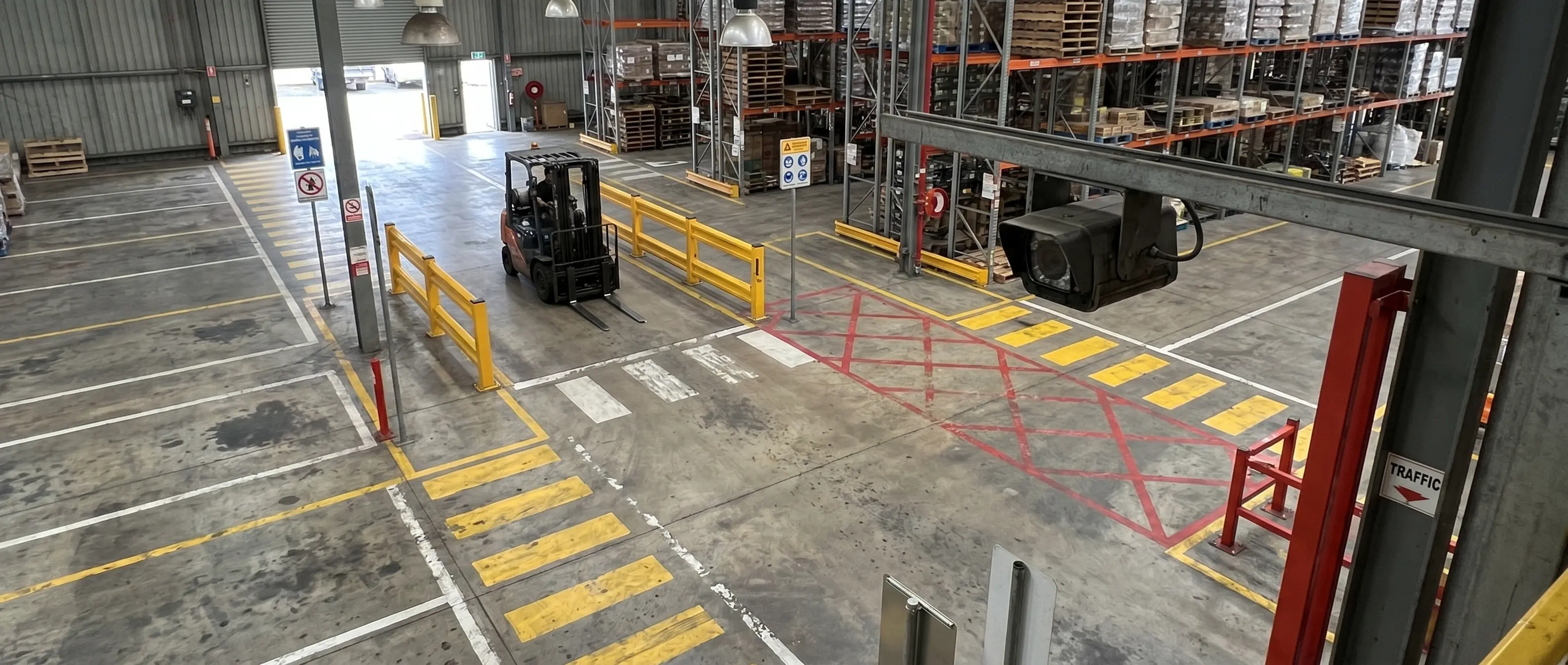
Traffic management in industrial areas: a layered-defense guide
A reach truck makes a left turn out of an aisle at 7 mph. A maintenance technician steps out from between racks, head down, on the way to the breakroom. They reach the same point in space within half a second of each other. The painted line on the floor said both should slow at the intersection. Neither did.
Traffic management in industrial areas is the most consequential safety system most facilities never properly engineer. Workplace transport accounts for roughly a quarter of UK workplace fatalities, according to HSE data, and OSHA reports approximately 100 forklift-related fatalities a year in the United States. Most happen at exactly the kind of crossing described above: predictable interaction points where vehicle and pedestrian paths converge under restricted visibility. Most facilities have a plan on paper. Few have a system that enforces it in real time.
This guide covers what traffic management in industrial areas actually means, what regulators require, how to map traffic risk in your facility, the hierarchy of controls applied to vehicle and pedestrian flow, and where modern Edge AI fits inside the engineering-control layer. By the end you'll have a defensible framework for designing or auditing a plan, with pointers into the deeper sister articles for tactical detail on speed detection and blind-spot coverage.
What is traffic management in an industrial setting?
Traffic management in an industrial setting is the systematic design, operation, and enforcement of vehicle and pedestrian movement inside a facility, with the goal of preventing struck-by incidents, collisions, and crush injuries. It covers layout, signage, segregation, speed control, right-of-way rules, training, and the technology layer that ties them together.
Two principles separate effective plans from theoretical ones. First, the plan is a two-actor system: vehicles and pedestrians, each with predictable but conflicting needs. Second, and this is HSE's framing in its workplace transport guidance, the locus of safety is the site, not the operator. A plan that depends on operator vigilance to function will fail eventually. A plan engineered into the layout, the controls, and the active monitoring will not.
What the regulators require
There is no single global standard for industrial traffic management. There is a small set of documents that auditors expect to see cited.
HSE HSG136 (UK and global reference)
The UK Health and Safety Executive publishes HSG136, A guide to workplace transport safety, which is the most-cited methodology document in the field. It defines the duty under the Workplace (Health, Safety and Welfare) Regulations 1992, Regulation 17, and lays out the safe-site / safe-vehicle / safe-driver framework. Most ISO 45001 audits use HSG136 as the reference even outside the UK.
OSHA 1910.178 and 1926 Subpart G (US)
In the United States, OSHA's Motor Vehicle Safety standards and 29 CFR 1910.178 (powered industrial trucks) cover most of the duty inside facilities, while 1926 Subpart G covers signs, signals, and barricades on construction sites. Neither sets a hard speed limit; both require employers to set safe operating limits appropriate for the conditions.
EU-OSHA and ISO 45001
The European Agency for Safety and Health at Work publishes a vehicle safety e-guide covering segregation, traffic routes, speed, and visibility. ISO 45001 doesn't address traffic management directly, but clauses 6.1.2 (hazard identification) and 8.1.2 (operational planning and control) require documented hazard controls in any vehicle traffic zone. Auditors expect to see traffic management plans referenced as the implementation evidence.
How to map traffic risk in your facility
Before you choose controls, you need a risk map. Most facilities have between 10 and 25 traffic interaction zones once mapped honestly. The work is to find them, score them, and prioritize.
The high-risk zones in most industrial facilities:
- Aisle intersections and racking corners: the classic struck-by location
- Loading dock approaches and dock plates: vehicle acceleration into pedestrian space
- Yard-to-warehouse transitions: outdoor-speed traffic entering an indoor environment
- Pedestrian crossings near break rooms and locker rooms: predictable shift-change traffic
- Crane operating zones: overlap of below-the-hook and ground-level movement
- Conveyor crossings and AGV paths: automated equipment with limited audible warning
- Mezzanine drops and elevated work platforms: vertical sightline issues
For each zone, score three factors: traffic frequency (movements per hour), peak speed (typical operating velocity), and visibility (line of sight in meters). The product of those three is a usable risk index. The near-miss data you already have, even if it's incomplete, will validate the ranking.
The hierarchy of controls applied to industrial traffic
Industrial safety practice borrows from occupational hygiene the hierarchy of controls: a five-tier framework ordered by effectiveness. Applied to traffic management, it gives you a defensible logic for choosing controls per zone.
| Tier | Definition | Traffic example | Residual risk |
|---|---|---|---|
| 1. Elimination | Remove the hazard | Move the forklift route out of the pedestrian corridor entirely | Lowest |
| 2. Substitution | Replace with a less hazardous option | Replace forklift transport with conveyor or gravity-roller systems | Low |
| 3. Engineering controls | Physical and technological barriers | Bollards, one-way design, AI-camera detection, traffic-light interlocks | Low-Medium |
| 4. Administrative controls | Procedures and training | Speed limits, right-of-way rules, scheduling, induction training | Medium |
| 5. PPE | Personal protective equipment | High-visibility vests, hard hats | Highest (last line) |
Most warehouse traffic management plans operate primarily in tiers 4 and 5: administrative rules and PPE. The highest-leverage improvements come from moving more decisions up to tiers 1, 2, and 3. A facility that eliminates a route, redesigns a crossing, and installs a fixed-camera detection layer is doing structurally more for safety than one that adds another sign and another mandatory toolbox talk.
Physical engineering controls
Bollards, guardrails, retractable barriers, swing gates, painted lanes, dome and convex mirrors, and one-way layouts. Strengths: durable, no software dependency, easy to audit visually. Limitations: static (zones can't be reconfigured without physical work), can't classify what's approaching, can't trigger machine actions. Best for: zone definition, fall-from-height edges, and any place a worker should never enter regardless of context.
Procedural controls
Posted speed limits, right-of-way rules, scheduled pedestrian movements outside high-traffic vehicle hours, crossing protocols, supervisor enforcement, and induction training. Strengths: low capital cost, fast to deploy. Limitations: depends on operator memory and supervisor presence; degrades over time without retraining; covers only the workers and operators who attended the training.
Technology engineering controls
UWB tag-based geofence systems, truck-mounted proximity sensors, fixed-camera AI detection, traffic-light interlocks, telematics platforms. Strengths: continuous monitoring, contextual logic, direct PLC integration, machine-stop capability. Limitations: capital investment up front, integration complexity, requires commissioning. Best for: high-frequency interaction zones where physical and procedural controls have hit their ceiling.
| Sub-layer | Coverage | Reconfigurability | Real-time intervention | Covers untagged vehicles |
|---|---|---|---|---|
| Physical | Defined zones only | Low (requires construction) | No | Yes (passively) |
| Procedural | Trained personnel only | High | No | No |
| Technology: UWB tags | Tagged vehicles only | Medium | Yes (own truck) | No |
| Technology: fixed-camera AI | Every vehicle in camera view | High (software-defined) | Yes (any compatible truck) | Yes |
Who has right of way: forklifts or pedestrians?
In conventional facility rules, pedestrians have right of way and forklift operators must yield. That answer is correct as a procedural rule, and it's what auditors expect to find in your written traffic management plan. The engineering reframe matters more in practice: a safe traffic system shouldn't depend on real-time right-of-way negotiation between an operator with limited sightlines and a pedestrian with limited situational awareness. Right-of-way is the rule. Engineering controls make sure the rule never has to be enforced live.
Where AI camera traffic management changes outcomes
The technology layer of an industrial traffic plan has matured fast. Three capabilities now sit inside the price-point a mid-sized facility can justify, and they change which zones can be controlled to which standard.
Fixed-camera vs. truck-mounted detection
Most AI safety cameras on the market today mount on the forklift itself. They detect pedestrians in the forklift's path and alert the operator. That's useful, but it covers only the trucks you fit. Contractor tractors, third-party logistics deliveries, rental forklifts during peak season, and visitor vehicles all stay invisible. A facility-mounted camera detects every vehicle in its field of view, regardless of who owns it. For a strategic comparison of detection approaches, see our tag-based vs. tagless safety comparison.
Speed-with-context detection
Rule-based speed limiters cap top speed but can't interpret the surroundings. ISEE-CAM combines speed measurement with pedestrian-proximity logic in a single decision: a forklift at 6 mph in a clear lane is acceptable; the same forklift at 6 mph with a pedestrian 3 meters away is an immediate hazard. The full architecture and trade-offs are detailed in our guide to vehicle speed detection in industrial areas.
Blind-corner intervention
Aisle intersections and dock approaches are the sites where most struck-by incidents originate. Fixed-camera detection at these points sees both actors before either sees the other, and can trigger a traffic-light change, slow an approaching forklift via CAN bus, or sound an audible alert. The deeper treatment is in blind spot detection in industrial areas.
Direct PLC and traffic-light integration
Detection is only useful if it can act. ISEE-CAM communicates with industrial controllers over OPC-UA, Modbus TCP, REST API, digital I/O, and CAN bus. The same detection event can drop a forklift's speed limit, switch a traffic light at an intersection, open or close a roll-up door, and log a timestamped record for ISO 45001 audit: all without an operator in the loop.
Building a warehouse traffic management plan
A defensible plan follows five steps. Most facilities can complete the cycle in 6 to 12 weeks for a single-facility deployment, longer for multi-site rollouts.
- Risk map and zone definitions. Walk the facility with EHS, operations, and a representative operator. List every vehicle-pedestrian interaction zone. Score each on traffic frequency, peak speed, and line of sight. Document near-miss and incident history per zone.
- Control selection per zone using the hierarchy. For each zone, work down from elimination. Can the route be removed? Can it be substituted? If neither, layer engineering controls (physical plus technology), then administrative (rules plus training), then PPE. Do not skip directly to PPE.
- Documentation and operator induction. Produce a traffic plan document: floor plan, zone definitions, control list per zone, speed limits per zone, right-of-way rules, audit cadence. Brief every operator, every supervisor, and every contractor at induction. Keep records.
- Measurement and quarterly audit. Establish baseline metrics: near-miss rate per zone per month, incident rate per zone per month, compliance walk findings. Re-measure quarterly. The plan that's never measured is not a plan; it's a wish.
- Continuous improvement loop. Move incident data back into step 1. Reprioritize zones, re-tier controls, retire interventions that aren't earning their keep, and broaden ones that are. The plan is a living document.
For warehouse and distribution-specific tactical detail, see our companion guide to AI safety in logistics and warehousing. For the cluster-wide pillar covering forklift-specific controls, see our complete forklift safety solutions guide.
What measurable improvement looks like
Traffic management investment only earns its budget if the incident curve bends. The published evidence:
- HSE workplace transport guidance documents that facilities deploying systematic traffic management plans (not just signage) achieve substantial reductions in struck-by incidents over the first 12 to 18 months
- AI-vision deployment case data reports near-miss reductions in the 50 to 80% range at high-risk crossings, with ISEE Vision deployments specifically showing 40 to 70% reduction in safety incidents within the first year
- Insurance and downtime impact: facilities with documented traffic plans and verified engineering controls typically see insurance premium reductions in the 5 to 15% range, plus reduced unplanned downtime from incident investigations
A representative deployment: a Fortune 500 logistics distribution operator implemented a layered traffic plan across a 40,000-square-meter site. Physical layer: repainted pedestrian walkways and added six bollard-protected crossings. Procedural layer: zone-specific speed limits with operator induction. Technology layer: six ISEE-CAM units at the highest-risk crossings, integrated with traffic-light control at three intersections and forklift CAN bus for automatic speed reduction in pedestrian zones. The facility documented a 58% reduction in recorded near-miss events at the controlled zones over the first six months, with auto-generated compliance records that closed the quarterly audit in under an hour.
The architecture is repeatable. Same hierarchy of controls, same camera platform, different floor plans.
Closing the loop on traffic management in industrial areas
Three takeaways for an EHS manager building a budget request:
- Treat the plan as engineering, not paperwork. The facilities that actually reduce incidents apply the hierarchy of controls top-down, prioritize tiers 1 through 3, and treat tiers 4 and 5 as the safety net rather than the system.
- Cover every vehicle, not just yours. Per-vehicle safety devices protect only the equipment they're fitted to. Contractor trucks, rentals, and visitor vehicles need a facility-mounted detection layer to be covered. That's an architectural decision, not a feature decision.
- Document for audit from day one. ISO 45001 and OSHA expect timestamped, zone-specific records. Build the documentation into the system rather than producing it manually before each audit.
Traffic management in industrial areas is no longer a paint-and-mirrors discipline. The standards, the methodology, and the technology have caught up to the problem. The remaining question is which combination of controls fits your facility's traffic pattern. ISEE Vision offers free site assessments to map your interaction zones and propose a layered deployment plan. Schedule one with our team.