Vehicle identification in industrial areas: ANPR, RFID, and AI vision compared
Vehicle identification in industrial areas isn't one technology, it's three layers. Compare ANPR, RFID, and AI vision. Schedule a free site assessment.
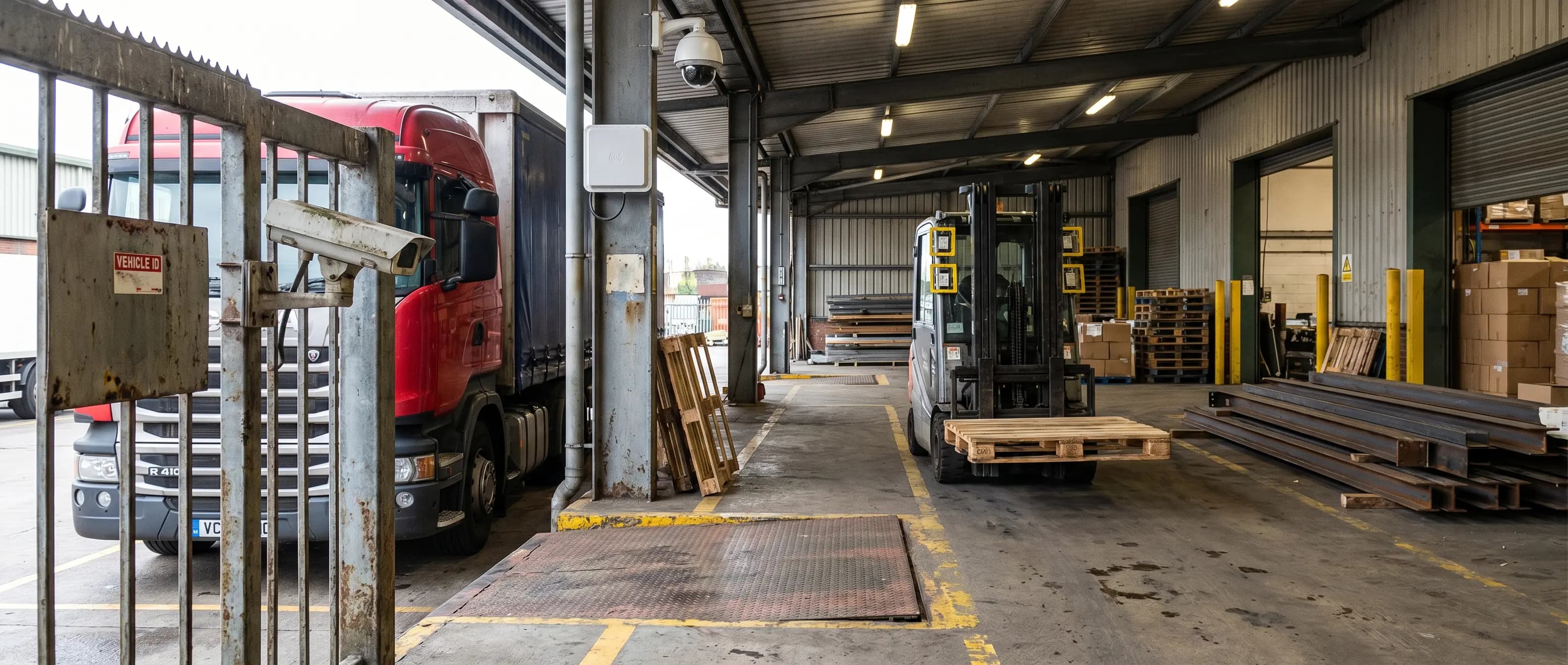
Vehicle identification in industrial areas: ANPR, RFID, and AI vision compared
A contractor truck pulls up to your facility's main gate at 07:14. An unfamiliar forklift, rented for peak season, rounds an aisle in the receiving warehouse. A pedestrian crosses the loading-dock approach with a clipboard. Three actors, three identification problems, and three different correct technologies for solving them.
Vehicle identification in industrial areas is one of the most consistently mis-scoped procurement categories in workplace operations. Most facilities buy whichever identification system the first vendor pitched, then try to stretch it across use cases it was never designed for. License plate cameras get blamed for not detecting pedestrians. AI safety cameras get asked to read plates. RFID tags get specified for vehicles the facility doesn't own. The result is a fragmented identification posture and three procurement rounds where one well-architected stack would do.
This guide walks through the three layers of industrial vehicle identification: gate-level ANPR / LPR for who enters the facility, asset-level RFID for tracking equipment you own, and safety-level AI vision for what's happening in real time at high-risk zones. By the end you'll have a defensible framework for which layers your facility actually needs and which technology fits each one.
What is vehicle identification in an industrial setting?
Vehicle identification in an industrial setting is the systematic capture of a specific vehicle's identity, by license plate, RFID tag, or visual signature, to enable access control, asset tracking, scheduling, or safety enforcement inside a facility. It differs from public-road ANPR by operating in controlled environments with known vehicle populations, integration with WMS / TMS / PLC systems, and overlapping safety obligations.
A useful distinction sits at the heart of the category: identification names a specific vehicle (truck plate ABC-123, forklift asset #47), while classification names a vehicle type (a forklift, a truck, a person). Both are useful. Different technologies do each one well, and most industrial facilities need both.
ANPR, LPR, ALPR, AVI, what's the difference?
Four acronyms describe the same broad family of technologies with regional and definitional variations:
- ANPR (Automatic Number Plate Recognition): typical UK and European usage; refers to camera-based OCR reading of vehicle license plates. The Wikipedia ANPR article is a useful definitional anchor.
- LPR (License Plate Recognition): typical US usage; functionally identical to ANPR.
- ALPR (Automatic License Plate Recognition): a longer-form US synonym for LPR, used interchangeably.
- AVI (Automatic Vehicle Identification): an umbrella term that includes ANPR / LPR plus tag-based methods like RFID and UWB. Use AVI when discussing the full identification stack rather than just the camera-OCR layer.
For the rest of this article we'll use ANPR and LPR interchangeably for camera-OCR identification, RFID for tag-based identification, and AI vision for camera-based classification.
Layer 1: Gate-level identification (ANPR / LPR)
Gate-level identification is the first checkpoint: who is entering the facility? ANPR cameras read truck and contractor vehicle plates at gates, log entry and exit times, and pass plate data to upstream systems for access decisions and dock scheduling.
How ANPR works at industrial gates
A high-resolution camera mounted at a gate captures plate images as vehicles approach. Image-processing algorithms locate the plate region, normalize for angle and lighting, and pass the cropped plate to OCR. The decoded plate string is matched against a database of authorized vehicles, expected deliveries, or contractor schedules. Match logic feeds gate decisions: open the barrier, dispatch to dock 3, flag for security review.
What ANPR solves
The use cases are operational, not safety-critical:
- Truck check-in automation at distribution-center gates
- Contractor and visitor access logging
- Dock allocation by matching arriving plates to scheduled bookings
- Dwell-time analytics per truck, per gate, per shift
- Inventory reconciliation by matching shipments to specific vehicles
Industrial deployments report up to 50% reduction in gate-cycle time and over 70% reduction in unauthorized vehicle entries when ANPR is integrated with a TMS or WMS, according to published warehouse case data. (Verify against current vendor case studies before quoting precise figures in customer-facing material.)
Limitations
ANPR works on plates, not people. Lighting, plate angle, dirty plates, snow, mud, and damaged plates degrade accuracy. ANPR also doesn't cover vehicles without plates, most forklifts, AGVs, and tow tractors operating inside the facility don't have road-legal plates. For those, you need a different layer.
Privacy and compliance
License plates are personal data under most data-protection regimes. KVKK in Turkey, GDPR in the EU, and parallel frameworks elsewhere all require lawful basis, retention limits, transparency, and operator awareness for LPR deployments. The HSE workplace transport guidance treats vehicle-monitoring camera systems as part of the broader workplace-surveillance posture. Treat ANPR as a surveillance system from a compliance standpoint, even when its purpose is operational. Our industrial camera privacy compliance guide walks through the documentation expectations.
Layer 2: Asset-level identification (RFID and UWB)
Inside the facility, the identification problem changes. The forklifts, AGVs, and tow tractors moving through aisles don't have plates and don't need them. They do need to be tracked: which asset is where, which one entered the restricted bay, which one needs maintenance.
RFID and UWB systems solve this with tags. Each asset carries a transponder with a unique ID. Readers mounted at key locations (gates, dock thresholds, restricted-zone perimeters) detect tag presence and feed asset-position data to the WMS. UWB extends RFID's reach with sub-meter positioning accuracy and the ability to define geofence zones in software.
What RFID and UWB solve
- Forklift identification and tracking inside the facility
- Restricted-zone access enforcement for tagged assets (auto-stop on entry to a no-go area)
- Asset utilization analytics (which forklifts work hard, which sit idle)
- Maintenance scheduling based on actual operating hours per asset
Limitations
The same constraint that makes RFID powerful inside a known fleet limits it elsewhere: only tagged assets are tracked. Contractor forklifts, peak-season rentals, and visiting tractor-trailers stay invisible. Tag batteries need replacement. Anchors require infrastructure investment. For a deeper comparison of tag-based versus tagless approaches in safety contexts, see our tag-based vs. tagless safety comparison.
Layer 3: Safety-level vehicle classification (AI vision)
The third layer is fundamentally different. AI safety vision cameras don't read plates and don't read tags. They classify what's in the frame: this object is a forklift, that one is a person, the third is a pallet. Classification feeds safety decisions in real time, including blind spot detection in industrial areas at aisle intersections and dock approaches.
A YOLO-architecture detection model running at 30+ FPS on edge hardware identifies vehicle types, tracks them frame-to-frame, measures velocity, and detects proximity to people. End-to-end latency under 100ms means a stop signal reaches a forklift's CAN bus before a human operator could react.
Why category-based detection complements identity-based identification
ANPR knows that truck ABC-123 entered the facility at 07:14. RFID knows that forklift asset #47 is in aisle 4. Neither system knows there's a pedestrian three meters in front of forklift #47 right now. Safety isn't an identification problem; it's a classification-and-context problem. The vehicle type, its speed, its path, and the people near it are the safety inputs.
Different cameras for different jobs
The hardware optimization for ANPR and the hardware optimization for safety vision are genuinely different. ANPR cameras are tuned for plate-region exposure, OCR-friendly framing, and narrow-field high-resolution capture at gates. Safety cameras are tuned for wide-area scene understanding, multi-object tracking across a 25-meter detection range, and behavioral analysis. A serious facility runs both. ISEE Vision delivers across the full identification stack, ANPR cameras at gates, AI safety vision at high-risk crossings, and our solutions overview describes how the layers integrate.
Direct PLC and traffic-light integration
The safety layer earns its budget by acting, not just observing. AI vision cameras can drop a forklift's speed limit through CAN-bus integration, switch a traffic light at an intersection, open or close a roll-up door, and log every event for ISO 45001 audit. None of that requires the camera to identify a specific plate or tag.
Which layer do you actually need?
The honest answer is: you probably need at least two, often all three. Use this matrix to map identification questions to the right technology.
| Question / use case | ANPR / LPR | RFID / UWB | AI safety vision |
|---|---|---|---|
| Who is entering my facility? (trucks, contractors, visitors) | ✓ Best fit | Limited (tagged only) | ✗ Not designed for it |
| Which forklift is in restricted bay 7? | Limited (no plates) | ✓ Best fit | Partial (classification only) |
| Is a pedestrian within 3 meters of an active forklift? | ✗ Not designed for it | Limited (people need tags) | ✓ Best fit |
| How long did truck XYZ-789 sit at dock 3? | ✓ Best fit | Limited (truck must be tagged) | Limited |
| Did unauthorized contractor enter the press cell? | Partial (gate only) | Partial (tagged only) | ✓ Best fit (any person, any vehicle) |
| Auto-stop forklift before pedestrian crossing | ✗ | Partial (tagged forklifts only) | ✓ Best fit |
| Documented compliance log for ISO 45001 audit | ✓ (gate events) | ✓ (asset events) | ✓ (safety events) |
The technology mix depends on the facility profile. A distribution center with heavy third-party logistics traffic prioritizes Layer 1 (ANPR) and Layer 3 (safety vision). A manufacturing plant with a stable in-house fleet leans on Layer 2 (RFID) and Layer 3. Steel mills with heavy contractor presence and high-hazard zones typically need all three.
Privacy and compliance: the LPR-specific obligation
ANPR is the most legally sensitive layer in the stack. License plates are personal data; capturing and storing them triggers data-protection obligations that the other two layers largely escape.
Three points worth keeping in front of the procurement and compliance teams:
- Lawful basis must be documented. Operational necessity (access control, dock scheduling) is a defensible basis under both KVKK and GDPR, but it must be written down with retention limits, security controls, and a clear deletion schedule.
- Identity-based vs. category-based detection. ANPR is identity-based by definition: a plate is a unique identifier. AI safety vision, by contrast, is category-based: it detects "a person" or "a forklift" without facial recognition or plate OCR. The compliance burden on category-based detection is materially lighter, which is one reason the safety and identification layers should run on different cameras.
- Operator and visitor awareness. Both ANPR and AI vision deployments require visible signage and disclosure to drivers and personnel entering the monitored area. The exact wording differs by jurisdiction; our KVKK compliance guide covers the documentation patterns expected by KVKK and equivalent frameworks.
If you're scoping a deployment that combines layers, run the compliance review per layer, not per camera. The same operator will manage all three; the legal posture differs.
What measurable outcomes look like across the stack
The three layers produce different kinds of returns, and the case for each is strongest when measured separately:
- ANPR / LPR: published warehouse case data reports up to 50% reduction in gate-cycle time and over 70% reduction in unauthorized vehicle entries after ANPR integration with TMS / WMS systems
- RFID / UWB: documented asset-utilization improvements in the 15 to 30% range and measurable reduction in restricted-zone violations once auto-stop interlocks are wired in
- AI safety vision: ISEE Vision deployments show 40 to 70% reduction in safety incidents within the first year, with insurance premium reductions in the 5 to 15% range tied to verified safety improvements
- Combined-stack effect: facilities running all three layers report the largest dwell-time, throughput, and incident-rate improvements together, because the layers each unblock a different operational constraint
A representative deployment: a Fortune 500 logistics distribution operator running three identification layers across a single 40,000-square-meter site. ANPR at the main gate handled truck check-in and contractor access, with plate data feeding the TMS for automated dock allocation. RFID on company-owned forklifts fed the WMS for asset tracking and restricted-zone enforcement. AI safety vision at six high-risk crossings handled forklift-pedestrian proximity detection and CAN-bus speed reduction. Three different downstream systems, three different identification problems, one architectural design decision: each layer for the job it actually does well.
Closing the loop on vehicle identification in industrial areas
Three takeaways for an operations or EHS lead scoping this work:
- Identification is three layers, not one product. ANPR for who enters, RFID for asset tracking, AI vision for safety detection. Trying to force one camera or one tag system to handle all three weakens all three.
- Run different cameras for different jobs. ANPR optics and safety-vision optics are tuned differently. The cost of combining them on shared hardware is worse performance on both jobs. Plan the camera count and budget per layer.
- Compliance posture differs by layer. Identity-based identification (LPR) carries heavier KVKK / GDPR obligations than category-based safety detection. Run the compliance review per layer.
Vehicle identification in industrial areas has matured into a real architectural discipline, paralleling the way industrial traffic management became a layered-defense discipline. The remaining question is which combination of layers fits your facility's traffic profile, vehicle population, and compliance posture. ISEE Vision offers free site assessments that map identification needs across all three layers and propose a deployment that integrates with your existing TMS, WMS, and PLC infrastructure. Schedule one with our team to design the right combination for your site.