Blind spot detection in industrial areas: AI vision vs. traditional methods
Choosing blind spot detection for industrial areas? Compare mirrors, ultrasonic, UWB, LiDAR, and Edge AI cameras on latency, coverage, and tagless protection.
Blind spot detection in industrial areas: AI vision vs. traditional methods
It's 14:47 on a busy distribution center floor. A forklift rounds a racking corner at 5 meters per second. A pedestrian steps out from between pallets at the same moment, head down, looking at a packing slip. Neither sees the other until 0.8 seconds before contact.
Industrial blind spots create incidents like this thousands of times every year, and blind spot detection in industrial areas has become one of the fastest-shifting categories in workplace safety technology. According to OSHA data, forklifts are involved in approximately 85 fatalities and 34,900 serious injuries annually in the United States alone. A substantial share happen at points where line of sight is broken: aisle corners, dock approaches, crane zones, conveyor crossings. Manual observation cannot cover every aisle on every shift. Mirrors only show what the operator chooses to look at.
You probably already know this. You've walked your facility, mapped the corners, posted convex mirrors, painted yellow lines, and trained operators to slow down at intersections. The incidents still happen, just less often. This article walks through where industrial blind spots actually form, why traditional countermeasures hit a ceiling, and how detection has shifted from passive aids to active, AI-powered intervention.
We'll cover seven things: what blind spot detection means in an industrial context, the specific zones where blind spots form, the limits of mirrors and spotters, the trade-offs between sensor-based options, how AI camera systems close the gap, what to evaluate when choosing a system, and what measurable improvement looks like in practice.
What is blind spot detection in industrial areas?
Blind spot detection in industrial areas is a safety capability that automatically identifies people, vehicles, or equipment in zones where operators have restricted visibility, and triggers a warning or protective action before contact occurs. Unlike automotive blind spot monitoring, which protects vehicle occupants, industrial blind spot detection protects pedestrians, contractors, and visitors who share the operating environment.
The distinction between detection and warning matters. A warning is reactive: it alerts a human after a hazard appears. Detection is preventive: it identifies the hazard, classifies it (person versus pallet versus forklift), and either alerts the operator or directly intervenes through connected machinery.
In the safety control hierarchy, blind spot detection sits in the engineering controls layer, above administrative controls (training, procedures) and personal protective equipment. That placement matters. Engineering controls protect workers regardless of whether anyone remembers the rule.
Where blind spots form on the plant floor
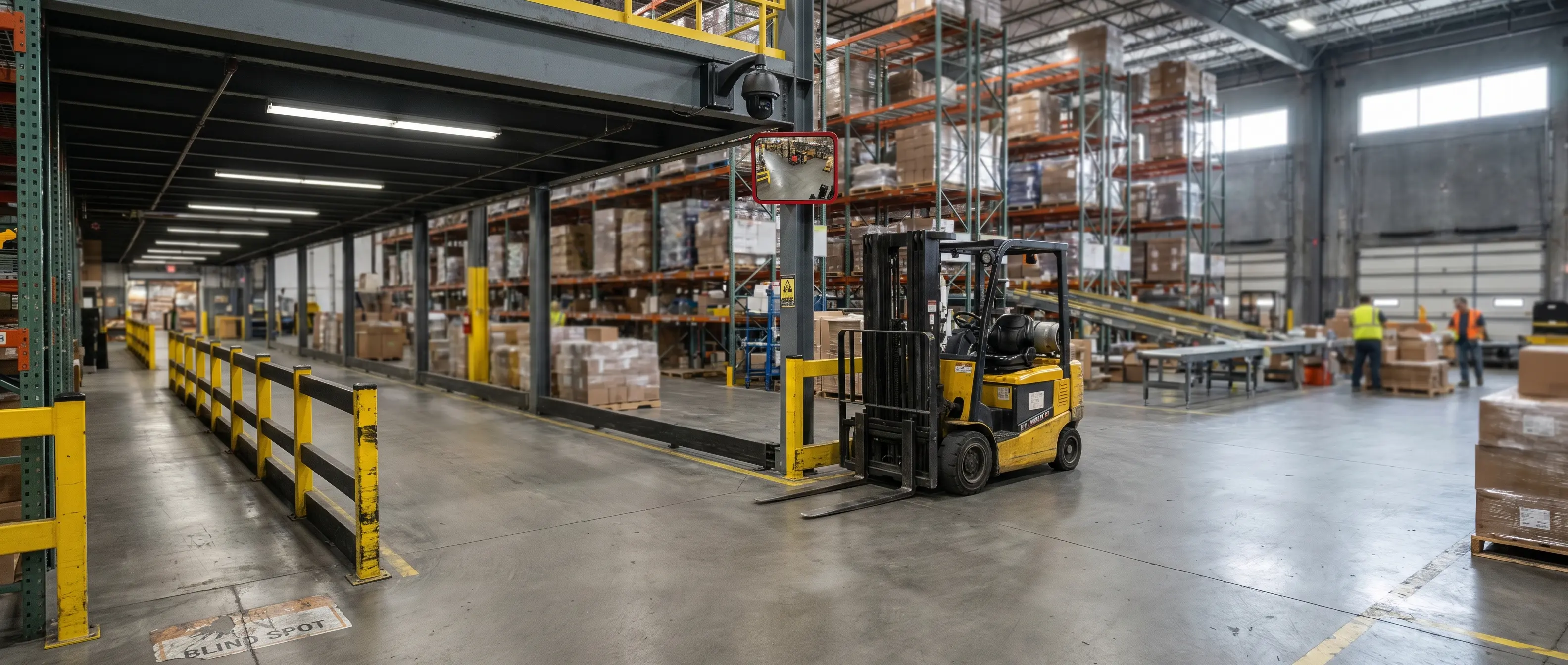
Blind spots are not random. They cluster around predictable points where physical structures, equipment geometry, or workflow patterns break line of sight. If you're auditing your facility, these are the high-risk zones to map first:
- Aisle intersections and racking corners: Forklift carrying a tall load, pedestrian rounding the corner, neither visible to the other until the last meter.
- Loading dock approaches: Trailers parked tight against the building create a wall. A forklift exiting a dock door cannot see staging-area pedestrian traffic, which is where a blind spot monitoring system in a warehouse or distribution center earns its keep.
- Crane operating zones: The operator in the cab has a top-down view but loses the underside of the load. Personnel walking under the projection area are invisible at certain angles.
- Conveyor crossings and AGV paths: A pedestrian crosses where automated equipment moves on a fixed schedule, often with limited audible warning.
- Mezzanine edges and elevated platforms: Personnel on the upper level are out of sight from forklift operators positioning loads below.
- Heavy vehicle reverse paths: Trucks, telehandlers, and large mobile equipment have rear-quarter blind zones that exceed 3 meters in length, the classic case for forklift blind spot detection at outdoor yards and loading bays.
- Press and machine approach corridors: Operators focused on the work piece miss personnel approaching from the side or rear.
- Door-controlled transitions: Automatic dock doors and high-speed roll-up doors hide pedestrian or vehicle traffic behind them until the moment of opening.
Most facilities have between 12 and 30 of these zones once mapped honestly. Few have systematic coverage of more than a handful.
Why mirrors, spotters, and painted lines fall short
Traditional blind spot countermeasures work, partially, until they don't. Each one has a failure mode tied to the same root cause: they depend on consistent human compliance.
Convex mirrors miss moving hazards above 5 meters per second
A standard convex mirror at an aisle intersection compresses a wide angle into a small reflective surface. The optics force the operator to interpret motion that's already shrunk by a factor of five or six. At forklift speeds above 5 meters per second, the time between a hazard becoming visible in the mirror and reaching the intersection is under one second. That's useful for slow-moving traffic, marginal for production-pace operations. Speed itself is part of the blind-spot equation; our vehicle speed detection in industrial areas guide covers the speed-context piece in depth.
Spotter availability is a coverage problem, not a detection problem
Assigning a spotter to a high-risk crossing solves the detection problem during one shift, in one zone, when the spotter is paying attention. It doesn't scale. Most facilities have far more blind zones than dedicated personnel, and spotters are themselves exposed to the same hazards they're watching for.
Painted floor markings depend on operator compliance
Yellow lines and pedestrian walkways work when everyone follows them. New hires learn them eventually. Visitors and contractors don't. On busy shifts under production pressure, even trained operators cut corners. The line is information, not protection.
The sensor-based alternatives and their trade-offs
Once a facility recognizes that human-dependent controls cap out, the natural move is sensor-based detection. Three technologies dominate the market, each with real strengths and real limits.
Ultrasonic and radar proximity sensors
These detect objects within a defined range, useful for fixed-zone protection around stationary equipment. The problem in cluttered industrial environments is contextual ambiguity. Ultrasonic sensors can't tell a person from a pallet. Radar performs better but still struggles with stationary metal racking, leading to either false positives that operators learn to ignore, or sensitivity tuning that misses real hazards.
UWB and RFID tag systems
Ultra-wideband and RFID tag systems work by giving every employee a wearable that broadcasts location to fixed anchors. When a tag enters a defined exclusion zone, the system alerts. The technology is mature and reliable, but it has a coverage gap that matters in safety contexts. Visitors don't have tags. Contractors often don't have tags. Workers who forget tags or have dead batteries are invisible. Our tag-based vs tagless safety comparison covers this trade-off in detail.
LiDAR scanners
LiDAR provides precise geometric mapping of zones around equipment, useful for outdoor logistics and AGV path safety. The detection is high-resolution but classification-blind: it sees an object's shape and distance, not what it is. A pallet, a person, and a piece of fallen scrap all read the same way. Tuning LiDAR to trigger only on relevant intrusions in a busy industrial zone is challenging.
| Technology | Tagless? | Person/object distinction | Reconfiguration | Typical latency |
|---|---|---|---|---|
| Convex mirrors | Yes | Operator-dependent | Manual repositioning | Human reaction (200-300ms) |
| Ultrasonic/radar | Yes | Limited | Wiring required | 100-200ms |
| UWB/RFID tags | No | Tag-only | Software | 200-400ms |
| LiDAR | Yes | Geometric only | Software | 50-150ms |
| AI camera (Edge) | Yes | Yes | Software | 30-100ms |
How AI camera blind spot detection works
AI camera systems for blind spot detection in industrial areas combine three capabilities that earlier technologies kept separate: tagless detection, contextual classification, and real-time intervention.
Edge AI processing keeps detection deterministic
In an Edge AI architecture, the camera itself runs the detection algorithms. Video frames are captured, analyzed, and acted on locally, with no round trip to a remote server. ISEE-CAM uses on-device NVIDIA Jetson processing to deliver detection latency between 30 and 100 milliseconds, every cycle, regardless of network conditions.
That deterministic latency matters at blind-spot intersections. A forklift at five meters per second covers half a meter in 100ms. At cloud-based latencies of 300 to 500ms, that same forklift has already covered 1.5 to 2.5 meters. The difference is whether the speed-reduction signal reaches the controller before contact or after.
Object classification distinguishes people from materials
Modern industrial AI camera systems use YOLO-architecture object detection trained specifically on industrial scenes. ISEE-CAM achieves above 95% accuracy in distinguishing people, forklifts, and other vehicles from pallets, racking, and stationary equipment. That distinction eliminates the false-positive problem that limits ultrasonic and radar deployments.
Software-defined zones make reconfiguration practical
Detection zones are defined in software, not in hardware placement. When a facility reorganizes a layout, adds a new dock, or shifts a packing line, zones move with a configuration change rather than a rewiring project. For facilities that change layouts more than once a year, this alone is a meaningful operational saving.
Direct PLC integration moves from alert to action
The strongest argument for AI camera blind spot detection isn't the alert. It's what happens after the alert. ISEE-CAM connects directly to existing automation infrastructure through OPC-UA, Modbus TCP, REST API, digital I/O, and CAN bus. When a pedestrian enters a forklift blind zone, the system doesn't just buzz the operator. It can send a speed-reduction signal to the forklift controller, trigger a traffic light change, or hold an automatic door open until the zone clears. This is the blind spot warning detection mode in operation, paired with forklift-pedestrian classification for shared zones.
Choosing a blind spot detection system for your facility
The right system depends on what you're protecting and what infrastructure you already have. A few questions sort the decision quickly.
Coverage area and detection range
Single-point sensors work for a defined corner. Wide-area cameras, particularly those with 25-meter detection range, cover entire aisle segments with one device. If your blind-spot inventory is concentrated, point sensors are economical. If it's distributed across a large facility, fewer high-coverage cameras typically deliver lower total cost.
Environmental conditions
Steel mills, foundries, and washdown environments destroy consumer-grade equipment within weeks. Ratings to look for: IP69K dust and water protection, vibration-rated housing, and operating temperature range from at least -20°C to +70°C. Ask vendors to show you deployments in environments comparable to yours.
Integration with existing infrastructure
A detection system that can't talk to your PLCs is a standalone alarm box. Verify protocol support before scoping: OPC-UA and Modbus TCP cover most modern PLCs, REST API handles MES and ERP connections, digital I/O works with relay-based legacy systems, and CAN bus is essential for direct forklift integration.
Compliance documentation
ISO 45001 and OSHA 1910.178 increasingly expect documented evidence of hazard identification and controls. Systems that automatically log every detection event with timestamp, zone, and image evidence reduce audit preparation time substantially. Systems that only alert without logging push that work back to your team.
Building the business case? Our forklift safety solutions guide lays out the ISEE-CAM modes that map to specific incident types, including the integrations that turn alerts into machine stops.
What measurable improvement looks like
Facilities deploying AI camera blind spot detection report incident reductions in the 40 to 70% range across the first year of operation. The variation depends on baseline incident frequency, the number of blind zones covered, and whether the system is configured for alerts only or for direct equipment intervention.
Consider a recent deployment at a Fortune 500 logistics operator. The team retrofitted four ISEE-CAM units across the highest-traffic aisle intersections in a regional distribution center. Each camera covered a 25-meter aisle segment and integrated with the forklift CAN bus to trigger automatic speed reduction within 3 meters of detected personnel. Over six months, near-miss reports at the covered intersections dropped 62%. Insurance underwriters reviewed the documentation and reduced workers' compensation premiums at renewal.
A steel manufacturer used the same computer vision platform for crane blind spot safety: personnel detection under the projection area paired with an industrial blind spot warning signal wired into the crane's pendant controls. The IP69K housing tolerated the heat and dust that had destroyed two previous camera installations. Over the first year, the facility recorded zero incidents in zones that had averaged three to four near-misses per month before deployment.
Beyond incident reduction, two secondary benefits show up consistently. Compliance documentation time drops because automated event logging replaces manual incident logs. Audits run faster because timestamped image evidence answers most auditor questions before they're asked. The National Safety Council estimates the average cost of a workplace fatality at over $1.17 million, which puts even a single prevented incident in clear financial perspective.
Closing the gap between preventable and prevented
Blind spots in industrial facilities are predictable, mappable, and addressable. The gap isn't usually awareness. EHS managers and plant directors know where the corners are. The gap is between the controls available a decade ago, which depended on operator behavior, and the controls available today, which don't.
Three takeaways for your next safety review:
- Map your blind zones systematically. Most facilities have 12 to 30 once they look honestly. Convex mirrors and yellow lines indicate awareness, not coverage.
- Match the technology to the failure mode. Tag-based systems leave visitors and contractors uncovered. Geometric sensors miss the person-versus-pallet distinction. AI camera detection with Edge processing closes both gaps and adds the integration path to active intervention.
- Insist on integration, not just alerts. A buzzer that requires a human to react is incremental. A signal that slows a forklift controller before contact is the difference between a near-miss and a logged event.
Blind spot detection sits inside the broader industrial traffic management discipline as one of the highest-leverage engineering controls. If you're evaluating blind spot detection in industrial areas for your facility, schedule a free site assessment. Our engineering team will walk the floor with your safety lead, identify the blind zones that matter most, and scope a deployment that integrates with the PLC infrastructure already in place.
The technology to close most of these gaps exists. The question is no longer whether it works, but how quickly you can put it in front of the corners that matter.