Vehicle speed detection in industrial areas: a technology guide for EHS teams
How does vehicle speed detection in industrial areas actually work? Compare speed limiters, geofence zones, and AI cameras. Schedule a free assessment today.
Vehicle speed detection in industrial areas: a technology guide for EHS teams
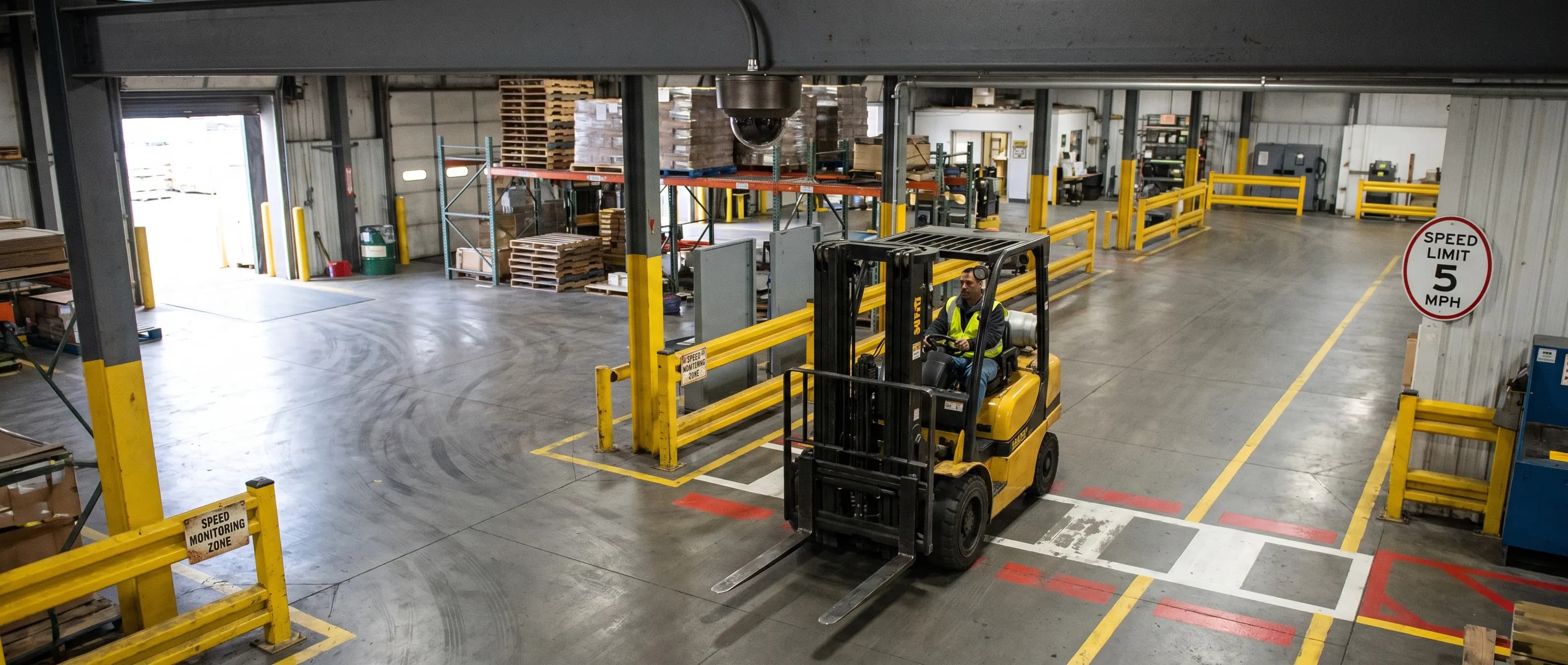
A loaded forklift moving at 8 mph needs roughly 42 feet to stop. A pedestrian rounds a rack 12 feet away. The math is the incident, not the operator's reaction.
Vehicle speed detection in industrial areas sits at the center of one of the most stubborn workplace safety problems we have. The National Safety Council reported 67 forklift-related workplace deaths in 2023, with an additional 24,960 nonfatal injury cases over 2021 and 2022. OSHA's powered industrial truck standard, 29 CFR 1910.178, doesn't post a number, it requires operators to drive at speeds appropriate for conditions. Most facilities post 5 mph and have no instrumentation to confirm whether anyone follows it.
That's the gap this article addresses. We'll cover what vehicle speed detection actually means in an industrial setting, what the standards say (and don't say), where overspeeding causes incidents on a typical plant floor, the four detection-and-enforcement approaches available today, and how AI camera-based forklift speed monitoring closes the gap that hardware limiters and tag-based geofences leave open. By the end you'll have a defensible framework for evaluating systems against your own facility's traffic patterns.
What is vehicle speed detection in an industrial setting?
Vehicle speed detection in an industrial setting is a safety capability that measures the velocity of forklifts, AGVs, tow tractors, and other mobile equipment in real time, then triggers an alert, a slowdown command, or an automatic stop when speed exceeds the configured threshold for that zone. Detection is the measurement; enforcement is the response.
The distinction matters in procurement conversations. A telematics dashboard that logs overspeed events for next week's safety meeting is detection without enforcement. A throttle governor that caps a single forklift's top speed is enforcement without contextual detection. The systems that actually reduce incidents combine both: they detect speed continuously, classify the surrounding context (pedestrian present, restricted zone entered), and intervene in milliseconds rather than minutes.
What the standards say about industrial vehicle speed
OSHA does not publish a hard speed limit for powered industrial trucks. In a 2004 standard interpretation letter that's still cited today, OSHA confirmed that "safe speed" depends on the type of truck, load, surface conditions, pedestrian traffic, and stopping distance: the totality of operating circumstances. The legal duty falls on the employer to set and enforce limits appropriate for each zone.
Industry consensus fills the gap. The most common references EHS managers cite during audits:
- MHEDA general guidance: maximum 8 mph in open areas, 3 mph in pedestrian zones
- Common posted limits: 5 mph indoors at most facilities
- ASME B56.1 stopping-distance formula: a calculation method for deriving the maximum safe speed given truck weight, load, and floor friction
- ISO 45001 clauses 6.1.2 and 8.1.2: hazard identification and operational planning, both of which require documented speed controls in vehicle traffic zones
- Stopping-distance reality check: at 4 mph a typical forklift needs roughly 17 feet to stop; at 8 mph, roughly 42 feet
The math reframes the policy. A 5 mph limit posted at an aisle intersection only protects pedestrians if the operator can see them at least 25 feet out. In most facilities with 12-foot aisles and tall racking, that line of sight doesn't exist.
Want to see how AI cameras handle the zone-by-zone speed problem at facility scale? Explore ISEE-CAM's detection modes →
Where overspeeding causes incidents on the plant floor
Overspeeding rarely causes an incident in a clear, straight aisle. It causes incidents at transition points, places where the operator's cognitive load spikes, line of sight changes, or pedestrian density shifts. Mapping these zones is the first step in any forklift speed monitoring deployment.
The high-risk transition points in most industrial facilities:
Aisle intersections and blind corners: An operator entering a cross-aisle at 6 mph has under a second to react if a pedestrian appears in the perpendicular line of travel. This zone overlaps directly with blind spot detection in industrial areas, the same intersection needs both speed control and visibility detection.
Loading dock approaches: A forklift accelerating out of a dock door encounters staging-area pedestrian traffic without a clean transition zone. Posted limits help; instrumented limits help more.
Pedestrian crossings and break-room paths: Walking traffic crosses vehicle paths at predictable times, shift change, lunch, end of day. Speed enforcement that ignores time-of-day patterns misses the actual risk window.
Yard-to-warehouse threshold: Outdoor yard trucks moving at 12 to 15 mph pass through high-speed roll-up doors directly into pedestrian-heavy receiving areas. This single threshold accounts for a disproportionate share of struck-by incidents in distribution-center deployments.
Four ways to detect and enforce vehicle speed in industrial areas
Industrial vehicle speed monitoring systems fall into four categories. Each one solves part of the problem and leaves part of it open.
1. Posted limits and operator training
The baseline, present in every facility. Painted speed signs, training-curriculum coverage of MHEDA recommendations, supervisor enforcement during walkthroughs. Cost per facility: nominal. Coverage: depends entirely on operator compliance and supervisor presence. Detection capability: zero. Enforcement capability: retrospective only, after a near-miss is reported.
2. On-vehicle speed limiters and governors
Aftermarket throttle-control modules installed per truck. Vendors include LoadingZoneSafety (Pace One G2), Quarion (SpeedNFORCE), Toptree, and several regional manufacturers. The module caps top speed at a programmed limit and, in newer models, accepts external triggers (such as pedestrian-detection signals) to drop the limit further. Coverage is per-vehicle: the truck you fitted is governed; the contractor's tractor that arrived this morning is not.
3. Zone-based geofence speed control (UWB or RF)
Anchored radio infrastructure (Zemco SL900Ci, Trio Mobil, Elokon ELOprotect) defines virtual speed zones inside the facility. Each forklift carries a tag or receiver. When the truck enters a defined polygon, its onboard governor enforces that zone's limit. Multi-zone, configurable, but requires both the anchor infrastructure and the per-truck receiver. Same coverage limitation as on-vehicle limiters: only equipped trucks are governed. (For a deeper look at the trade-offs, see our tag-based vs. tagless safety comparison.)
4. AI camera vehicle speed detection
Fixed cameras mounted at high-risk zones run on-device computer vision models that detect vehicle position frame by frame, calculate velocity, classify the vehicle type, and identify nearby pedestrians. When a forklift exceeds the zone limit (or moves at any speed near a detected pedestrian), the camera triggers an alert, a traffic-light change, or a direct stop signal to the connected forklift via CAN bus. Every vehicle in the camera's field of view is monitored: equipped, unequipped, contractor, visitor, rental.
| Approach | Coverage | Infrastructure cost | Contextual logic | Third-party trucks | Direct PLC/CAN enforcement |
|---|---|---|---|---|---|
| Posted limits + training | Everywhere | Low | None | Yes (passively) | No |
| On-vehicle limiter | Equipped truck only | Per-vehicle | Limited | No | Yes (own truck) |
| UWB/RF geofence zones | Tagged trucks in defined zones | Anchors + per-truck tag | Zone-based | No | Yes (own truck) |
| AI camera speed detection | Every vehicle in camera view | Per-zone camera | Speed + pedestrian + zone | Yes | Yes (any compatible truck) |
The procurement question isn't which approach is "best." It's which mix protects against the full set of vehicles that move through your facility, including ones you don't own or fit.
How AI camera speed detection actually works
Modern AI vehicle-speed cameras don't measure speed the way a radar gun does. They calculate it from the geometry of object tracking, frame by frame, on-device.
Object tracking and frame-to-frame velocity calculation
A YOLO-architecture detection model running at 30+ FPS identifies a forklift in each frame and assigns it a persistent track ID. The system measures the pixel displacement of the bounding-box centroid between frames, then converts pixels to real-world distance using the calibrated camera intrinsics and the known plane of the floor. Velocity is distance divided by elapsed frames. Accuracy in calibrated zones runs in the ±0.3 m/s range for typical industrial-camera mounts.
Edge AI processing: why on-device matters at 8 mph
Speed math is only useful if the response is fast. ISEE-CAM runs the full detection-and-decision pipeline on-device using NVIDIA Jetson hardware, with end-to-end latency under 100ms. A cloud-routed equivalent typically lands at 300 to 500ms under normal conditions. At 8 mph (3.6 m/s), that 400ms gap covers about 1.4 meters of forklift travel; meaningful when the action you're triggering is "slow down before the dock-door pedestrian zone."
Software-defined speed zones (no anchors, no rewiring)
Each camera covers up to 25 meters of detection range. Within that range, an EHS manager can define multiple polygonal speed zones in software, 3 mph at the dock approach, 5 mph in the cross-aisle, 8 mph in the through-lane. Reconfiguring a zone takes minutes in the management interface. There are no wall anchors to relocate, no UWB receivers to re-pair.
Contextual alerts: speed-with-pedestrian-proximity logic
This is where vision systems pull ahead of rule-based limiters. A forklift moving at 6 mph in a clear lane is acceptable. The same forklift at 6 mph with a pedestrian 3 meters away is an immediate hazard. ISEE-CAM's forklift-pedestrian safety detection (Mode 5) combines speed measurement with pedestrian proximity in a single decision. Hardware governors can't make that distinction.
Direct PLC and CAN-bus enforcement
The detection only matters if it can act. ISEE-CAM communicates with industrial controllers over OPC-UA, Modbus TCP, REST API, digital I/O, and CAN bus. In practice, that means the camera can drop a forklift's speed limit through its own controller, switch a traffic light at an intersection, or trigger a horn-and-strobe at a dock door: all from the same detection event, without an operator in the loop.
Ready to test the difference? ISEE Vision offers free site assessments to map your facility's speed-risk zones and design a deployment plan. Schedule one here →
Choosing a vehicle speed detection system for your facility
The right architecture depends less on the technology and more on the traffic pattern. Speed control is one piece of a broader program; pair it with the rest of the complete forklift safety solutions guide when you're scoping a deployment. A few decision filters:
Single fleet vs. mixed-vendor traffic. If every vehicle in your facility belongs to your fleet and stays inside the perimeter, on-vehicle limiters or UWB geofence systems will cover the population. If you have third-party logistics tractors, contractor trucks, rental forklifts during peak season, or visitor vehicles, only fixed-camera vision detects them. Distribution centers, port facilities, and steel mills almost always sit in the second category.
Coverage zones vs. number of vehicles. Hardware limiters scale with fleet size, 30 forklifts means 30 modules. Camera-based systems scale with zones, five high-risk transition points means five cameras, regardless of fleet size. The crossover point varies, but for fleets above 15 to 20 trucks, the camera approach typically wins on cost.
Integration with existing PLCs and traffic-light systems. If you already run a Siemens or Allen-Bradley control infrastructure, OPC-UA and Modbus TCP integration is non-negotiable. ISEE-CAM speaks both natively. Generic surveillance cameras with bolt-on analytics usually don't.
Compliance documentation. Every speed event captured by an AI camera generates a timestamped log entry with zone identification, vehicle classification, and a still-image snapshot. That's the evidence trail an ISO 45001 auditor expects to see. Posted limits and training records are necessary; instrumented logs are persuasive.
Total cost of ownership over 5 years. Hardware limiters carry low upfront cost and high installation labor at fleet scale. UWB systems carry significant anchor infrastructure cost up front. Camera systems carry per-zone hardware cost but no per-vehicle installation. Run the math against your fleet size and zone count before committing.
What measurable improvement looks like
Speed-control technology only earns its budget if the incident curve bends. The published evidence:
- NIOSH has documented up to 25% reductions in internal vehicle incidents at facilities deploying active speed-control systems
- National Safety Council case data shows up to $300,000 per facility per year in damage, claim, and downtime costs avoided after AI vision deployment (NSC Injury Facts)
- ISEE Vision deployments report 40 to 70% reduction in safety incidents within the first year, with insurance premium reductions in the 5 to 15% range tied to verified safety improvements
A representative deployment: a Fortune 500 distribution operator retrofitted four ISEE-CAM units at the highest-risk aisle intersections and the main dock entry. Each camera ran forklift-pedestrian Mode 5 with speed thresholds dropped to 3 mph when a pedestrian was detected within 4 meters. The facility's recorded near-miss rate at those four locations dropped by 62% over the six months following commissioning, with documented compliance reports auto-generated for the quarterly audit.
The deployment is repeatable because the architecture is. Same camera, same models, different zone polygons.
Closing the loop on vehicle speed detection in industrial areas
Three takeaways for an EHS manager building a budget request:
-
Detection without enforcement is a logbook. The systems that actually reduce incidents combine real-time speed measurement with automatic intervention: a stop signal, a slowdown command, a traffic-light change. Telemetry-only platforms have their place, but they don't prevent the next incident; they document it.
-
Per-vehicle limiters miss the trucks you don't own. Hardware governors and UWB tags only protect the equipment they're fitted to. If contractors, third-party logistics, or rentals operate in your facility, a facility-mounted detection layer is the only way to cover them.
-
Edge AI matters when speed matters. At industrial vehicle speeds, the difference between 100ms and 400ms response time is meters of travel. On-device processing isn't a marketing distinction; it's a physical requirement for stop-in-time interventions.
Vehicle speed detection in industrial areas is no longer a future capability. The technology is mature, the integrations are standardized, and the deployment data is documented. The remaining question is which architecture fits your traffic pattern. ISEE Vision offers free site assessments to map your speed-risk zones and recommend a deployment plan. Get in touch with our team to schedule one.