Photo eye sensors on industrial doors: what they do and miss
How a photo eye sensor protects people at an industrial door, what EN 12453 and UL 325 expect, where photo eyes fall short, and what an AI camera adds.
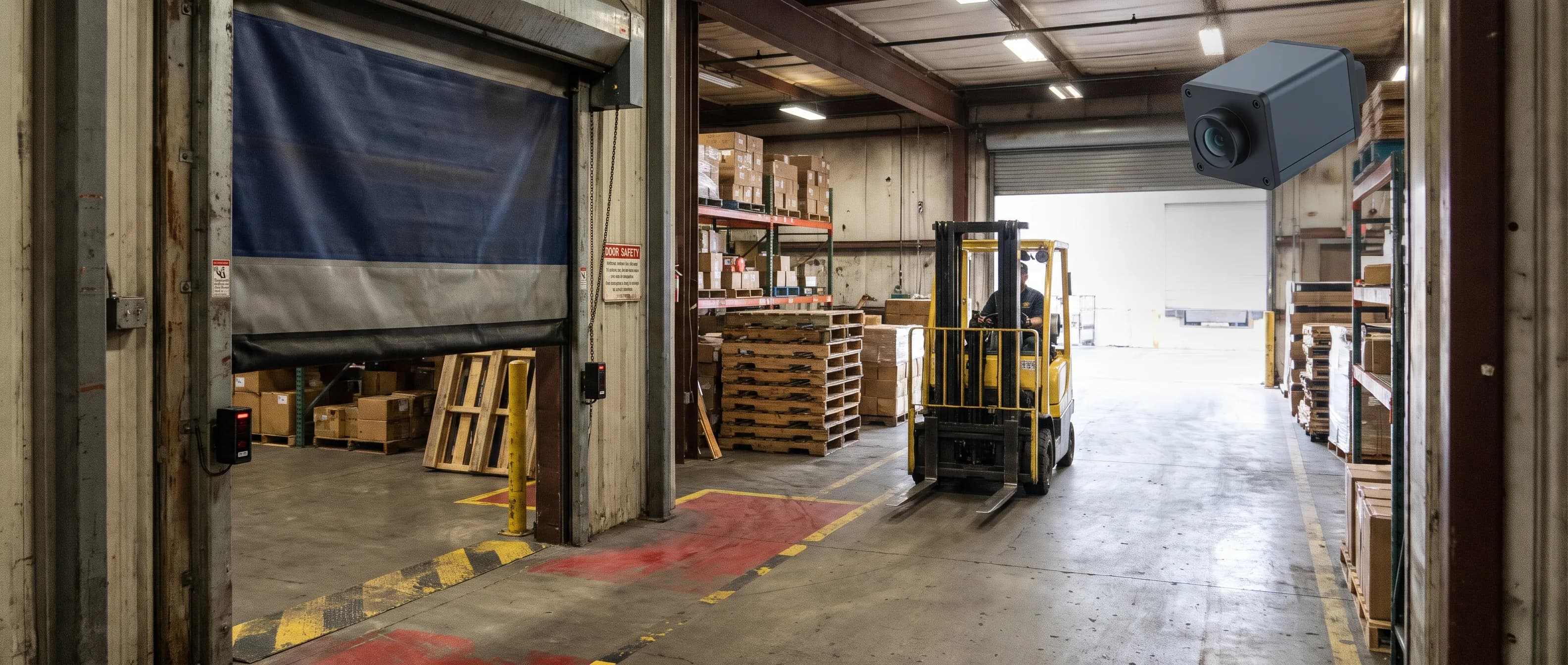
On an industrial door, the photo eye sensor is not there to open the door. Its job is to stop the door from closing on someone. That distinction explains most of the trouble we see at loading docks: one device is expected to handle safety, traffic and energy, and it was only designed for the first.
Below: how a photo eye works on an industrial door, which standards apply in Europe and the US, where photo eyes fall short, and what an AI camera adds and does not.
What is a photo eye sensor?
A photo eye is a photoelectric sensor. It detects when a light beam is broken, or when light bounces back from a surface, and turns that into an electrical signal.
There are three basic types:
- Through-beam: emitter and receiver sit in separate housings facing each other. An object breaks the beam.
- Retro-reflective: emitter and receiver share one housing, and a reflector on the other side returns the beam.
- Diffuse: the light reflects straight off the object back to the sensor.
According to the photoelectric sensor overview on Wikipedia, through-beam gives the longest sensing range and the highest accuracy. Retro-reflective is only slightly less accurate, and diffuse is the least accurate of the three. For the wiring side (NPN vs PNP outputs, dry contacts, relays), see our guide to sensor outputs and safety relays.
How a photo eye sensor works on an industrial door
On a powered industrial door, the photo eye detects an obstruction in the closing path and tells the door controller to stop or reverse. The most common layout is a through-beam pair mounted low on both door jambs. Some doors use a single retro-reflective unit with a reflector on the opposite jamb.
Opening is usually handled by something else: an inductive floor loop, a radar motion sensor, a pull cord or a push button. Keeping those two jobs apart, the open trigger and the closing protection, is the first step to fixing most door problems.
Why closing protection matters
The photo eye's real job is to keep a closing door from crushing or trapping a person or a vehicle. This is not a theoretical risk.
The UK Health and Safety Executive (HSE) reported that two children died in the summer of 2010 after becoming trapped in powered gates. HSE gave two causes: their presence at the closing edge was not detected, and the closing force was too high. The alert lists safety edges, light beams and force limitation together, and notes that force limitation is unlikely to be enough to stop injury on its own.
A separate HSE bulletin from February 2010 is even more instructive. In a fatal incident, the light beam between the gate pillars was there to stop the gate closing on a vehicle. It was not designed to detect a person in the crushing zone. The photo eye existed. It was protecting the wrong place.
Which standards apply to industrial doors?
Europe: EN 13241 and EN 12453
In Europe, two standards are read together for powered industrial doors: the product standard EN 13241 and the safety-in-use standard EN 12453. Ask the supplier and installer for the declaration of conformity showing which standards the door was assessed against.
Door maker Manusa's explainer on EN 13241 says EN 13241 sets out performance characteristics for industrial, commercial and garage doors and gates. EN 12453 complements it on protection against crushing, shearing and entrapment, force limitation, and detection of people or obstacles. Manusa also notes that a motorised door counts as both a construction product and a machine, so machinery and EMC rules apply as well.
The current edition is EN 12453:2017+A1:2021, listed as confirmed and in force on its standards record. It covers powered doors, gates and barriers within reach of people. Lock and dock gates, lift doors, vehicle doors and pedestrian-only barriers are outside its scope. Automatic pedestrian doors have their own standard, EN 16005:2023+A1:2024, which in turn excludes vertically moving doors and doors used in industrial processes.
Manusa makes one more point worth repeating. Conformity does not depend only on fitting certain sensors; the door is assessed as a whole. Removing protective devices or changing the safety control may require a reassessment.
United States: UL 325
In the US, door operators are listed to UL 325. A DASMA technical tip by LiftMaster's training manager states that since August 29, 2010, UL 325 has required commercial door operators to use constant pressure to close or a primary external monitored entrapment protection device, typically a photo eye. The same article says photo eyes used for primary entrapment protection must be installed parallel to the floor and no higher than 6 inches above it. Mounting them higher to protect vehicles conflicts with the requirement; extra photo eyes, edges or loops can be added for vehicles.
Where photo eye sensors fall short
A photo eye does one well-defined job: is something in the beam, or not? Problems start when we expect more.
- It only sees the beam line. An object above or below the beam, such as a raised load, may not be detected. If the crushing zone does not match the beam line, protection is incomplete. That is exactly the HSE case.
- It does not know what it sees. A person, a pallet and a loose piece of stretch film all produce the same signal. A photo eye cannot answer "who" or "what."
- Paired with motion sensors, it causes false openings. A radar-triggered door opens for the pedestrian walking past and for the forklift passing alongside. According to Rite-Hite, door openings are among the biggest sources of energy loss in a building, and the problem is amplified in large warehouses and manufacturing plants.
- Dirt and alignment. Lenses foul in dusty or steamy areas. A forklift clipping the jamb knocks the beam out of line. Periodic testing and a maintenance log are essential.
High-speed and sectional doors: typical scenarios
High-speed roll-up doors with PVC curtains serve busy internal forklift routes. The problem there is usually flow: open for everything and the cold room or clean area is no longer separated; open late and the forklift hits the curtain. Sectional dock doors are heavier and slower, so closing protection matters more, with the bottom safety edge and photo eye working together.
At both we hear the same three complaints: the door opens needlessly for pedestrians, forklifts wait in front of it, and people and trucks pass through the open door at the same time. The third is not a door fault. It is a traffic problem, which we cover in our traffic management guide. Door corners are also classic blind spots; see our blind spot monitoring guide.
Photo eye vs radar vs AI camera
The closing protection column is the door's mandatory safeguard; the other columns are about operations.
| Method | Closing protection (entrapment) | Open trigger | Person vs forklift | Detection area | False openings |
|---|---|---|---|---|---|
| Photo eye (through-beam / retro-reflective) | Yes, if selected to the door standard | Rarely | No | Single beam line | High if used to open |
| Safety edge (bottom profile) | Yes, on contact | No | No | Leading edge | None |
| Radar / motion sensor | No | Yes | No | Cone in front of door | Medium to high |
| Inductive floor loop | No | Yes, metal vehicles only | Partly (vehicle present or not) | Loop area | Low; ignores pedestrians |
| AI camera | No, does not replace it | Yes | Yes | Drawn zone (forklifts up to 20 m, people up to 25 m) | Low, rule-based |
The last row matters most: the camera improves opening and flow, not closing protection.
What an AI camera adds to an industrial door
An AI camera classifies what is in a zone drawn in front of the door and signals the door controller accordingly. Instead of "the beam is broken," it reports "a forklift is in the zone" or "a person is in the zone."
ISEE-CAM has two detection modes for doors. Forklift-door interaction (Mode 15) detects forklifts up to 20 m away, opens the door only for forklifts, and holds it open while a forklift or a person remains in the zone. Personnel-door interaction (Mode 16) does the same for pedestrian doors, detecting people up to 25 m away; forklifts and carried materials do not open it.
On site, that means three things:
- Selective opening: the high-speed door opens for forklifts only, and pedestrians use the side door. Rules are set in the web interface.
- Earlier opening, less waiting: the approach zone can be far larger than a beam line, so the door starts opening before the truck arrives.
- A record: every opening is logged and summarised in daily, weekly and monthly reports. Where the needless openings come from stops being an argument and becomes data.
Detection runs on the device, with alert-to-output latency under 100 ms. The housing is IP69K and rated from −20 to +70 °C; for freezer doors, the mounting side is decided in a site survey. The camera connects to the door controller by dry contact or through the PLC, with three outputs and one input. One output can drive the door while another lights a warning lamp on the far side. Details are on the PLC integration page.
Does the camera replace the door's safety photo eye?
No. The photo eye, safety edge and force limitation that protect people as the door closes are mandatory parts of the door, chosen through the manufacturer's risk assessment and the door standard. They stay exactly as they are. ISEE-CAM's own product pages say so: it is not a certified door safety sensor.
The camera is a flow and awareness layer on top of that chain. Its output asks the door to open or stay open; protection against closing on someone stays in the door's own safety circuit. Connecting it never requires bypassing a safeguard.
FAQ
What does a photo eye sensor do on an industrial door?
It detects an obstruction in the closing path and tells the controller to stop or reverse the door. Its main job is entrapment protection. Opening is usually triggered by radar, a floor loop or a button.
Why does my industrial door keep opening by itself?
Common causes are dirty lenses, misalignment, stretch film or hanging objects in the beam, and a motion sensor reacting to everything that passes. Check lenses and alignment first. If the open trigger is the problem, narrow its field or use a trigger that can tell objects apart.
Can an AI camera replace a door photo eye?
Not for closing protection. The camera manages the opening and flow side by telling forklifts from people. The door's photo eye, safety edge and force limitation stay in place.
Conclusion: photo eyes protect, cameras manage flow
The photo eye sensor on an industrial door has one clear safety job: stop the closing door from hitting anyone. Photo eyes, safety edges and force limitation selected to EN 12453 or UL 325 do that job together, and they stay.
What a photo eye cannot do is understand who is coming. Needless openings, forklifts waiting at the door, and people and trucks passing at the same time are flow problems. That is the layer where an AI camera helps.
Is your door opening all day for nothing? Send us a short video of the traffic at the door, the door type and the controller model. We will suggest the camera position, the approach zone and how to wire the open signal. Contact our team.
Contact: info@isee-vision.com · +90 216 455 95 44
Sources
- Photoelectric sensor, Wikipedia
- Powered perimeter gates, HSE Safety Alert
- Risks to pedestrians from crushing zones on electrically powered gates, HSE
- Industrial doors: EN 13241 standard explained, Manusa
- EN 12453:2017+A1:2021, Genorma
- EN 16005:2023+A1:2024, Genorma
- At what height are you installing commercial photo eyes?, DASMA / Door & Access Systems, Spring 2014
- Understanding high-speed doors and industrial curtains, Rite-Hite