Employer PPE obligations: five duties under EU and OSHA rules
Employer PPE obligations under EU Directive 89/656/EEC and OSHA 1910.132: hazard assessment, free provision, training, supervising use and keeping records.
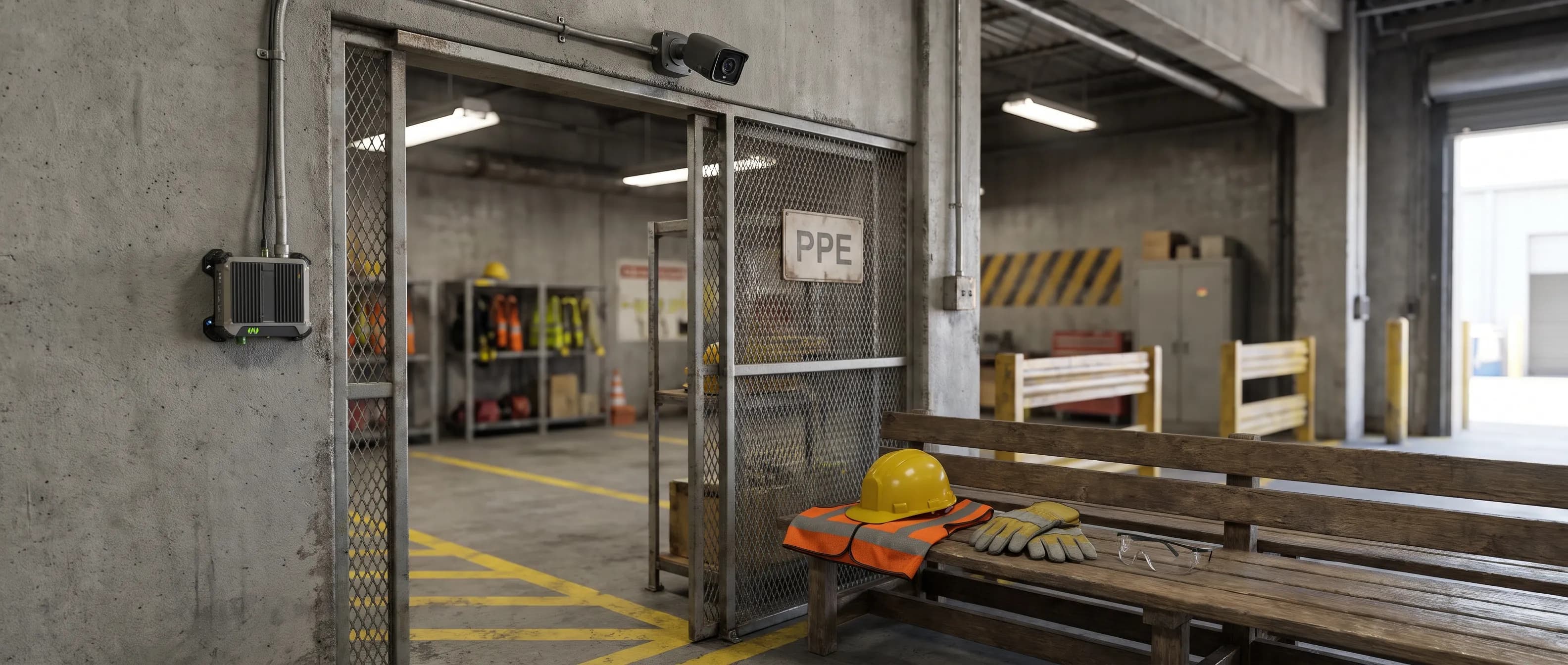
Employer PPE obligations do not end when the hard hats are handed out. In both the EU and the US, the rules ask employers to choose the right equipment, pay for it, train people to use it, make sure it is actually worn, and be able to show all of that. The fourth duty is where most sites slip. Hats are issued, training is signed off, the file looks complete, and on the floor half the shift has a hat clipped to their belt.
A 2022 field study by Türkiye's national OSH research institute (İSGÜM) found exactly that pattern in ten metalworking and construction sites: workers had received PPE training, yet actual use was inadequate. Some used dust masks while working with gaseous chemicals, which offer no protection against gases (İSGÜM field analysis report, in Turkish). The problem is not local. It is what happens when PPE is treated as a purchase rather than a process.
This guide maps the five duties to the two texts most English-speaking safety managers work with: EU Council Directive 89/656/EEC on the use of PPE at work, and OSHA's general PPE standard, 29 CFR 1910.132.
Two kinds of PPE rules: use at work vs placing on the market
There are two separate layers of PPE law, and they address different people. The EU splits them cleanly into two texts; in the US, OSHA 1910.132 is the employer-side text for general industry.
| Use at work | Product (market) rules | |
|---|---|---|
| EU text | Council Directive 89/656/EEC | Regulation (EU) 2016/425 |
| Addresses | Employers and workers | Manufacturers and their representatives |
| Covers | Selection, provision, training, use, maintenance | Design, conformity assessment, CE marking |
Regulation (EU) 2016/425 covers the design, manufacture and marketing of PPE, and the European Commission notes that CE marking can only be affixed after testing and the required conformity assessment (European Commission, PPE). The employer is not the manufacturer, but under the use directive the equipment it provides must comply with the product rules. In practice: do not accept PPE without a CE mark, instructions in the workers' language and a declaration of conformity.
Why PPE comes last in the hierarchy of controls
PPE does not remove a hazard. It puts a layer between the worker and the hazard. NIOSH ranks controls as elimination, substitution, engineering controls, administrative controls and, last, PPE. It notes that PPE can be effective only when workers use it correctly and consistently (NIOSH, Hierarchy of Controls).
EU law says the same. Article 3 of Directive 89/656/EEC states that PPE shall be used when the risks cannot be avoided or sufficiently limited by technical means of collective protection or by work organization (Directive 89/656/EEC, Article 3).
On a loading dock, this means a high-visibility vest does not replace a physical barrier between forklifts and pedestrians. PPE covers the risk that remains after everything else.
Employer PPE obligations: the five duties
Read together, the EU directive and the OSHA standard break the employer's job into five steps.
1. Select: start with a hazard assessment
Under OSHA 1910.132(d), the employer assesses the workplace for hazards, selects PPE that protects against them, and selects PPE that properly fits each affected employee. The employer must also verify the assessment with a written certification naming the workplace evaluated and the date (OSHA 29 CFR 1910.132).
The EU version is Article 5 of the directive. Before choosing PPE, the employer analyses the risks that cannot be avoided by other means, defines the characteristics the PPE needs (including any risks the equipment itself creates), and compares the products available against those characteristics. The assessment is reviewed whenever any element changes (Directive 89/656/EEC, Article 5).
2. Provide: free of charge, maintained, available
Article 4(6) of the directive requires PPE to be provided free of charge by the employer, who keeps it in good working order and hygienic condition through maintenance, repair and replacement (Directive 89/656/EEC, Article 4). OSHA 1910.132(a) requires PPE to be provided, used and maintained in a sanitary and reliable condition. Under 1910.132(h), the employer generally pays for required PPE, with listed exceptions such as certain non-specialty safety footwear and everyday clothing.
3. Train: hands-on, in language people understand
The directive requires the employer to first inform workers of the risks the PPE protects them against (Article 4(7)) and to arrange training and, where appropriate, demonstrations in wearing it (Article 4(8)). Instructions must be understandable to the workers (Article 4(9)).
OSHA 1910.132(f) is more specific. Each employee must know when PPE is necessary, what PPE is necessary, how to put it on, take it off, adjust and wear it, its limitations, and its care and disposal. If the employer has reason to believe a trained employee lacks the understanding or skill, it must retrain. The dust-mask-for-gas mistake above is what happens when training is a slide deck, not a hands-on session with the actual equipment.
4. Supervise use: the duty most sites miss
OSHA's wording matters here: PPE must be provided, used and maintained. "Used" makes wearing the employer's concern, not only issuing. The EU directive points the same way: PPE must be used in accordance with instructions, and only for its intended purposes.
The worker has duties too: wear the equipment correctly, check it, report defects. But a signed acknowledgement does not show that the equipment is worn at 3 a.m. on the night shift. Supervisors and safety managers need some way to see real use across every shift.
5. Record: evidence of supervision
OSHA requires the written hazard assessment certification described above. The EU directive requires adequate information on each item of PPE to be available within the establishment (Article 4(5)).
Beyond these, issue records, maintenance logs and records of non-compliance found on the floor are what you show an inspector or an incident investigation when you say "we supervised use". The rules do not prescribe the format, but supervision you cannot document is supervision you cannot prove. National rules in each EU member state add their own record-keeping and penalties, so check the transposing law where you operate. For operations in Türkiye, see our guide to occupational health and safety in Turkey.
How to supervise PPE use in practice
Most sites combine several methods. Each has a strength and a limit.
| Method | Strength | Limit | Produces records? |
|---|---|---|---|
| Supervisor or safety walk | Sees context, corrects on the spot | A snapshot; ends when the walk ends | Manual, irregular |
| Attendant at the entry point | Firm check at the zone entrance | Staffing cost; attention fades over a shift | Usually no |
| Turnstile or badge access | Stops unauthorized entry | Cannot tell if PPE is worn | Entry log |
| Continuous AI camera monitoring | 24/7, same criteria, automatic log | Limited to the camera's field of view | Yes, per violation |
A camera does not replace the safety walk. It covers the hours between walks and gives the safety team data on where, on which shift and which item is missing. For broader site measures, see factory workplace safety measures.
How an AI camera supports employer PPE obligations
ISEE-CAM adds a monitoring layer to duty four. Selection, provision and training stay with the employer and the safety team. Detection runs on the camera, and video does not leave the facility. We cover the technology in AI PPE detection; here is how it maps to the obligation.
- Hard hat and vest check (Mode 20): watches a work area with a 150° field of view up to 15 meters. If a hard hat or high-visibility vest is missing, it triggers an audible and visual alarm on site and logs the violation.
- PPE-controlled access (Mode 21): at the entrance to a hazardous area, it checks the items selected in the web interface: hard hat, vest, safety shoes, gloves, goggles, ear protection, mask and safety harness. If one is missing, the turnstile, door or barrier stays closed.
- Helmeted personnel counting (Mode 3): counts people with and without hard hats separately at entry and exit points.
Many sites use Mode 21 at the door and Mode 20 inside: entry is checked, and use inside the zone is monitored continuously. The violation logs feed duty five directly. The camera does not replace any safety function; machine guards, light curtains and interlocks stay in place.
FAQ
Who pays for PPE?
The employer. EU Directive 89/656/EEC requires PPE to be provided free of charge, and OSHA 1910.132(h) requires employers to pay for required PPE, with a short list of exceptions such as certain non-specialty safety footwear.
Does OSHA require a written PPE hazard assessment?
Yes. Under 1910.132(d)(2), the employer must certify in writing that the hazard assessment was performed, naming the workplace evaluated, the person certifying and the date.
Is the employer responsible if a worker refuses to wear PPE?
Workers must use PPE correctly, but the employer's duty covers use, not only provision. OSHA's standard requires PPE to be provided, used and maintained, so supervision and enforcement remain the employer's job.
Does PPE need a CE mark in the EU?
Yes. PPE placed on the EU market falls under Regulation (EU) 2016/425, and the CE mark shows the product went through the required conformity assessment.
Conclusion: PPE is a cycle, not a purchase
Employer PPE obligations form a cycle: assess and select, provide free of charge, train hands-on, supervise use, keep records. On most sites the weak link is supervision, because no one can watch every shift. Keep PPE in its place in the hierarchy too: after collective protection, never instead of it.
Tell us about your entry points and high-risk zones, and we will work out where Mode 21 belongs at the door and where Mode 20 belongs inside. Contact our team.
Contact: info@isee-vision.com · +90 216 455 95 44