OHS in Turkey: what Law 6331 asks of employers
OHS in Turkey explained for foreign employers: Law 6331 duties, hazard classes, OHS specialists, training, accident reporting and work stoppage. Learn more.
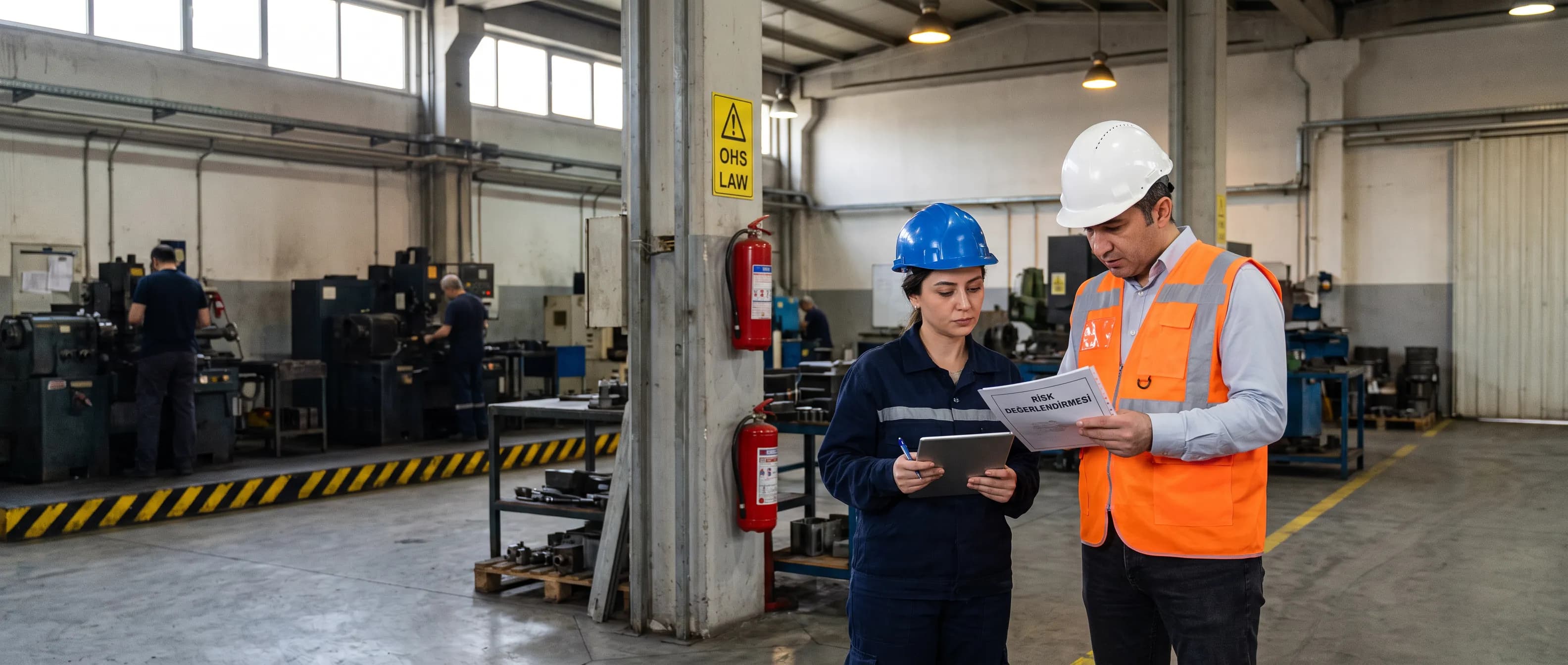
If your company is opening a plant, a warehouse or a project site in Türkiye, occupational health and safety (OHS) in Turkey will look familiar in principle and different in detail. OHS in Turkey rests on one law. That law is Law No. 6331 on Occupational Health and Safety, published in 2012. It covers every public and private workplace, and it puts the employer at the center of every obligation.
This guide is written for EHS managers and country managers at foreign companies. It covers the duties Law 6331 places on the employer, how a workplace's hazard class changes those duties, the people you must appoint, and where monitoring technology fits.
What is Law 6331, and who does it cover?
Law 6331 was published in the Official Gazette on 30 June 2012. Its stated purpose is to regulate the duties, authority, responsibilities, rights and obligations of employers and workers so that health and safety are ensured at the workplace and existing conditions improve (Law 6331, Turkish text, Ministry of Labour).
It applies to all work and workplaces in the public and private sectors, to employers and their representatives, and to all workers including apprentices and interns, regardless of the field of activity. The exceptions in Article 2 are narrow: certain military and police activities, disaster response, domestic services, and self-employed people with no employees.
The Ministry of Labour and Social Security publishes an English translation of Law 6331. It is a useful working copy. For legal decisions, rely on the current Turkish text, since the law has been amended several times.
What does OHS in Turkey require of employers?
Article 4 sets the general rule: the employer must ensure the health and safety of workers in every aspect related to work. In practice that breaks down into five duties:
- Take every preventive measure, including training and information, set up the organization, provide the equipment, and adapt measures as conditions change.
- Monitor and inspect whether the measures are followed, and fix nonconformities.
- Carry out, or have someone carry out, a risk assessment.
- Consider each worker's health and safety fitness when assigning tasks.
- Keep workers who lack adequate information and instructions out of areas with life-threatening or special hazards.
Two clauses matter for foreign groups that rely on contractors. Using outside experts or service providers does not remove the employer's responsibility. And the employer cannot pass the cost of OHS measures on to workers.
How do hazard classes change the rules?
Every workplace in Türkiye falls into one of three hazard classes: less hazardous, hazardous or very hazardous. The class is set by a Ministry communiqué and is based on the main activity carried out at the site (Article 9). Many deadlines and requirements depend on it:
| Requirement | Less hazardous | Hazardous | Very hazardous |
|---|---|---|---|
| OHS specialist certificate (Art. 8) | Class C or higher | Class B or higher | Class A |
| Risk assessment renewal | At least every 6 years | At least every 4 years | At least every 2 years |
| Basic OHS training (minimum) | 8 hours | 12 hours | 16 hours |
| Training refresh | At least every 3 years | At least every 2 years | At least once a year |
| Periodic medical examination | At least every 5 years | At least every 3 years | At least once a year |
Sources: certificate classes from Law 6331, Article 8. Risk assessment intervals from the Ministry's risk assessment guide (in Turkish). Training hours and refresh periods from the new training regulation published in the Official Gazette on 2 April 2026, No. 33212 (regulation text, in Turkish). Medical examination intervals from the Ministry's OHS FAQ (in Turkish); the workplace physician may shorten them.
A practical tip for a new site: confirm the hazard class before you budget. The class follows the site's main activity, and it decides how much specialist time, training and medical follow-up you need.
Who must you appoint?
OHS specialist and workplace physician. The employer appoints an OHS specialist and a workplace physician. In very hazardous workplaces with 10 or more workers, other health personnel are required as well (Article 6). Specialists must hold a Ministry-issued certificate of the class that matches the hazard class. If you have no qualified staff, you can buy the service in, fully or partly, from a joint health and safety unit.
Workers' representatives. The number scales with headcount: one for 2–50 workers, two for 51–100, three for 101–500, four for 501–1,000, five for 1,001–2,000 and six above that (Article 20).
OHS committee. Workplaces with 50 or more workers and continuous work lasting longer than six months must set up an OHS committee (Article 22).
Training, health surveillance and reporting
Under Article 17, training is given before work starts, when a worker changes job or work area, when equipment changes and when new technology is introduced, and it is repeated at regular intervals. Training time counts as working time. In hazardous and very hazardous work, nobody may start without a medical report confirming they are fit for the job (Article 15).
Work accidents must be reported to the Social Security Institution (SGK) within three working days of the accident (Article 14). Our post on occupational accidents in Turkey gives the national picture. The same article requires the employer to investigate and document events that caused no injury but damaged, or could have damaged, people or equipment. Those near-miss records feed your next risk assessment; see our guide to near miss reporting.
What can stop work at your site?
If a life-threatening hazard is found in the buildings, work methods or equipment, work is stopped in all or part of the workplace until it is fixed (Article 25). In very hazardous mining, metal and construction work, in work with hazardous chemicals and at sites where a major industrial accident could happen, the absence of a risk assessment is enough on its own to stop work.
Article 26 sets separate administrative fines for each obligation. Amounts change over time, so check the Ministry's current figures rather than relying on old tables.
Workers have duties too. Under Article 19 they must use the PPE provided correctly and report serious and imminent danger without delay. Under Article 13, a worker facing serious and imminent danger can ask the committee or the employer to act, and if the request is upheld, can refuse to work until measures are taken, with pay and rights protected.
How does Turkish law rank controls?
Article 5 lists the principles the employer must follow: avoid risks, evaluate risks that cannot be avoided, combat risks at source, replace the dangerous with the less dangerous, give collective protection priority over individual protection, and give workers appropriate instructions. This matches the hierarchy of controls most international EHS teams already use. NIOSH ranks elimination, substitution and engineering controls above administrative controls and PPE because they depend less on worker behavior (NIOSH).
Signs and PPE sit at the bottom of that list, and Turkish regulations treat them that way. Our guides to workplace safety signs and employer PPE obligations cover both in more detail.
Where does monitoring technology fit?
Technology plays two roles in OHS in Turkey, as anywhere. Some of it is an engineering control: machine guards, light curtains and safety PLCs physically remove the hazard. These are certified safety devices, and nothing replaces them.
The rest is monitoring, and it serves the Article 4 duty to check that measures are followed. One OHS specialist cannot watch every zone on every shift. ISEE-CAM runs detection on the device and flags people in restricted zones, missing hard hats and vests, or forklifts and pedestrians getting too close. It drives sirens, beacons or a machine stop through PLC integration, with less than 100 ms from detection to output. It does not replace the machine's safety system. It adds a layer and produces a record of where the rules break down, which is what your specialist needs for the next risk assessment.
Because the video is processed on the camera, it does not have to leave the site. That matters under Türkiye's personal data protection law; see our PDPL compliance guide for industrial cameras.
Frequently asked questions
Does Law 6331 apply to foreign-owned companies?
Yes. It applies to all public and private workplaces in Türkiye regardless of the field of activity. Ownership does not change the obligations.
Can we outsource OHS services in Turkey?
Yes. Employers without qualified staff can use a joint health and safety unit. The employer remains responsible for compliance either way.
How often must a risk assessment be renewed in Turkey?
At least every 2 years in very hazardous workplaces, every 4 years in hazardous ones and every 6 years in less hazardous ones, and earlier when conditions change, for example when the workplace moves.
How fast must a work accident be reported?
Within three working days of the accident, to the Social Security Institution (SGK).
Key takeaways on OHS in Turkey
Occupational health and safety in Turkey runs on one law and one principle: the employer owns every link in the chain. Confirm your hazard class early, appoint certified professionals or a joint unit, keep the risk assessment current, train on schedule and report accidents within three working days. Then make sure you can show that the measures are followed on the floor, not just written down.
Planning a new site or reviewing an existing one? Send us a few photos or a short video of your hazard zones, entrances and vehicle routes, and we will discuss which rules can be monitored where. Contact us.
Contact: info@isee-vision.com · +90 216 455 95 44