Workplace safety signs: types, colors and where they fall short
Workplace safety signs explained: ISO 7010 shapes and colors, EU Directive 92/58/EEC, OSHA 1910.145, where to mount signs, and why signs alone are not enough.
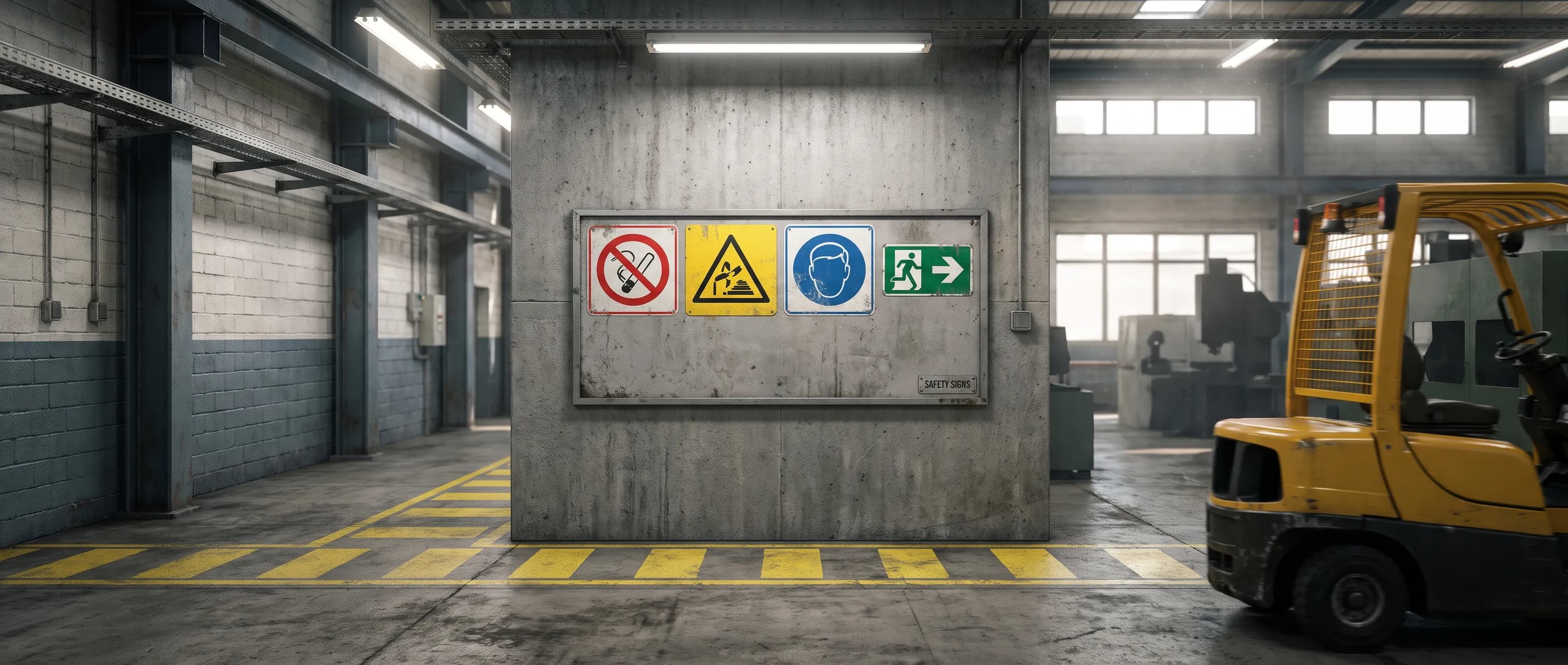
A "No entry for unauthorized persons" sign hangs at the entrance to a press shop. It has been there for three years. Hundreds of people walk past it every day, and nobody reads it anymore. Workplace safety signs state the rule correctly, but they have no idea whether anyone follows it.
This guide covers what the rules ask for first: which sign takes which shape and color under ISO 7010 and EU Directive 92/58/EEC, how US signs differ under OSHA 1910.145, and where signs should go. Then it looks at where a sign stops working and how to close that gap.
Which rules govern workplace safety signs?
In the EU, workplace safety signs are governed by Council Directive 92/58/EEC on safety and health signs at work. It is one of the individual directives under the OSH Framework Directive 89/391/EEC, and each member state transposes it into national law (EU-OSHA).
The Directive requires signs where risks cannot be avoided or adequately reduced by collective protection or by how work is organized. Employers must also inform workers about the signs and train them on what each one means (Directive 92/58/EEC, EUR-Lex). Two points follow. A sign is not a first-line control. And a sign that workers were never taught to read does very little.
The pictograms themselves usually come from ISO 7010. In the US, OSHA 29 CFR 1910.145 sets the rules for accident prevention signs and tags.
Where do signs sit in the hierarchy of controls?
Signs are an administrative control. The NIOSH hierarchy ranks controls from most to least effective: elimination, substitution, engineering controls, administrative controls, and PPE. The top three work better because they do not depend on what a worker chooses to do (NIOSH). A sign depends entirely on someone seeing it, understanding it and acting on it.
Workplace safety signs by type and color
Annex II of Directive 92/58/EEC defines five signboard types. Each has a fixed shape, a background color and a minimum share of the sign area that the safety color must cover.
| Sign type | Shape | Colors | Minimum safety color | Meaning | ISO 7010 examples |
|---|---|---|---|---|---|
| Prohibition | Round | Black pictogram on white, red edging and diagonal bar | Red at least 35% | Forbids a dangerous action | No smoking, No access for forklift trucks |
| Warning | Triangular | Black pictogram on yellow, black edging | Yellow at least 50% | Draws attention to a hazard | Electricity, Forklift trucks and other industrial vehicles |
| Mandatory | Round | White pictogram on blue | Blue at least 50% | Requires a specific action | Wear head protection, Wear eye protection |
| Emergency escape and first aid | Rectangular or square | White pictogram on green | Green at least 50% | Shows escape routes and first-aid points | Emergency exit, First aid, Eyewash station |
| Fire-fighting equipment | Rectangular or square | White pictogram on red | Red at least 50% | Shows where fire equipment is | Fire extinguisher, Fire hose reel |
What color are mandatory signs?
Mandatory signs are blue. They are round, carry a white pictogram on a blue background, and the blue must cover at least half the sign. ISO 7010 examples include "Wear head protection", "Wear ear protection" and "Wear a safety harness". The most common mix-up on the floor is between mandatory and prohibition signs, because both are circles. Look at the background: white with a red bar means "don't", solid blue means "do".
What does ISO 7010 add?
ISO 7010 prescribes the safety signs themselves for accident prevention, fire protection, health hazard information and emergency evacuation. Per the standard, the shape and color of each sign follow ISO 3864-1, and the graphical symbols follow ISO 3864-3 (ISO 7010:2019 scope). The current edition dates from 2019.
The practical value is a pictogram that works without words. On a site where contractors and workers speak different languages, the same ISO 7010 symbol on every door means the same thing to everyone.
How do US signs differ under OSHA 1910.145?
OSHA 1910.145 classifies signs by hazard level rather than by pictogram shape. Danger signs mark immediate danger and use red, black and white. Caution signs warn of potential hazards and use a yellow background with a black panel. Safety instruction signs give general instructions on a white background with a green panel. A separate biological hazard sign covers biohazards (OSHA 1910.145).
The color specifications point to ANSI Z535.1. For a US plant that also follows EU or ISO practice, the usual approach is a signal-word header in the OSHA style with an ISO 7010 pictogram beside it.
How are obstacles and traffic routes marked?
Annex VII of the Directive covers floor and structure marking. Obstacles and places where people can bump into something, fall or be hit by falling objects are marked with alternating yellow-and-black or red-and-white stripes at roughly 45 degrees. Vehicle routes are marked with continuous yellow or white lines, chosen to stand out against the floor, and drawn to keep a safe distance between vehicles, nearby objects and pedestrians.
In a warehouse where forklifts and pedestrians share the floor, these lines carry a lot of weight. They are still paint, not a barrier. We cover the layered approach in our guide to traffic management in industrial areas.
Where should workplace safety signs be placed?
The Directive's placement rules come down to four points:
- Right spot: Next to a specific hazard, or at the entrance to a generally hazardous area.
- Right height: At a suitable height and position for the line of sight, taking obstacles into account.
- Lighting: In a well-lit, easily visible place. Where natural light is poor, use fluorescent colors, reflective material or artificial lighting.
- Removal: Take the sign down once the situation it describes no longer exists.
Two more rules matter in practice. Do not cluster many signs close together. And if anything, including PPE, makes it harder for workers to see or hear a signal, strengthen or replace that signal.
Why are workplace safety signs not enough on their own?
The short answer: a sign states the rule but cannot enforce it. A prohibition sign does not know who entered the zone, does not warn the person who did, and does not record the event.
The second problem is habituation. Eyes that pass the same sign every day stop seeing it. Brain imaging points the same way: in an fMRI study of 22 participants, the visual-processing response to a repeated security warning dropped with each repetition and kept dropping across all six exposures (Kirwan et al., 2020). That study used on-screen software warnings, not wall signs. It still gives good reason to expect the same fatigue in front of a sign you see a thousand times a year. The rule against clustering signs is an admission of the same problem.
The third problem is that a sign cannot be measured. An EHS manager can confirm the sign is up. They cannot say how many times the zone was entered last month. An auditor will ask how you check that controls are followed, and "the sign is there" is not an answer.
| Control | Defines the rule | Detects a breach | Warns in the moment | Creates a record | Physically blocks |
|---|---|---|---|---|---|
| Sign | Yes | No | No | No | No |
| Floor marking | Yes | No | No | No | No |
| Barrier, guardrail | Partly | No | No | No | Yes |
| Badge access, turnstile | Yes | At the gate | Partly | Yes | At the gate |
| AI camera | No, it backs up the sign | Yes, inside the zone | Yes | Yes | No, it sends an output |
This is a list of layers, not a ranking. The strongest setup has the sign stating the rule, the barrier providing physical separation and a monitoring layer catching whatever gets past both. Machine safety functions such as light curtains, interlocked doors and safety relays are not part of this trade-off. They stay exactly where they are.
How do you monitor the zone a sign defines?
You can draw the area a sign describes as a detection zone on a camera and give the rule to the software. ISEE-CAM is an industrial camera built for this. Detection runs on the device, video does not have to leave the facility, and the time from detection to output is under 100 ms.
The counterpart of a red prohibition sign is restricted area personnel detection (Mode 0). It detects people up to 25 m away inside zones drawn in the web interface. When someone crosses the line, its dry-contact outputs drive a siren, a beacon or a PLC signal. Events roll up into daily, weekly and monthly reports, so "how many entries last month?" finally has a number.
The counterpart of a blue mandatory sign is PPE-checked access control (Mode 21). At a "Wear head protection" entrance, if one of the selected PPE items is missing, the turnstile, door or barrier stays closed and the attempt is logged. Our post on employer PPE obligations covers what the rules expect beyond the gate.
Around machines, personnel detection in hazardous machinery zones works the same way. None of these replace the sign, and none replace the machine's safety circuit. They add a layer that makes the sign's rule visible and measurable.
Frequently asked questions
How many types of workplace safety signs are there?
EU Directive 92/58/EEC defines five signboard types: prohibition, warning, mandatory, emergency escape and first aid, and fire-fighting equipment. Each has a set shape and color.
What color are warning signs?
Warning signs are triangles with a black pictogram and black edging on a yellow background. Yellow must cover at least 50% of the sign.
What color are mandatory signs?
Mandatory signs are blue circles with a white pictogram. Blue must cover at least 50% of the sign.
Is ISO 7010 mandatory?
That depends on national law. The EU Directive sets shape and color rules without naming ISO 7010, and OSHA 1910.145 uses its own classification. ISO 7010 pictograms follow the same shape and color logic, which is why most sign makers use them.
Does putting up a sign meet the employer's duty?
Not on its own. Signs are for risks that collective protection and work organization cannot adequately reduce. Employers must also train workers on the signs and check that controls are actually followed.
Key takeaways
Workplace safety signs are the shared language of the floor: red forbids, yellow warns, blue commands, green shows the way out. Choosing the right type, mounting it in the right spot with good light and keeping the count low is half the job. The other half is knowing whether the rule on the sign is followed.
Let's look at your restricted zones and PPE entrances together. Send us a photo or short video of the area and tell us what should happen when someone enters. We will propose the camera position, the zones and the output wiring. Contact us.
Contact: info@isee-vision.com · +90 216 455 95 44