HACCP principles and kitchen hygiene: where the plan meets the prep line
The 7 HACCP principles explained, with Codex, FDA and EU 852/2004 references, and why kitchen hygiene rules like hairnets and handwashing are hardest to audit.
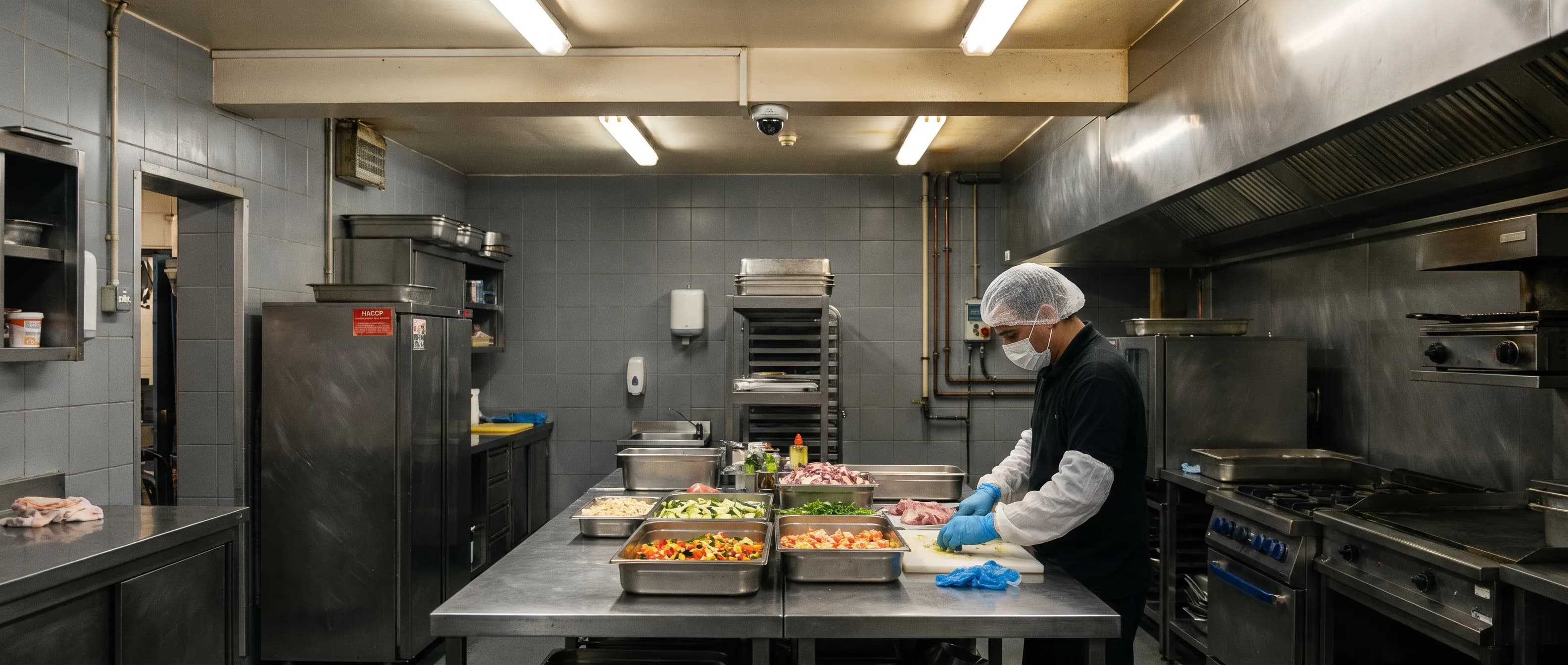
The seven HACCP principles tell a food business how to find hazards and control them at the steps that matter. Kitchen hygiene is the ground those principles stand on. Most HACCP plans are well written. The weak point is usually not the plan but the prep line at 11:15, two hours before a contract caterer sends out a thousand lunches. Someone has pushed their hairnet back. Someone else goes from raw chicken to the salad station without washing their hands. Nobody is careless on purpose. They are busy.
This article walks through the seven principles, the international and regulatory texts behind them, and why personal hygiene is the part of a HACCP system that is hardest to verify. It ends with what an AI camera can and cannot do in that picture.
Why food safety still costs so much
The World Health Organization's fact sheet, updated in June 2026, estimates that 866 million people, almost 1 in 9, fall ill each year after eating contaminated food, and 1.52 million die. Unsafe food costs an estimated US$310 billion a year in lost productivity and medical expenses (WHO, Food safety). In the United States alone, the CDC estimates 48 million foodborne illnesses a year, with 128,000 hospitalizations and 3,000 deaths (CDC, Facts About Food Poisoning).
In contract catering and staff canteens, one mistake reaches hundreds of plates in a single service. For the caterer, that is a public health event and, very quickly, a contract problem.
Where the HACCP principles come from
HACCP (Hazard Analysis and Critical Control Point) is a preventive system for biological, chemical and physical hazards in food. Instead of testing the finished meal, you control the steps where a hazard can be prevented, removed or reduced, such as cooking temperature and time.
The international reference is the Codex Alimentarius General Principles of Food Hygiene (CXC 1-1969). FAO's training toolbox explains both good hygiene practices and HACCP "as set out in" that Codex text (FAO GHP and HACCP Toolbox). In the US, the National Advisory Committee on Microbiological Criteria for Foods adopted its HACCP Principles and Application Guidelines in 1997, and FDA still publishes them (FDA, HACCP Principles & Application Guidelines). In the EU, Article 5 of Regulation (EC) No 852/2004 requires food business operators to put in place, implement and maintain a permanent procedure based on HACCP principles (Regulation 852/2004, Article 5, as adopted).
Kitchen hygiene is the foundation, not an add-on
Every major HACCP text says the same thing: HACCP sits on top of prerequisite programs. FAO advises that a food business should only implement HACCP once it has established solid prerequisite programs, and describes good hygiene practices as the foundation for it (FAO, Introduction to HACCP). The NACMCF guidelines say HACCP must be built on a solid foundation of prerequisite programs, naming cleaning and sanitation, personal hygiene and pest control among them, and managed separately from the HACCP plan.
In kitchen terms: hairnets, gloves, sleeve covers, handwashing, cleaning and pest control are the floor. If the floor is cracked, it does not matter how carefully you log the critical control points. A salad handled with dirty hands goes out next to a perfectly cooked main course.
The 7 HACCP principles
The FDA/NACMCF wording is the one most English-speaking teams train on:
- Conduct a hazard analysis. List the hazards that must be prevented, eliminated or reduced to an acceptable level.
- Determine the critical control points (CCPs). Find the steps where control is essential.
- Establish critical limits. Set the line between acceptable and unacceptable, such as a minimum internal cooking temperature.
- Establish monitoring procedures. Decide how, how often and by whom each CCP is checked.
- Establish corrective actions. Define in advance what happens when monitoring shows a CCP is out of control.
- Establish verification procedures. Confirm on a schedule that the system works as intended.
- Establish record-keeping and documentation procedures. Keep the evidence.
EU Article 5(2) lists the same seven steps and adds that documents and records should fit the nature and size of the business. The principles form a loop. Without records, verification has nothing to check. Without verification, nobody knows if the plan works.
What the EU rules say about staff hygiene
Regulation 852/2004 puts personal hygiene and training in Annex II (Annex II, as adopted):
- Chapter VIII (personal hygiene): everyone working in a food-handling area must maintain a high degree of personal cleanliness and wear suitable, clean and, where necessary, protective clothing.
- Chapter XII (training): food handlers must be supervised and instructed or trained in food hygiene matters, and the people who develop and maintain the HACCP procedure must be adequately trained in HACCP principles.
Note what the text does not do. It does not list garments. Whether a hairnet, beard snood or overshoes are mandatory in a given zone is set by your own hygiene procedure. That is exactly what an auditor asks: what is your rule, and how do you show it is followed?
Why personal hygiene is the hardest part to audit
Most kitchens check hygiene three ways: a supervisor at the door, the supervisor's eye during the shift, and a periodic internal audit. All three are needed. All three share one limit: they are not continuous.
- Snapshots: an internal audit sees one moment, not the rest of the shift.
- Handwashing is invisible: who washed, when and for how long cannot be tracked by eye.
- Record gap: principle 7 asks for records. Cooking temperatures go on a log sheet. Ten minutes without a hairnet does not.
- Peak load: workload and hygiene risk peak at the same hour, right before service.
The same limits apply to foreign material reaching the product. We cover where visual checks fall short on production lines in foreign material in food detection.
| Criterion | Supervisor observation | Internal audit | Checklist | AI camera |
|---|---|---|---|---|
| Continuity | Partial, during the shift | On audit days | At set times | Continuous in defined zones |
| Handwashing time and frequency | Not measurable | Not measurable | Self-reported | Measured |
| Hairnet, sleeve, glove use | What is in sight | At audit time | Self-reported | What the camera sees |
| Records | Usually none | Report | Form | Time-stamped violation log and reports |
| Context and judgment | Strong | Strong | Medium | Weak; flags to a person |
| HACCP responsibility | Operator | Operator | Operator | Operator |
The last row matters most. Whatever tool you use, the food business operator owns the HACCP plan.
Where an AI camera fits in a HACCP system
An AI camera does not replace a HACCP system and is not a HACCP certificate. Its job is narrower: continuous monitoring and recording of prerequisite programs like personal hygiene, so corrective action happens sooner.
ISEE Vision's catering and kitchen hygiene system runs on ISEE-CAM, an IP69K camera rated for −20 to +70 °C, which matters in washdown areas and next to cold rooms. Kitchen scenarios include:
- Clothing check at the turnstile: work shoes, hairnet, mask, gloves, sleeve covers and overshoes, checked against a rule set per zone. If something is missing, entry is refused. In factories the same idea runs as PPE-controlled access.
- 24/7 kitchen monitoring: hairnet and sleeve-cover use in defined production zones, with an audible and visual alert on a violation and an optional email with the image.
- Handwashing monitoring: duration of each wash and number of washes per day, averaged and compared to a threshold, with daily, weekly, monthly and yearly reports.
- Around the kettles: packaged products left beside cooking kettles are detected, and the alert continues until they are removed.
- Cold room door: open time is tracked, and an alarm sounds until the door closes.
- One-way passages: entry through an exit-only route is flagged.
- Hand near a hazardous machine: if a hand is detected over the machine, an output is generated so the machine is not allowed to run. This is an extra layer. It does not replace the machine's own guard or safety devices.
Write the camera into your HACCP plan by naming which control it supports. A cold room door alarm can support temperature control, but temperature is still measured with a thermometer and logged. The handwashing report closes the principle 7 gap: instead of "staff were trained", you can say "average wash time on yesterday's lunch shift was this".
All analysis runs on the device, with no cloud dependency, and images stay on site unless you enable a notification such as a violation email. We explain why that architecture matters in edge AI vs cloud safety systems. For the wider quality picture, see what is quality control.
FAQ
What are the 7 principles of HACCP?
Hazard analysis, critical control points, critical limits, monitoring, corrective actions, verification, and record-keeping. Codex, FDA/NACMCF and EU Regulation 852/2004 all use the same seven.
Is HACCP a legal requirement?
In the EU, yes: Article 5 of Regulation 852/2004 requires food business operators to run a permanent procedure based on HACCP principles. In the US, requirements depend on the sector and the jurisdiction, so check the rules that apply to your operation.
What are HACCP prerequisite programs?
The basic hygiene conditions HACCP depends on: cleaning and sanitation, personal hygiene, pest control, staff training and similar. They are managed separately from the HACCP plan but must be in place first.
Can an AI camera replace a HACCP audit?
No. It monitors and records hygiene rules continuously. The HACCP plan, training and verification remain the operator's responsibility.
Conclusion: writing the rule is easy, seeing it followed is hard
HACCP stops hazards in the process, not at the plate, and it stands on personal hygiene. In a commercial kitchen the hard part is not writing the rule but seeing it followed at the busiest hour, and having a record that proves it. An AI camera adds that visibility. It works next to your HACCP system, not instead of it.
Tell us about your kitchen's entry points, prep zones and handwashing stations, and we will map which scenario supports which control in your plan. Contact our team.
Contact: info@isee-vision.com · +90 216 455 95 44