Industry 4.0 examples: what it looks like on a real factory floor
Industry 4.0 examples from real plants: sensors, AI decisions, robots, and vision inspection, with measured results and a simple way to pick your first project.
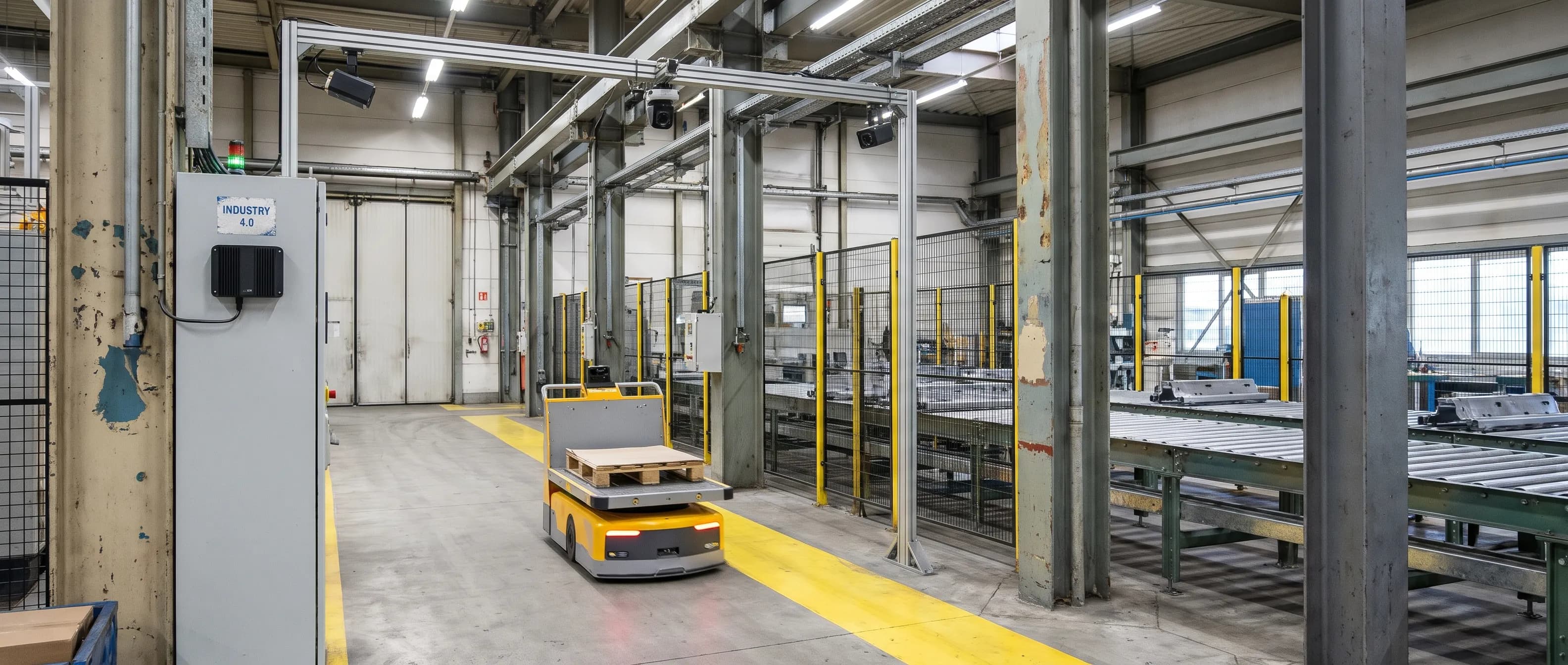
Most Industry 4.0 examples you will read are slogans: connected, smart, data-driven. This guide starts with real plants and the numbers they published. A refrigerator plant with 3,500 sensors. A refinery that cut tanker loading time by 75%. An instrument factory that raised productivity by 56%. Then it turns to the projects a mid-size plant can actually start with, and how to choose the first one.
Industry 4.0 examples from real plants
The World Economic Forum's Global Lighthouse Network recognizes plants that lead in Fourth Industrial Revolution technologies. The companies' own announcements give concrete detail on what changed.
Refrigerator plant: sensors, AI decisions, and mobile robots
Arçelik's (now Beko) refrigerator plant in Eskişehir, Türkiye, joined the network in 2021. Its 11 robots and 3,500 sensors collect 7.5 million data points a day. AI-based decision systems and closed-loop feedback control cut customer complaints by 20% and raised capacity by 43%. Autonomous mobile robots replaced forklifts in material distribution. The plant got there through more than 30 separate use cases, not one big project (Koç Holding, 2021).
Oil refinery: a digital supply chain
Tüpraş's İzmit refinery joined the network in 2025 for an end-to-end digital supply chain program. Better demand forecasting and planning tools cut average tanker truck loading time by 75% and raised on-time delivery from 85% to 95% (Koç Holding press release, 18 September 2025).
Instrument factories: AI in design and 3D printing
Agilent had two factories named in January 2025. In Shanghai, AI-assisted instrument design for highly customized gas chromatographs raised productivity by 56% and cut lead time by 31%. In Penang, Malaysia, AI applied to 3D printing, plus machine learning and real-time monitoring, raised productivity by 40% and cut manufacturing cost by 32% (Agilent via PR Newswire, 2025).
Automotive plant
Ford Otosan's Kocaeli plant in Türkiye was named a Lighthouse in 2018, in the network's first year (Koç Holding, 2021).
What these plants share is not one technology. Each picked measurable problems, such as complaints, capacity, loading time, and lead time, and solved them one at a time.
Industry 4.0 examples a mid-size plant can start with
You do not need a lighthouse budget. The most practical start is to connect one process you now run by eye, on paper, or by gut feel to real data. These examples work in mid-size plants too.
1. Automated visual inspection
A camera over the line captures every unit. AI compares each image with a good reference and flags deviations. Instead of sampling by eye, every unit is checked and every defect is stored with its image. The basics are in our guide to what quality control is.
2. Edge AI for workplace safety
A camera detects a forklift getting close to a pedestrian, entry into a restricted zone, or a missing hard hat or vest, on the device itself. It triggers a beacon, siren, or PLC signal. Because video never leaves the camera, latency stays low and data stays on site. We compare the two architectures in edge AI vs cloud safety systems.
3. Predictive maintenance
Vibration, temperature, and current sensors feed machine learning models that look for early signs of failure. Maintenance follows machine condition instead of the calendar. This is usually built with IoT sensors and maintenance software; cameras play a supporting role.
4. Mobile robots in intralogistics
Autonomous mobile robots move material between stations on set routes, as in the Eskişehir plant above. They suit plants with repetitive, predictable material flows.
5. Digital twins
A digital twin is a virtual model of a machine or line, fed with live data. Teams use it to test a layout change or a new cycle time before touching the real line.
What is Industry 4.0?
Industry 4.0 means connecting machines, sensors, and software so production is run on data. The idea behind it is the cyber-physical system: a physical machine and the software that monitors and steers it, working as one.
The name has a clear origin. According to DFKI, Wolfgang Wahlster, Henning Kagermann, and Wolf-Dieter Lukas found "cyber-physical production systems" too unwieldy in December 2010 and proposed "Industrie 4.0" instead. Wahlster first presented it publicly at the opening of Hannover Messe on 3 April 2011. The "4.0" points to the fourth industrial revolution and, like a software version number, to the central role of software (DFKI).
Klaus Schwab, founder of the World Economic Forum, summed up the four revolutions in 2016 (Schwab, 2016):
| Era | Core technology | Effect on production |
|---|---|---|
| First | Water and steam power | Mechanized production |
| Second | Electric power | Mass production |
| Third | Electronics and IT | Automated production |
| Fourth | A fusion of technologies | Blurred lines between physical, digital, and biological |
The short version: the third revolution programmed machines. Industry 4.0 connects them to each other and to data.
The technologies behind the examples
- Internet of Things (IoT): Machines and sensors sharing data over a network
- AI and machine learning: Finding patterns, predicting failures, and classifying defects
- Machine vision: Software that interprets camera images, from product inspection to safety
- Edge computing: Processing data on the device that produces it, for low latency and data privacy
- Cloud and big data: Central storage and analysis across sites
- Digital twins, robotics, and additive manufacturing: Simulation, automated handling, and tool-free parts
Which Industry 4.0 project should come first?
This table is a starting framework you can take to management. The ratings are general; check them against your own data.
| Criterion | Automated visual inspection | Edge AI for safety | Predictive maintenance |
|---|---|---|---|
| Problem it solves | Escaped defects, scrap, complaints | Forklift-pedestrian contact, PPE violations, restricted zones | Unplanned downtime |
| Infrastructure | Camera, lighting, line integration | Camera, alert device, optional PLC | Sensors, data collection, analytics software |
| Time to results | Shortly after commissioning | Alerts and records from day one | Once enough failure data builds up |
| Measurable output | Defect rate, scrap, escapes | Violation count, near-miss records | Downtime hours, maintenance cost |
| Data privacy | On site with edge processing | On site with edge processing | Mostly machine data |
Let your own risk and defect data decide which column comes first. Define the baseline before you start: today's scrap rate, monthly violations, or unplanned downtime hours.
Where ISEE Vision fits
The ISEE-CAM industrial AI camera covers the safety column. ISEE Vision's automated visual inspection covers the quality column.
ISEE-CAM runs detection on the device and needs no cloud connection. Alert-to-output time is under 100 ms. It is rated IP69K and works from −20 to +70 °C. It has several detection modes, such as forklift-pedestrian proximity, PPE checks, and restricted-zone entry, with zones and rules set in a web interface. Its outputs connect to a PLC, an alarm or beacon, or a machine stop signal through PLC integration.
Those outputs work alongside the machine's own safety system. They do not replace a light curtain, safety relay, interlock, or any other safety function; they add a layer on top.
On the quality side, the system learns a good reference product, compares every unit on the line, and turns deviations into a heat map with a confidence score.
FAQ
What are some examples of Industry 4.0?
Automated visual inspection, edge AI safety alerts, predictive maintenance, mobile robots in intralogistics, and digital twins are common examples. Real plants report results such as a 20% drop in complaints, a 75% cut in loading time, and a 56% rise in productivity.
What is Industry 4.0 in simple terms?
It is production run on connected data: machines, sensors, and software linked so decisions are based on what is actually happening. The term was first presented at Hannover Messe in 2011.
What is a smart factory?
A plant where machines, sensors, and cameras produce data that feeds production, quality, maintenance, and safety decisions. Full automation is not required; the goal is faster decisions based on better data.
How can a small or mid-size manufacturer start?
Pick one costly, measurable problem and set a baseline. Solve it, measure the result, then move to the next. The lighthouse plants above followed the same pattern, one use case at a time.
Conclusion: Industry 4.0 starts with one measurable problem
The best Industry 4.0 examples are not big-bang programs. They are problems solved one by one with connected data. Large plants do it with dozens of use cases. For a mid-size plant, automated visual inspection and edge AI safety are two practical starting points that show results quickly and fit existing lines.
Quality or safety first? Tell us about your site and your priority, and we will help you pick the first step. Contact us.
Contact: info@isee-vision.com · +90 216 455 95 44
Sources
- Ten Years of Industrie 4.0: Interview with Wolfgang Wahlster, DFKI
- The 4th Industrial Revolution: what it means, how to respond, Klaus Schwab (2016, reprinted by GE Reports)
- Koç Group's Industry 4.0 practices named among global best practices, Koç Holding (27 Sept 2021)
- Tüpraş İzmit Refinery Global Lighthouse press release (Turkish), Koç Holding (18 Sept 2025)
- Two Agilent factories among 13 to join World Economic Forum Lighthouse Network, PR Newswire (15 Jan 2025)