Fabric defects: eight hours at the inspection table
Anyone who has spent eight hours at an inspection table knows the problem is not the method. It is the limits of the person. Knowing those limits shows you where and how to support the inspection.
Anyone who has spent eight hours at an inspection table knows the problem is not the method. It is the limits of the person. Knowing those limits shows you where and how to support the inspection.
In most mills, fabric defects are hunted in the same place and by the same person: the inspector at the inspection table. The classic fabric inspection machine looks much the same in almost every textile plant: a slanted surface lit from behind or above, fabric moving at a steady speed, and an inspector watching it. When the inspector sees a defect, they stop the machine, mark it, write down the points, and carry on. When the roll is done, the points are added up and the grade is set.
This post is about the person at the machine: what the table does well, where it struggles, and how in-line AI visual inspection changes the picture. The short answer: one does not replace the other, but the weight of the work shifts.
How are fabric defects found at the inspection table?
In the classic method, fabric defects are found by an inspector's eye while finished fabric unrolls across a lit table at a steady speed. The inspector sees, marks, and scores each defect. The machine moves, lights, and measures the fabric; the person does the seeing.
Fabric unwinds from the beam or roll, passes over the lit surface, and is wound up again, usually with a yardage counter and a speed control. But the machine does not find the defect. The inspector's eye does.
What does the 4-point system measure, and what does it miss?
Many mills grade fabric with the 4-point system; ASTM D5430 is one of the standards that describes it. The logic is simple: each defect gets 1 to 4 points by size, the total is related to a set amount of fabric, and that decides whether the roll is first quality or seconds.
It gives buyers and suppliers a common language, but it carries two hidden assumptions. It assumes defects are seen; a defect nobody sees gets no points. And it happens after production, when the roll is already made, defects included. Both tie inspection quality to the attention of the person at the table.
Why is it so hard to watch moving fabric?
Fabric inspection is one of the tasks where human perception is weakest: watching a surface that barely changes and waiting for something that rarely appears. That is why even the most experienced inspector is less alert at the end of a shift than at the start. It is not a discipline problem. It is a known limit of human perception.
Research on radar operators during World War II showed that attention in long monitoring tasks drops noticeably from about the first half hour (Mackworth, 1948). A radar screen and a fabric table are alike: a person waits for a rare signal in a stream where nothing usually happens.
In a more recent study at Sandia National Laboratories, 82 inspectors examined 140 precision-manufactured nuclear-weapons parts for eight defect types (See, Human Factors, 2015). Under controlled conditions, they correctly rejected 85% of defective items, which the author calls "not vastly superior to the industry average of 80%". Roughly put, one defect in five gets through a typical visual inspection. In that study, the hit rate also came with 35% of acceptable parts rejected, which the author describes as "a high scrap rate not typically observed". The study is not about textiles, but the message carries over: even a careful eye misses some defects, and tightening it risks downgrading good fabric to seconds. No one can hold the same attention for eight hours.
Knits and lace make it harder still. A knit is thousands of repeating loops, and lace is full of openings and motifs, so the eye keeps separating pattern from defect and tires faster.
Inspection table vs. in-line AI for fabric defects
The classic table checks fabric after production, by eye and at human speed. In-line AI checks it during production, without slowing the line, every meter of it; it positions each defect by the meter and builds a defect map for the roll. The table does not go away, but the load it carries and the quality of the records change.
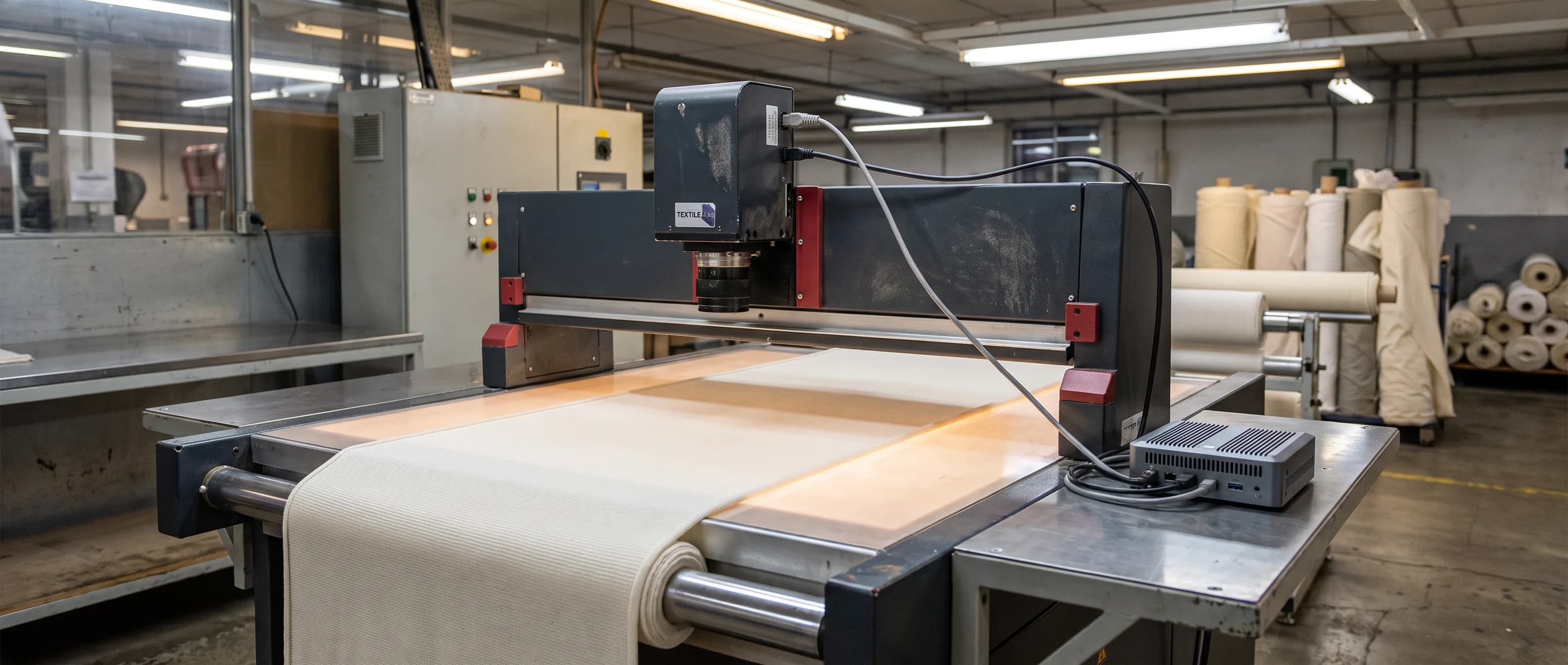
ISEE Vision's AI visual inspection system brings automated fabric inspection onto the line. It is added to weaving, knitting, printing, and coating lines as an independent station, runs at up to 450 m/min without slowing the line, positions every defect by the meter through an encoder, and builds a per-roll defect map that feeds the cutting plan.
| Criterion | Classic inspection table | In-line AI (ISEE Vision Anomaly Detection) |
|---|---|---|
| When is fabric checked? | After production, at a separate station | During production, while the fabric runs |
| Coverage | Depends on the inspector's attention; drops with fatigue | Every meter, same criteria all shift |
| Speed | What the inspector can follow; stops at each defect | Up to 450 m/min without slowing the line |
| Defect position | Yardage counter and hand marking | By the meter via encoder, automatic |
| Records | Hand-filled point sheet | Images stamped with time and meterage, heatmap, confidence score |
| Output | Total points and grade per roll | Per-roll defect map, input to the cutting plan |
| Defect definition | Inspector experience and the 4-point table | Good-fabric reference and an adjustable threshold |
| Decision | The inspector | Your team; the system flags, records, and alerts |
This is not about declaring a winner. The table is still the right tool for the 4-point report and for judging borderline defects by hand. The in-line difference is seeing the defect when it is made. If the same dropped stitch keeps appearing in a roll, that is noticed before the roll is finished, and someone can look at the knitting machine.
When a defect surfaces after cutting
Follow a missed defect. The lay is spread and cut, and a dropped stitch only gets noticed in sewing or at pressing. By then, the loss is cutting and sewing labor, and maybe a ship date.
The 1-10-100 rule describes this: if preventing an error at the source costs 1 unit, finding and fixing it in-house costs 10, and letting it reach the customer costs 100 (Labovitz, Chang & Rosansky, Making Quality Work, 1992). The numbers are an order of magnitude, not measured costs, but the direction is not in doubt.
The per-roll defect map helps here: the cutting room can plan the marker around defective zones. And when a garment maker files a claim, "which roll, which meter, what defect?" is answered from an image record, not a hand-filled form.
How are fabric defects told apart in knits and lace?
Rule-based detection struggles with knits and lace, because a rule like "an opening is a defect" makes no sense for lace, which is made of openings. AI that learns the good product, meaning anomaly detection, simplifies the question to: does this area fit the pattern I learned?
You show the system good fabric, not a defect catalog. It learns that fabric's texture, color, and pattern repeat, compares each new frame against that reference, and marks the deviating area on a heatmap with a confidence score. The general logic is in our post on anomaly detection and its industrial applications.
Fabric defects caught on a textile line include holes, floats, broken yarn, warp and weft faults, stains, oil marks, pattern drift, print distortion, and color tone deviation. They are labeled by type, so reports say which defect, where, and how often.
Two examples from our sample work show this well:
- Dropped stitch in a knit: The knit structure itself was quite complex. The dropped stitch gathered into a single region on the heatmap, while the good knit around it stayed quiet.
- Pattern fault in lace: On a floral lace, the areas where motifs were broken were marked separately, while the openings that belong to the pattern were treated as normal.
The same logic applies to upholstery fabric in furniture; we show how small tears in a dense weave are marked in our post on furniture surface defects.
How does the inspector's job change?
The inspector's role does not disappear; it changes. Instead of waiting for hours in case something happens, the inspector reviews what the system flagged and decides how serious it is, how many points it gets, and whether cutting can work around it.
Each detection is stored with its time and meterage, the original image, the heatmap, and the confidence score, and every roll gets its own quality report.
You decide what happens at the moment of detection. ISEE Vision Anomaly Detection can be set to alert only, alert plus stop, or full automation, using a siren, tower light, screen notification with the defect image and meterage, and PLC or relay outputs. But whether defective yardage is cut out, reworked, or accepted is the quality team's call.
What about style changes?
Mills fairly ask: "Our styles change daily. Do we retrain every time?" No. A new fabric is taught from a good sample in a few minutes, with its texture, pattern, and color profile saved under the product code, and sensitivity set for that fabric type.
Pattern images have commercial value, so processing location matters. Processing runs on the device, with no cloud dependency, and the data stays in the mill. We compare the architectures in edge AI vs. cloud systems.
Frequently asked questions
Does AI replace the inspection table?
In most mills, no; it lightens the table's load. In-line inspection catches defects during production and records them by the meter, while the classic table can stay in use for borderline calls and the 4-point report customers ask for.
How fast does in-line inspection run?
ISEE Vision's visual inspection station for textile lines runs at up to 450 m/min without slowing the line. Each defect's position is recorded by the meter through an encoder.
Does it replace the 4-point system?
No. The 4-point system is the common language between buyer and supplier, and it stays. AI visual inspection makes sure the defects to be scored are not missed, and that each one is recorded with its image.
How much fabric do we need for a trial?
One roll of good fabric and a few defective samples are enough. The good fabric builds the reference; the defective samples show how the system marks your defects.
Key takeaways
- The inspection table checks by eye after production; in-line AI checks every meter while the fabric is made.
- Visual inspection misses some fabric defects: in Sandia's controlled study, experienced inspectors caught 85%, not far above the reported industry average of 80%.
- Encoder positioning and a per-roll defect map let the cutting plan work around defective zones.
- The system flags, records, and alerts; the quality team decides what happens to defective yardage.
You can browse every ISEE Vision AI automated visual inspection system configuration. To see how your knit or lace looks with this approach, one roll of good fabric and a few defective samples are enough. Contact us for a free trial on your own fabric.
Contact: info@isee-vision.com · +90 216 455 95 44