Furniture quality inspection: natural variation or defect?
In furniture, the craftsman knows quality best. But the craftsman's eye cannot be at every piece. The challenge is carrying that knowledge into series production.
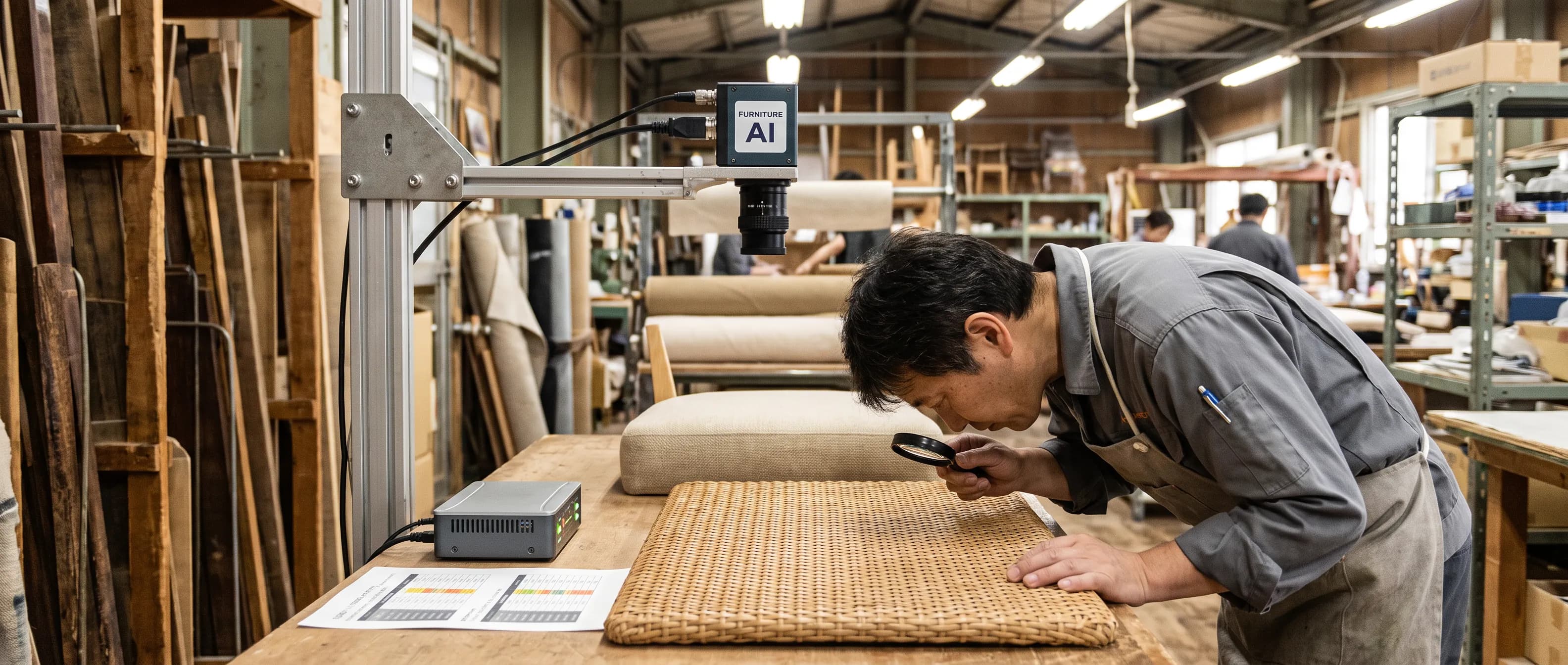
In furniture, the craftsman knows quality best. But the craftsman's eye cannot be at every piece. The challenge is carrying that knowledge into series production.
Hand a woven cane chair back to an experienced furniture maker. They look for a few seconds, run a finger across the weave, and say "this one's good" or "that spot is off." Furniture quality inspection is rarely about a single measurement. It is about the consistency of the whole: the rhythm of the rows, tension that feels the same everywhere, a pattern that never "catches."
The product is still partly craft and partly series production. Cane, rattan, and upholstery fabric carry the trace of the hand, and no two good pieces are identical, yet volumes keep growing. This post covers the line between natural variation and a defect, how AI that learns the good product applies that line, and why the decision still stays with your team.
"Every piece is a little different" has two meanings
"Every piece is a little different" is true, and it is also where defects hide most easily. Tone variation and hand marks in natural materials are the product's character. A skipped row in the weave or a broken thread is a reason for a return. The real job of quality control is telling the two apart.
Furniture makers say this often, and they are right: small tone differences, shifts in grain direction, and hand marks in a weave are what customers pay for. But the sentence can become an excuse. A skipped row, a thread breaking into a small tear, or a pattern gone wrong in one area is not "natural variation," and customers notice it at first glance.
Writing rules for this is close to impossible. A threshold like "tone difference above this value is a defect" either catches natural differences too or misses the real defect. The craftsman decides with the intuition of having seen thousands of good pieces.
How does AI-based furniture quality inspection separate surface defects?
AI separates furniture surface defects by being shown good pieces, not by having every defect described. From those pieces, the system learns the accepted range of natural variation, compares every piece from the line against that reference, and marks the region that falls outside it with a heatmap and a confidence score.
This is close to how the craftsman works. ISEE Vision's AI visual inspection system for furniture manufacturing quality control is added to the line as an independent station: a light-isolated enclosure with controlled lighting, engineered for your line. You do not need to rebuild the line. Images are processed on the device and never sent to the cloud, so pattern and collection images stay inside the plant.
That is why the choice of good samples matters. Show good pieces that carry the tone differences and weave marks you accept, and the system learns them as part of normal.
Which deviation triggers an alert is up to you: sensitivity and the acceptance limit are set per product. The answer to "what do we call a defect?" stays with you; the system applies it to every piece consistently. For the broader picture, see our post on anomaly detection and its industrial applications.
What does a defect look like in woven cane and upholstery fabric?
In woven cane and upholstery fabric, a defect looks like a "break" inside a repeating texture. For a system that has learned the good product, what matters is not the color of a single pixel but whether that area fits the learned texture. So natural variation stays quiet, and the real flaw gathers in one region.
Where the weave goes wrong in cane
Woven cane repeats, but not perfectly; hand or machine leaves small differences between rows. To a classic rule-based system, this surface looks "different" all the time.
In one cane sample from our trials, the rows had lost their order in one area and a few strands crossed in the wrong place. On the heatmap, that region stood out clearly. The small variations across the rest of the weave did not, because they had been learned as part of the reference.
A small tear in dense upholstery fabric
Upholstery fabric is dense, often patterned or with a raised pile, and a small tear is easy to lose on dark, moving material. If it is found after the fabric is cut and stretched onto the frame, you lose not just the fabric but the labor already spent on that piece.
On one upholstery sample, the system marked several damaged areas separately. Instead of a single "defective" verdict, you see where and at how many points, which helps decide whether the fabric can be saved in the cutting plan. We cover how rolls are checked meter by meter in our post on detecting fabric defects on the line.
Wood surface defects on panels and edge banding
On melamine and lacquered panels, edge banding, and joinery points, inspection is more industrial. There is less natural variation; the targets are surface defects, edge-band faults, and whether holes, grooves, and dowels are where they should be.
The same reference logic applies. A good panel is taught, and scratches, dents, stains, coating blisters, and delamination are flagged as deviations from it. Edge-band overrun, drift, or detachment shows up the same way. Holes, grooves, dowels, and cam fittings are verified against the reference product, so a missing one is caught on the line instead of at assembly.
For collection makers, the system also compares tone, pattern direction, and texture across batches, so a cabinet door and drawer front from different batches do not meet for the first time at assembly.
| Material / area | Accepted as natural | Counted as a defect | How it shows in the system |
|---|---|---|---|
| Woven cane, rattan | Small row-to-row variation, hand marks | Skipped row, disrupted pattern, broken strand | The disrupted area gathers into one region on the heatmap |
| Upholstery fabric | Fiber direction, slight tone shifts, pile | Tear, broken thread, stain, pattern shift | Each damaged area is marked separately, with its location |
| Melamine / lacquered panel | Tone matching the reference batch | Scratch, dent, stain, coating blister, delamination | Surface deviation shown with confidence score and heatmap |
| Edge banding | Joint within the defined tolerance | Overrun, drift, detachment | The section deviating from the reference along the edge is marked |
| Holes, grooves, dowels, cam fittings | Position and count on the reference product | Missing, extra, or misplaced fitting | Stands out as a different region against the reference |
Precision can reach down to 6 µm depending on the optical configuration, but in furniture the right light and the right reference usually matter more than microns. Lighting for gloss lacquer is not lighting for pile fabric, so each station is engineered for its line.
Furniture quality inspection: craftsman or system?
The point of a visual inspection system is not to remove the craftsman but to spend the craftsman's time where it really counts. The system looks at every piece with the same attention and brings the suspicious ones forward. Deciding on borderline pieces, and defining what is acceptable, is the job of the craftsman and the quality team.
Yet most of a craftsman's day goes to looking at hundreds of pieces with nothing wrong.
The human eye tires on this kind of repetitive work. Classic vigilance research shows that attention drops noticeably from about the first half hour of a monotonous monitoring task (Mackworth, 1948). In a more recent study at Sandia National Laboratories, 82 inspectors examined 140 precision-manufactured nuclear-weapons parts for eight defect types (See, Human Factors, 2015). They correctly rejected 85% of defective items, which the author calls "not vastly superior to the industry average of 80%": roughly one defect in five gets through. In that study, the hit rate also came with 35% of acceptable parts rejected, "a high scrap rate not typically observed". Where natural variation is everywhere, tightening the eye sends good pieces to scrap too.
ISEE Vision Anomaly Detection takes over that repetitive load. It inspects every piece, not a sample, and brings the suspicious ones to the craftsman with a heatmap and confidence score. You configure the action: alert only, alert plus stop, or full automation, using a siren, tower light, screen notification, and PLC or relay outputs. Whether a flagged piece is scrapped, repaired, or accepted is the quality team's call.
- The system: looks at every piece, flags what deviates from the good reference, and stores the image.
- The craftsman: decides on borderline pieces and defines what is acceptable.
- The manager: reviews time-stamped records and daily, weekly, and monthly reports to see where problems concentrate.
What happens when the collection changes?
A line may run rattan chair backs one week and a new upholstery color the next. A new product is taught from its good samples in a few minutes and saved as a profile under its product code. When it comes back, the saved profile is switched from the panel in one touch. Every detection is stored with a time stamp, the original image, the heatmap, and the confidence score, so when a return comes in, the answer to "what did we see when this shipped?" rests on an image record, not a guess.
Frequently asked questions
Won't AI mistake natural variation in cane for a defect?
If the good pieces used as the reference include the natural variation you accept, the system learns it as normal. Which deviation triggers an alert is set by a threshold per product, and you can loosen it if it proves too strict.
How many samples do we need for a trial?
A few good pieces and a few problem pieces are enough for a first trial. The good ones build the reference; the problem ones show how the system marks your defects. In a permanent setup, the reference is widened to cover the natural variation you accept.
Can the system stop the line?
Yes, through a relay or PLC, but it is not required. You choose alert only, alert plus stop, or full automation. The quality team decides what happens to the flagged piece.
Are images sent to the cloud?
No. Processing runs on the device and records stay in the plant. In furniture, where collection designs and patterns have commercial value, this is worth asking up front.
Key takeaways
- In furniture quality inspection, the line between natural variation and a defect is set by your good samples and an adjustable threshold, both in your hands.
- In cane and upholstery fabric, a defect shows up as a break in the learned texture and gathers into one region on the heatmap.
- Panel surface defects, edge-band faults, and missing fittings are checked in the same station.
- The system inspects and records every piece; scrap, repair, or accept stays with the craftsman and the quality team.
You can browse every ISEE Vision AI automated visual inspection system configuration. If you want to see how your own cane, fabric, or panel looks with this approach, a few good and a few problem pieces are enough. Contact us for a free trial on your own samples, and we will review the results together.
Contact: info@isee-vision.com · +90 216 455 95 44