Tablet defects: a short guide from chips to capsule flaws
What people mean by a "defect" in a tablet or capsule, one by one, and how each shows up in an image.
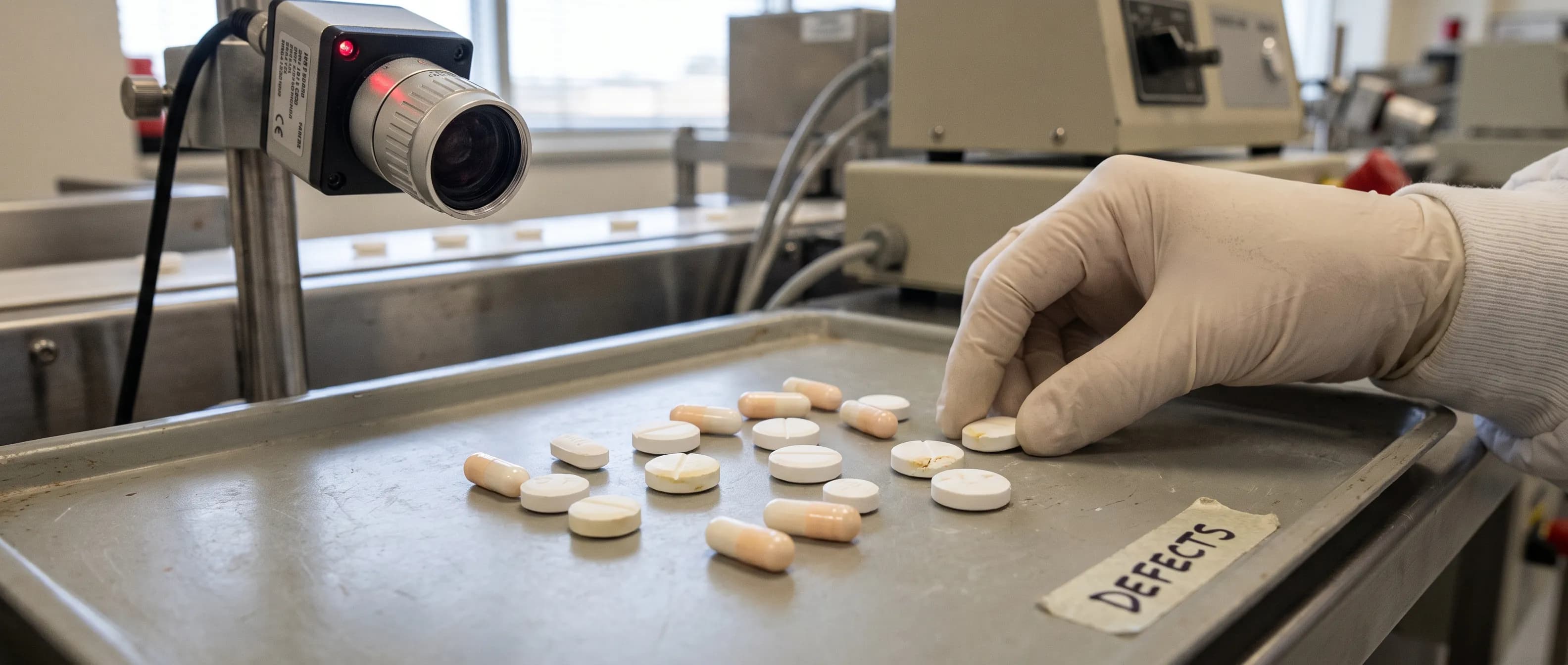
What people mean by a "defect" in a tablet or capsule, one by one, and how each shows up in an image.
In solid dose manufacturing, tablet defects have names everyone uses, but the same word can mean different things to a press operator, a QA specialist, and a buyer. This guide explains the most common tablet and capsule defects with three questions each: What is it? Why does it matter? How does it show up in an image?
Tablet defects: chipping, cracking, capping, and stains
Most tablet defects come from two places: compression and handling after compression. Chips and broken edges usually start in handling; cracks, capping, and lamination usually start in compression. The common challenge in the image is telling defects apart from irregularities that are supposed to be there, such as embossing and score lines.
Chipping and broken edges
What is it? A piece breaks off the tablet, usually at an edge or corner. It happens when tablets hit each other and metal surfaces during handling after compression, in the coating pan, or while feeding the packaging machine.
Why does it matter? Even a small missing piece changes weight and therefore dose, and it shakes the patient's trust.
How does it show up in an image? A tablet surface already has "irregularities" such as embossing, a logo, or a score line. A system that learns the good tablet treats embossing and the score line as part of the product and marks only the broken edge. ISEE Vision's AI visual inspection system for pharmaceutical packaging inspection makes this comparison against a perfect reference, in real time, for every product.
In our sample work, a tablet embossed "500" and "M 12" with a score line had a chipped lower edge. The heatmap showed only the broken edge.
Cracking
What is it? The tablet splits without breaking apart. It appears as a thin line on the surface and sometimes sits under the coating.
Why does it matter? A cracked tablet that is in one piece today can break in the blister or in the patient's hand. A crack can also signal a problem during compression.
How does it show up in an image? A crack can look like a score line, but the score line is in the same place and shape on every tablet. A crack appears in an unexpected place and direction. A system that looks for deviation from good catches that difference. For very fine cracks under coating, the lighting angle is decisive.
Capping and lamination
What is it? Capping is when the top or bottom face of the tablet separates like a cap. Lamination is when the tablet splits into horizontal layers. Both usually come from problems in the compression process.
Why does it matter? The product is unusable, and capping and lamination point to a press setting or formulation problem. Caught early, they don't spread to thousands of tablets.
How does it show up in an image? Once separation is complete, it shows as an obvious break on the face or edge. In the early stage, it appears as a thin line at the edge, so a camera angle that also sees the edge matters here.
Sticking and picking
What is it? Powder sticks to the punch face, so a small piece is pulled from the tablet surface or the embossing, logo, or letters come out incomplete.
Why does it matter? Incomplete embossing loses identification, and a pit points to a punch or formulation issue that repeats on the same punch.
How does it show up in an image? On a good tablet, the shape and depth of the embossing are known. If part of a letter is missing or the surface has an unexpected pit, that region stands out on the heatmap.
Stains and color deviation
What is it? A dark or differently colored spot, or a local color difference on the surface. It can come from oil, machine residue, a foreign particle, or an irregular coating.
Why does it matter? Until its source is known, nobody can say the product is safe, and patients notice it most easily.
How does it show up in an image? A region whose color and texture differ from the good surface stands out on the heatmap. The system learns from good samples which shades are "normal."
Capsule defects: internal flaws, dents, and bad closures
Capsule defects fall into two groups: those affecting the shell's shape and those affecting the contents. Dents and bad closures show in the silhouette. Internal flaws hide behind reflections on a clear shell and are easy to miss in a check that only looks at the outer surface.
Internal flaws
What is it? A deviation seen inside a clear or translucent capsule. It may be contents distributed differently than expected, a foreign object, or a flaw in the capsule wall.
Why does it matter? A capsule can look fine from outside while its contents are not.
How does it show up in an image? A clear capsule's reflections fool the human eye. The system learns them as part of the good capsule, so the internal deviation concentrates in one region of the heatmap despite the glare. The field examples on our medical page show the same idea on gelatin: a capsule crack, a dark particle on the surface, and a surface bubble.
Dents and bad closures
What is it? A dent in the capsule body, or two halves that don't seat fully or slide out of line.
Why does it matter? A badly closed capsule can open during packaging, spill its contents, or take on moisture.
How does it show up in an image? The shape deviation becomes clear against the silhouette of a good capsule and stands out on the heatmap.
Tablet defects and capsule defects in one table
The source column shows the most common cause; confirm the actual cause with your own process data.
| Defect | Most common source | Why it matters | Image cue |
|---|---|---|---|
| Chipping, broken edge | Impact in handling, coating, feeding | Changes weight and dose | Edge silhouette differs from reference |
| Cracking | Compression problem | Can break later | Thin line in an unexpected place and direction |
| Capping, lamination | Press settings, formulation | Unusable product, process warning | Separation on the face or a line at the edge |
| Sticking, picking | Powder sticking to the punch | Loss of identification | Missing letter in embossing, pit in surface |
| Stain, color deviation | Oil, machine residue, coating | Raises a safety question | Color and texture differ from good surface |
| Capsule internal flaw | Content distribution, foreign object | Looks fine from outside | Deviation in one region behind reflections |
| Capsule dent, bad closure | Closing, handling | Opening, spilling, moisture | Silhouette differs from reference |
Do you need to define each defect in advance?
No, not to set up the system. Anomaly detection that learns the good product doesn't need a defect list; anything that differs from good is flagged, whether it is a chip or a deviation nobody has named yet. Naming a flagged deviation and deciding what to do about it is where this guide still helps the quality specialist.
Every product and press has its own defects, so any list is incomplete. Classic machine vision needs each defect type described in advance. ISEE Vision Anomaly Detection works the other way round: a perfect reference is taught, every product is compared with it, and the deviation is shown as an anomaly heatmap with a numeric confidence score. We explain the approach in our post on anomaly detection and its industrial applications.
The system can still label flagged deviations by type, such as chip, crack, or stain, so reports show which problem is rising. The "defect or not?" call is tied to a sensitivity and acceptance threshold set per product, not to an operator's judgment in the moment. Precision goes down to 6 µm, depending on the optical configuration.
Scrap, re-inspect, or accept is always the quality team's decision. Time-stamped image records can support those decisions and your GMP documentation, but they don't deliver compliance on their own.
Why isn't manual inspection enough on its own?
Manual inspection catches most defects but misses some, and attention fades, especially with small, look-alike tablets passing in huge numbers. The camera's job isn't to remove the person but to point them to suspect product.
In a study at Sandia National Laboratories (See, Human Factors, 2015), 82 inspectors examined 140 precision-manufactured nuclear-weapons parts for eight defect types and correctly rejected 85% of the defective items. The author notes this is "not vastly superior to the industry average of 80%," so roughly one defect in five gets through typical visual inspection. The high hit rate in this study also came with 35% of good parts rejected, a scrap rate the author says is not typically observed. The lesson for pharma: tightening the threshold to cut misses can send good product to destruction.
Mackworth's 1948 study showed detection dropping noticeably from about the first half hour of a monotonous monitoring task. Searching a tray of hundreds of white tablets for one with a slightly chipped edge is exactly that kind of task.
ISEE Vision's AI visual inspection system checks every product, and the quality specialist looks at the flagged ones, with their images, as a second pair of eyes.
Frequently asked questions
What are the most common causes of tablet defects?
Most come from compression or from handling after compression. Cracking, capping, and lamination usually point to press settings or formulation; chipping and broken edges point to impact.
Can tablets and capsules inside blisters be inspected too?
Yes. Pill presence and count in each pocket, broken tablets, and gelatin capsule condition can be checked at the same station. Our post on vial and blister inspection explains how each reject is recorded with an image.
How long does it take to teach a new tablet?
A new product is taught on site with good samples, typically in a few minutes, and you don't need to collect defect samples. The profile is saved under the product code and later selected on the control panel.
Do image records make us GMP compliant?
No, not on their own. GMP compliance depends on your processes, validation, and documentation as a whole. Time-stamped images, heatmaps, and confidence scores can support that documentation as evidence.
Key takeaways
- Most tablet defects come from compression and handling; the defect's name tells you where to start looking for the cause.
- The real challenge in the image is separating features that belong, such as embossing, score lines, and reflections, from defects.
- Anomaly detection that learns the good product needs no defect list and also flags new deviations.
- Scrap, re-inspect, or accept stays with the quality team; image records document that decision.
You can see every line type on the automated visual inspection page. Bring a few tablets or capsules with the defect that troubles your line most, plus enough good samples. We'll run the system on your samples and review the result together; the first trial is free. Write to us for a trial.
Contact: info@isee-vision.com · +90 216 455 95 44