Packaging inspection on filling lines: 8 questions QA teams ask
The same questions come up every time we discuss AI inspection for caps and bottles. Here are our answers, without overselling.
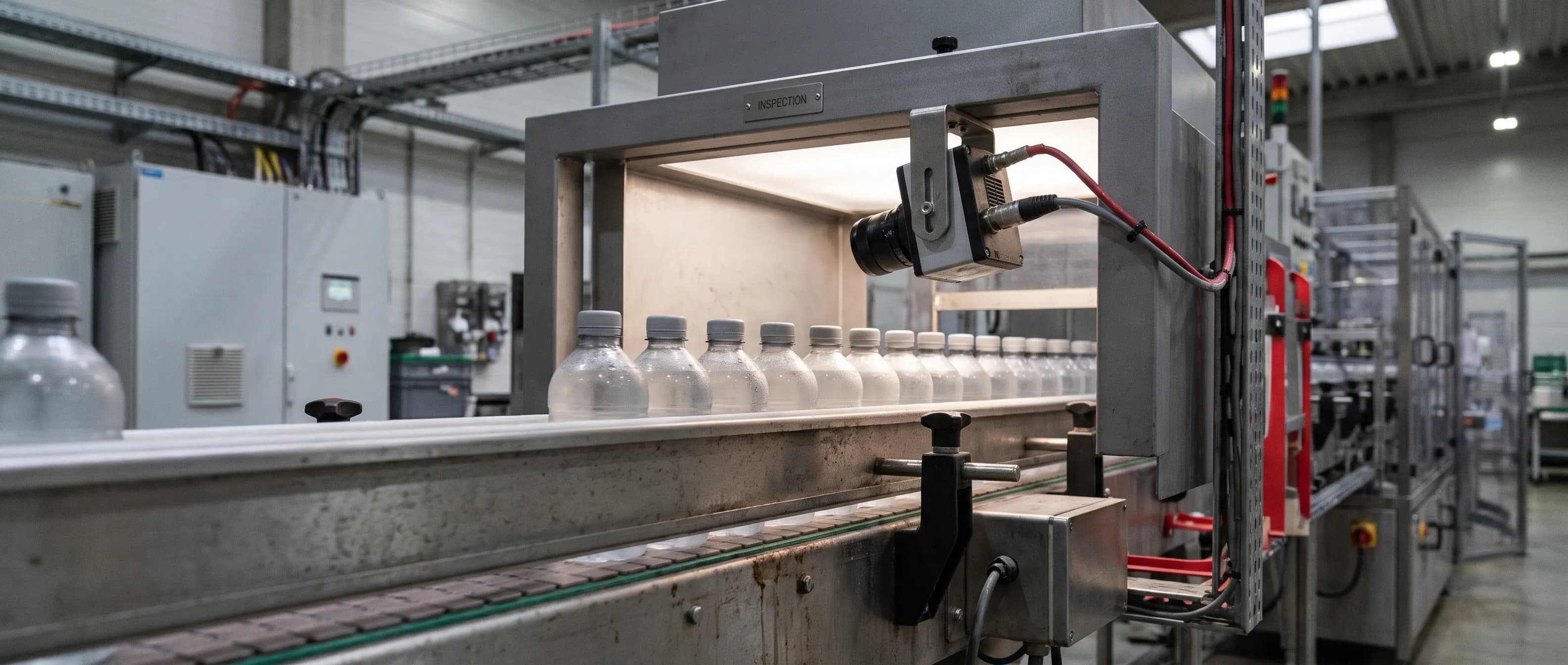
The same questions come up every time we discuss AI inspection for caps and bottles. Here are our answers, without overselling.
When teams consider a camera for packaging inspection on a filling line, the first meeting is usually questions, and good ones: the line is fast, the product range is wide, and a system was often tried once and shelved. Below are the eight we hear most, answered with what the system doesn't do as well as what it does.
Why shouldn't packaging inspection rest on one person at the end of the line?
The operator at the end of the line is valuable, but not enough on their own. On a conveyor moving several bottles a second, no human eye can check every cap edge and every bottle shoulder. The camera takes over the repetitive work, and the operator becomes the second pair of eyes on suspect product.
1. "We already have an operator watching the end of the line. Why isn't that enough?"
Not because the operator falls short, but because the task wasn't designed for human eyes. Attention fades, as known since the 1940s: Mackworth's experiments with radar operators showed detection dropping noticeably from about the first half hour of a monotonous monitoring task.
At Sandia National Laboratories, 82 inspectors examined 140 precision-manufactured nuclear-weapons parts for eight defect types (See, Human Factors, 2015) and correctly rejected 85% of the defective items. The author notes this is "not vastly superior to the industry average of 80%," so roughly one defect in five gets through typical visual inspection. That hit rate also came with 35% of good parts rejected, a scrap rate the author says is not typically observed.
In packaging, many defects are visible but easy to overlook. A hairline cap split can leave the bottle looking perfect while the closure fails, and it surfaces later as a leaking case in the customer's warehouse.
What defects does packaging inspection catch on a filling line?
Reference-based packaging inspection doesn't check against a predefined defect list. It learns what good product looks like and flags anything that deviates. A split cap, a skewed cap, a crushed bottle, an underfill, a skewed label, or a deviation nobody has seen before all stand out if they differ from good product.
2. "Which defects does the system find? Can you give us the list?"
Our answer is unusual: there is no closed list, because the system learns the good product, not the defects.
Classic machine vision makes you describe each defect type, and anything you didn't describe gets through. Anomaly detection learns what a perfect cap and bottle look like and compares every image against that reference. The deviating region is marked on a heatmap and scored with a numeric confidence score. We explain the approach in our post on anomaly detection and its industrial applications.
ISEE Vision's AI visual inspection system for food and packaging lines, the same station behind our label and fill level inspection, makes this comparison on the line for every product. It inspects 100%, not a sample. The defects we discuss most:
| Defect | Likely source | How it shows in the image |
|---|---|---|
| Split or flashed cap | Cap molding, stress during capping | A thin line or overflow at the cap edge that the good reference doesn't have |
| Skewed, missing, or loose cap | Capper setup, feed problem | Cap position and silhouette differ from the reference |
| Underfill or overfill | Filling valve or nozzle issue | Liquid line outside the reference and the defined tolerance |
| Crushed shoulder, body deformation | Handling, jams, blow-molding defect | Reflection and contour pattern differ from a good bottle |
| Missing or skewed label | Labeler, adhesive | Label position, angle, or presence differs from the reference |
| Unreadable barcode, faint expiry date | Print head, ink, speed | Missing or broken characters in the print area |
| Foreign matter in a water carboy | Washing, filling environment | A particle in the liquid that a good carboy doesn't have |
3. "The cap has a logo, embossing, and a pattern. Won't it read those as defects?"
No, they are learned as part of the good product. On a beverage can end, the text, embossing, and pull tab are all normal; when the shape around the pull tab deforms, only that region lights up on the heatmap.
If the good product itself varies a lot, such as a different print on every lot, each variant needs its own reference. Worth discussing at setup.
Clear bottles and fill level: what the camera can and can't tell you
Clear, glossy PET bottles can be inspected with the right lighting, and lighting often matters more than software. Fill level is also checked from the image, against the good reference and the tolerance you set. Where legal metrology requires a certified measurement, your existing measuring equipment stays.
4. "PET is clear and shiny. Can a camera actually see it?"
Transparent, reflective surfaces are among the hardest subjects in visual inspection. With the right angle and light, a crushed shoulder becomes obvious; with the wrong light, even the best model struggles.
That is why the station is a light-isolated enclosure, unaffected by ceiling lights or sun through a window. Camera count, lens, lighting angle, and working distance are set for each line.
In our sample work, a PET bottle's cap and shoulder were inspected in one image and the crushed area stood out. The only way to know about your bottle is to try it.
5. "Does it check fill level too?"
Yes. The system takes a correctly filled bottle as the reference and evaluates the liquid line in every bottle against that reference and your tolerance. Underfilled or overfilled bottles fall outside the tolerance and are marked NG; good ones pass as OK. It does this at the same station as the cap, body, and label checks.
One limit: where a certified measurement and its record are required, as with net-quantity rules for prepackaged goods, keep your checkweigher or level gauge. Visual inspection doesn't replace that legal record; it adds a second layer that shows any deviation with an image.
What happens when packaging inspection finds a defect?
You decide. The system is set up to respond the way you choose: alert only, alert plus line stop, or full automation that signals a reject mechanism. Every detection is logged with its image, heatmap, and time stamp.
6. "What happens when it finds a bad bottle? Does it stop the line?"
If you want it to. Notifications and actions are configured for your line:
- On-screen notification, tower light, or siren for the operator,
- Email to the responsible staff,
- A line-stop signal through relay or PLC,
- A reject signal to your reject mechanism, so only the bad bottle leaves the line.
Sensitivity and the acceptance limit are set per product, so "is this a defect?" depends on a defined limit, not on judgment in the moment. The system puts the decision in front of you with evidence; your quality team decides what is scrap, rework, or acceptable.
7. "When a customer complains about a lot, what will we have?"
Teams rarely ask this first, but value it most later. For every detection, the original image, heatmap, confidence score, and time stamp are stored. Daily, weekly, and monthly reports come from the same records, with a breakdown by defect type, product code, and shift.
When a complaint arrives, you can show with images how many bottles were rejected in that production window and why. Internally, if cap splits rise on one shift, check the capper. In BRCGS or IFS audits these records support your documentation, but they don't pass the audit on their own or guarantee compliance.
The 1-10-100 rule (Labovitz, Chang, and Rosansky, Making Quality Work, 1992) puts it as an order of magnitude: 1 to prevent an error at the source, 10 to fix it in production, 100 once it reaches the customer. A leaking bottle caught on the line is one bottle; in the customer's warehouse it is a lot.
Product changeovers and data: two operational questions
A changeover doesn't need an engineer on call: a new product is taught on site with good samples, and saved products are recalled from the control panel. On the data side, inspection runs at the station itself, so images don't need to go to the cloud.
8. "Will we need to call an engineer every time we change products?"
No. A new product is taught on site with good samples, typically in a few minutes, with no defect samples or rules to write. Each product is saved under its product code, and the operator selects it on the panel; no mechanical adjustment or reinstallation is needed.
Realistically, the station is designed around the product range discussed at setup, so mention any very different bottle formats early.
The question nobody asks: where does the data go?
IT usually asks this one. ISEE Vision's AI visual inspection system processes on the station itself, with no cloud dependency, so latency stays low and images stay on site. We explain the general logic in our post comparing edge AI and cloud systems.
Frequently asked questions
Does visual inspection replace a checkweigher?
No. A checkweigher produces the certified weight record; visual inspection checks the cap, body, label, and liquid line. They complement each other.
What line speeds does it handle?
ISEE Vision Anomaly Detection for food and packaging lines runs at up to 250 m/min. Real capacity depends on product size, spacing, and regions inspected, so we assess it before a pilot.
Can it see foreign matter inside a water carboy?
Yes. Foreign matter in the carboy's interior volume is detected from the image, and particles are told apart by size and characteristics. We cover this in our post on foreign material in food.
Are labels, barcodes, and expiry dates checked?
Yes. Missing or skewed labels, barcode legibility, and expiry date print can be checked at the same station, as decided at setup.
Key takeaways
The honest answer to most of these questions is "let's see it on your product." Bring a few good and bad samples of the defect that bothers you most.
- In packaging inspection, the camera takes on the repetitive work an operator can't sustain, and the operator becomes the second pair of eyes on suspect product.
- The system checks against the good product, not a defect list; cap, body, liquid line, and label are inspected at one station.
- Fill level is checked from the image against reference and tolerance; where a legal measurement is required, your certified device stays.
- Line stop, alert, or automatic reject is your choice. Your quality team decides what happens to the product.
See every line type on the automated visual inspection page. We run the system on your samples first; if it works, a short pilot follows, and if it doesn't, we'll say so. Write to us for a free trial with your cap or bottle samples.
Contact: info@isee-vision.com · +90 216 455 95 44