Choosing a visual inspection system: 10 questions to ask
Every system looks good in a demo. The real difference shows up on your surface, under your lighting, and at your next product changeover.
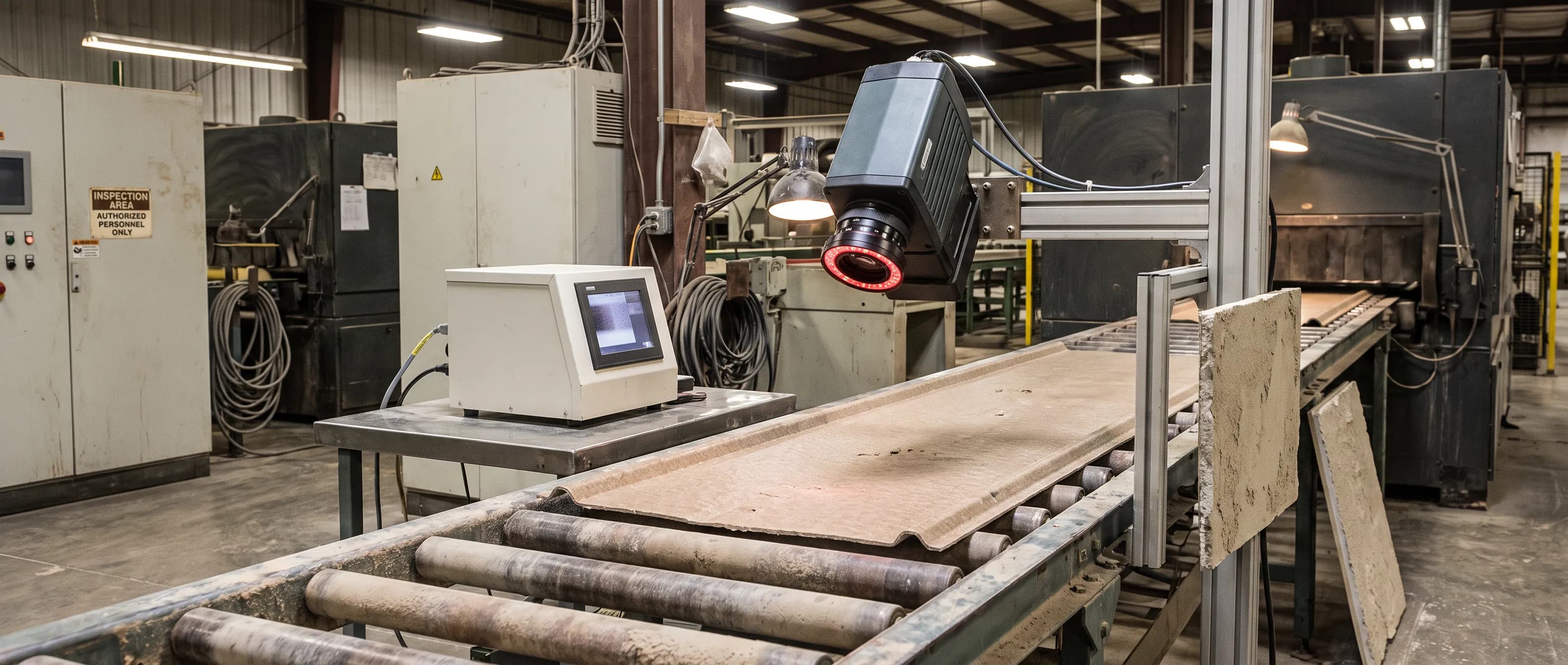
Every system looks good in a demo. The real difference shows up on your surface, under your lighting, and at your next product changeover.
In building materials, choosing a visual inspection system is not a catalog comparison, because appearance is part of the product. A roof panel is one of the most visible surfaces on a building, and a mark spotted on the job site is no longer a quality topic. It is a customer complaint. Plaster and other textured products have the opposite problem: the surface is rough to begin with, so a pull-out, a void, or a missing area disappears into the natural texture.
The 10 questions below work as a checklist you can take into any vendor meeting. Next to each one is a short note on how we approach it, and at the end all of them sit in one table.
Start with yourself: what slips through, and what does it cost?
Before you talk to any vendor, pin down which defect is born at which step and what an escaped defect really costs you. Those two answers decide where the camera goes and what a sensible budget looks like. Without them, you are comparing brochures.
1. What exactly are we missing?
Go through the last few months of complaints and returns. On panels, is it scratches, pressure marks, or paint runs? On plaster, pull-outs or color variation? If a defect forms before cutting, a camera placed after cutting will catch it, but it will not tell you where it came from.
2. What does an escaped defect cost us?
The 1-10-100 rule says catching a defect at the production step is the cheapest option, and the same defect gets far more expensive once it leaves the plant (Labovitz, Chang & Rosansky, Making Quality Work, 1992). The numbers are an order of magnitude, not measured costs, but the logic is concrete here. A panel pulled off the line is scrap. A panel already on a roof means removal, freight, reinstallation, and reputation. Run that math once with your own numbers.
Technical questions to ask when choosing a visual inspection system
Five topics decide the technical conversation: defect samples, textured surfaces, defect location and type, changeover time, and line flow. You should see the answers on your own samples, not in a brochure.
3. Do you need samples of defective product?
This may be the most decisive question. Some systems need many labeled examples of every defect type, and some building-material defects are rare. Collecting hundreds of photos of plaster pull-outs can take months. Systems that learn the good product start from good samples, so there is no defect library to build.
Our approach: ISEE Vision Anomaly Detection learns a good panel or plaster surface as a learned perfect reference and compares every product against it in real time. On site, this runs on ISEE Vision's building materials quality control station, which covers concrete and plaster, ceramic, glass, profile, board, and precast elements. The logic is explained in our post on anomaly detection and its industrial applications.
4. What happens on textured surfaces and in a dusty plant?
On a rough surface like plaster, every frame looks slightly different. You need to see the system ignore that natural variation and still isolate the area that has actually pulled out, on your own product. Building-material lines also add dust, vibration, and light that changes through the day.
Our approach: The station is an enclosed, light-isolated, IP-rated housing sealed against dust, vibration, and variable ambient light. Controlled lighting inside keeps the image stable. Camera count, lens, lighting angle, and working distance are engineered for each line.
5. Does it show where and what the defect is, and does it measure?
An anomaly heatmap shows in color which part of the image differs from the good product, and every decision comes with a numeric confidence score. On a long panel, that is the difference between searching for a defect and finding it.
Our approach: Defects are labeled by type: cracks, porosity, chips, burrs, stains, glaze defects, spalling, and color deviation. Length, width, thickness, squareness, and cross-section geometry are measured against tolerance. Products can be graded into quality classes by tone and defect density, with a sorting signal, which matters for tile, where the grade sets the price.
6. What happens when we change products?
Panel producers run many colors, profiles, and coatings. If every color change means calling in an engineer, the system gets pushed aside within weeks. Ask who introduces a new product, how, and how long it takes, and ask to see it on site.
Our approach: A new product is taught from its good samples in a few minutes. The profile is saved under the product code and recalled quickly at the next run. The time depends on the product, so see it with your own product during the trial.
7. Does the line have to stop?
Some solutions need the product to stop or move to a separate station, which a continuous panel line cannot accept. Clarify whether the system inspects moving product and how long installation affects the line.
Our approach: The station is added to the existing line as an independent inspection point, without rebuilding the line, and inspects 100% of the product while it moves. Every sector configuration is on the ISEE Vision AI automated visual inspection system page.
After installation: alerts, records, and the trial
The value of an inspection system is measured by what it does after it sees a defect. Who gets the alert, who makes the final call, what the records show later, and the trial terms are the last things to settle before you buy.
8. What happens when a defect is found?
On a noisy floor, a siren and a tower light work. In a control room, a screen notification works. For automatic sorting, ask whether the system can signal a PLC or relay. Then ask who makes the final decision, because a small mark is acceptable to some customers and not to others.
Our approach: Actions are configured per customer: alert only, alert plus stop, or full automation, through relay or PLC outputs. The decision is tied to a sensitivity and acceptance limit set per product, not to an operator's judgment in the moment. Whether a flagged product is scrapped, reworked, or accepted is your quality team's call.
9. What can we see after the fact?
When a complaint comes in, the answer to "what happened with that batch?" lives in the records. Ask whether every decision is stored with its time and what reports you can pull.
Our approach: ISEE Vision's AI visual inspection system stores each decision as a time-stamped record: original image, heatmap, and confidence score together, with daily, weekly, and monthly reports. Processing runs on the device with no cloud dependency, so data stays on site. We compare the architectures in edge AI vs. cloud systems.
10. Can we run a free trial, and on what terms?
No demo replaces a trial on your own product. Agree up front on the samples, the duration, and how success will be judged. We suggest discovery, trial, pilot, and commissioning, and you decide at each step whether to continue.
Why isn't a human inspector enough on a building-materials line?
Because attention drops on a long, monotonous line, and even the most experienced inspector misses part of the defects. An inspection system should take over the repetition and the record keeping, so the experienced eye can focus on decisions and improvement.
The study most often cited here was run at Sandia National Laboratories: 82 inspectors examined 140 precision-manufactured nuclear-weapons parts for eight defect types (See, Human Factors, 2015). Under controlled conditions, they correctly rejected 85% of defective items, which the author calls "not vastly superior to the industry average of 80%". Roughly one defect in five gets through a typical visual inspection. In that study, the hit rate also came with 35% of acceptable parts rejected, "a high scrap rate not typically observed". It is still a warning for textured surfaces: tighten the eye, and a good plaster panel or an in-grade tile can end up as scrap. And since Mackworth's 1948 vigilance study, we have known that attention on monotonous monitoring drops noticeably from about the first half hour.
Our post on surface defects on patterned sheet metal explains why textured surfaces are a separate challenge. The plaster problem is, in principle, the same as on diamond-plate steel.
Checklist for choosing a visual inspection system
Print this table for your vendor meetings and fill in the last column for each supplier.
| # | Question | Why it matters | A good answer |
|---|---|---|---|
| 1 | What are we missing? | Decides camera placement | Defect list from complaints and returns |
| 2 | What does an escape cost? | Sets the budget | A 1-10-100 estimate with your numbers |
| 3 | Defect samples needed? | Rare defects take months to collect | Starts from good samples |
| 4 | Texture and dust? | Natural texture causes false alarms | Sealed station, shown on your samples |
| 5 | Location, type, measurement? | "Defective" alone is not enough | Heatmap, score, defect class, dimensions |
| 6 | Changeover time? | Slow changes sideline the system | Profile saved by product code |
| 7 | Must the line stop? | Continuous lines cannot stop | 100% in-line, no line rebuild |
| 8 | What happens on a defect? | Alerts must reach the right person | Alert, stop, or full automation |
| 9 | What can we see later? | Complaints need records | Time-stamped images, periodic reports |
| 10 | Trial terms? | A demo is not your product | Free trial on your samples, agreed criteria |
Frequently asked questions
Which building materials can an inspection station like this handle?
Concrete and plaster, ceramic, glass, profile, board, and precast elements. The station works on continuous products like roof panels and on discrete pieces, and it looks at every product.
Don't dust and vibration ruin the image?
The station is an enclosed, IP-rated housing sealed against dust, vibration, and variable ambient light. Because the lighting inside is controlled, plant lighting changes do not affect the decision.
Does the system sort defective product by itself?
If you want it to. You choose alert only, alert plus line stop, or full automation through relay or PLC outputs. The scrap, rework, or accept decision stays with your quality team.
Can it judge tone and quality grade too?
Yes. Color deviation is a defect class, and products can be graded by tone and defect density, with a sorting signal. Class limits follow your acceptance criteria.
Key takeaways
- When choosing a visual inspection system, start with your own losses: which defect, born where, and what it costs when it escapes.
- Ask for a system that starts from good samples and works on your textured surface.
- See changeover, alerts, line stop, and records on site, not in a brochure.
- The system shows what is different and where; your team decides scrap, rework, or accept.
If you want to start with us, a few good and a few defective panel or plaster samples are enough. Contact us for a free trial on your own surface, and see the answers on your product, not in a demo.
Contact: info@isee-vision.com · +90 216 455 95 44